Episode Transcript
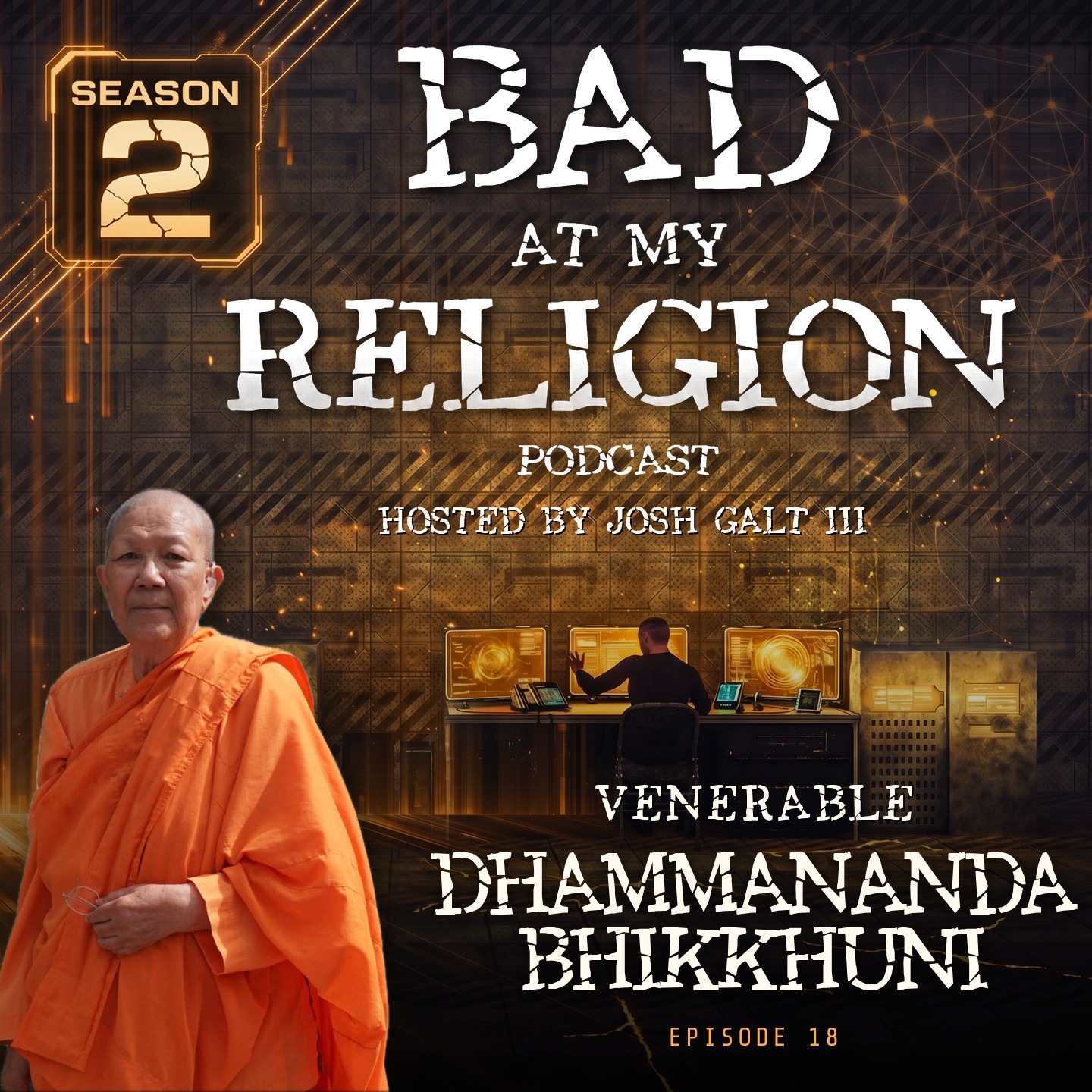
[00:00:02] Speaker A: Today's guest is Venerable Damananda bhikkhuni.
[00:00:05] Speaker B: I am 82 years old this year.
If I cling on to beauty as a young person, you know, I always cling to the value of being young, which is supposed to be good.
But as you are growing old, you cannot resist old age. Old age happens naturally, you know, and that also happens naturally. So when we hold on to life as opposite to death, of course you suffer because life comes with death. You know, life and death is just at our nostril.
[00:00:40] Speaker C: You're listening to the Bad at my religion podcast, hosted by Josh God.
[00:00:45] Speaker B: Yeah. As you know that in our country, in Thailand, we never had ordination for women. And I was the first one to start. In Buddhism, we have Mahayana and Theravada. My mother was the first one to be ordained in Mahayana, but in Thailand, we followed Theravada. So in Theravada Buddhism, I was the first one to start the ordination in the year 2001. But as a woman, you have to be ordained first as novice. We spent two years as novice before we receive full ordination.
So the ordination that we are giving today is a novice ordination. So the person who received the ordination today will have to remain for two more years before she receives full ordination.
[00:01:29] Speaker D: Okay, and what does it mean to you to be able to be an example and to live an example of being the first De Kuni and to bring these other women in? How important is it to have women in these positions in Buddhism?
[00:01:49] Speaker B: You know, I. I did not plan to be the first one. I was waiting for someone else to start, but as no one else started, so it.
It's a strong faith that I have for the Buddha, and it was the Buddha who gave us this lineage, and the lineage never came to Thailand. It's a shame that we are Theravada country. We have the largest Buddhist population in this area of the world, and it's a shame that women do not have space in ordination.
So as an academic studying ordinates, particularly on the issue of ordination, I felt that it was my responsibility to do something about it, to bring about social changes. That was my idea. And as I was waiting for someone to start, no one else started. So, you know, it dawned on me that I cannot wait for anyone else, but I have to be committed.
[00:02:43] Speaker D: Yes,
[00:02:45] Speaker B: by words, you know, but committed in action.
[00:02:48] Speaker D: And it seems from your story, you have absolutely done that. How does that apply to the principles of Buddhism? Could you explain just briefly the principles of Buddhism as you know it and believe it and Follow it.
[00:03:06] Speaker B: You know, Buddhism teaches a very simple, very simple thing. You know, just to know that there is suffering and to know the nature of suffering, and that when we cling on to it, that's why we suffer. It's so simple. The teaching of Buddhism is so simple. And then the Buddha said that, you know, we as men and women, we are.
We do have access to enlightenment, we do have access to be free spiritually, both men and women. So I don't see why men only have the ability to be ordained in my country, why not women? And the ordination was given by the Buddha himself. So in order to allow women to share this space of leading monastic life so that they can, in the future, they can proceed on for higher spiritual level.
So I think you are not just committing to be Buddhist by words, but committing to be Buddhist in action also. So I think it's very important that we do allow the space for women to enjoy the monastic lifestyle just like the men do. Whether we can proceed or not, it's up to us. But at least, you know, the basic space for practice should be there.
[00:04:25] Speaker D: Yes.
Spirituality is not a man or woman thing. It is. We are humans, we're spiritual beings having this human journey. Right?
[00:04:36] Speaker B: Yes.
[00:04:36] Speaker D: Is that how you see it,
[00:04:38] Speaker B: to be enlightened? Once you are enlightened, you are not enlightened as a man, you are not enlightened as a woman. You are an enlightened being. You know, we have to even cut across that gender differences.
[00:04:52] Speaker D: So it's interesting that you, you mentioned, because I spent a lot of time in Southeast Asia in, In Thailand as well. I have visited many of the pagodas there, the Watts, and I find it a very beautiful, peaceful, friendly part of the world.
Your country is, is the land of smiles, I think, right? It's.
[00:05:14] Speaker B: Yes,
[00:05:15] Speaker D: yes,
[00:05:16] Speaker B: it was, Josh. It was
[00:05:19] Speaker D: to me. To me. And I think to the Western mind, we look at Eastern Buddhism with, with sort of a respect for the ability to let go, to detach, to become enlightened, to pursue that path.
And it seems that in. From your experience, you have seen that everyone struggles, including people who follow the path of Buddhism.
Why do you think that is? Why do you think that even people who are seeking to follow simple precepts and principles also struggle in this human life?
[00:05:57] Speaker B: Because we don't understand. We don't understand the true nature of things. We don't understand the true nature of things, including us.
We don't understand the true nature of human being.
In our daily chanting, we say, upathan, Upathan, meh.
That which you see as real when it is not real, when you are holding on to something which is not real as real.
That's where suffering begins.
And the clinging on to the five aggregates, you know, that is the very first basic step that we start clinging to and causing us suffering.
[00:06:40] Speaker D: So a disconnect from reality is where suffering begins. Is that the basic premise? When we are not connected to reality, when we see things not as they are, but as we want them to be, or as we wish that they were, that's where suffering begins?
[00:06:56] Speaker B: Yes, Josh, that is really true. Yes. You know, for example, I am 82 years old this year.
If I cling on to beauty as a young person, I always cling to the value of being young, which is supposed to be good.
But as you are growing old, you cannot resist old age. Old age happens naturally, you know, and death also happens naturally. So when we hold on to life as opposite to death, of course you suffer because life comes with death. You know, life and death is just at our nostril.
[00:07:36] Speaker D: That's very interesting because there's a very popular movement in the usa, maybe all over the world, for anti aging products, for staying young, for skin
[00:07:47] Speaker B: care,
[00:07:47] Speaker D: for all of these things. And there's. There's a popular person in the US called Brian Johnson, and his slogan is don't die.
And he believes that over the next, the rest of this century, that we will. Humans will discover the ability to live forever.
And it's. It's interesting because they're trying to keep the body alive and, and all of this. And yet the simple explanation from your point of view, I think would be we are already eternal, right?
[00:08:18] Speaker B: Yes.
You know, when we were born, the possibility to die is together with the fact that we were born.
[00:08:33] Speaker D: Yes.
[00:08:33] Speaker B: If we were not born, then there is no death. Because death comes with birth, because we are born. That's why death is death at your nostril, as I said. Literally, Josh. Literally. Because there is this breathing in and breathing out.
And when you stop breathing in, there is no more breathing out.
So birth, life and death is at our nostril. That's our practice to be real in this moment. This moment is only that which is real.
[00:09:06] Speaker D: This moment, right now,
[00:09:07] Speaker B: this moment.
[00:09:08] Speaker D: Not the next one. Not tomorrow, not yesterday.
[00:09:11] Speaker B: Not. Not yesterday. That's right. That's right.
[00:09:14] Speaker D: Why do you think that it's so difficult for us to find the ability to live in this moment? Is it culture? Is it society? Is it our. Our giving in to things like greed and temptation and, and anger?
Why Is it that it seems like the world and you have experienced much more of life than I have, but in my experience, it seems like there is so much beauty, but there's also so much.
Not ugliness, but suffering and harm and death. Yeah.
Is it healthier to just look at that as part of the process? Or is it important to say, no, there is good, there is evil, and we need to find our purpose and we need to have a more moral framework.
[00:10:05] Speaker B: There is this holding on to self, and Buddhism speaks about this self, that this self is not real, it's not eternal. Whereas, you know, in. In the religions previous to Buddhism, insists on this self, which is called atman or Ata, you know, the self which is real forever. And eventually you will. You will be merged into Paramatman, you know, the larger self. So the self still exists, you know, the smaller self emerge into the larger self. But in Buddhi, we said even this self, which we hold out to be eternal is not real because it is composed of whatever is being composed of is not real.
[00:10:48] Speaker D: So how does one find purpose then, in your view?
How can someone who wants to really focus on the spiritual and they spend time in meditation and they.
They work on being present, but also they have a family or a job or a career or ambitions, just things that they want to accomplish.
How does one find purpose then, in this world right now? Because we do have life and life is beautiful and is to be lived, right?
[00:11:21] Speaker B: Yes. Yes. But this living in this life, one need to have compassion. Compassion for oneself and compassion for others.
When you enjoy wealth, you also think about sharing wealth with others.
So there is that purpose still. There is that purpose to continue on this life as life, as life goes, but does not hold on to life as final, eternal, so to say.
[00:11:51] Speaker D: Do you think it's possible to have compassion for others if we don't have compassion for ourselves first?
[00:11:59] Speaker B: I think it's important.
I think compassion for others without having understood compassion for ourselves will not last.
Will not last. So when you have compassion directing your compassion outward, eventually you have to come and look inward.
[00:12:18] Speaker D: And why is that so hard for us to do?
[00:12:22] Speaker B: Because we have this delusion of self,
[00:12:26] Speaker D: okay?
And so we. We build who we think we are. I. I build who this Persona of Josh Galt
[00:12:37] Speaker B: is.
[00:12:38] Speaker D: And then I, I don't have compassion for myself if I'm not living up to this Persona that I have built.
[00:12:46] Speaker B: Yeah. So. So this Josh that you have accomplished, you know, very successful Josh, you also understand there is that George inside understand also this George which you have created is eventually will not last.
That's hard. That's hard to believe, hard to think. But that is reality.
So we don't hold on to our health. Says yes. You know, I myself was working for television for seven years and I was very successful. That's, that's in the past.
If I live in the now, this very existence now, I am just one being, equal to others, having the joy, having suffering, just like others.
So you don't differentiate yourself too much beyond and above others.
Because if you think yourself above others, which is not real, then you suffer. Then you suffer.
[00:13:50] Speaker D: So one of my favorite quotes is, the universe is not competitive. It is creative.
What do you think about that quote?
[00:14:01] Speaker B: Yeah, that's good. That's very positive. Very positive. And practicable.
Practicable.
[00:14:08] Speaker D: Because I have been a very competitive person. I was an athlete and just naturally I am competitive, but that also can make me angry at people in certain situations. But over time I have been working to be more.
Just let the creativity flow and not do it in a way that is attempting to compete, but to just do, maybe be a vessel of my personal purpose, of whatever it is that the universe is looking to create.
[00:14:39] Speaker B: This creativity must be positive and this creativity must be yourself and myself. There is no barrier between yourself and myself. You know, it goes.
If it's going to be eternal, it has to overcome. Overcome this boundary between you and me. Then creativity becomes creativity, the real creativity that will last. That will last. Yes. Creativity is very good. Very, very positive energy.
Very positive energy. It is the kind of energy that takes you forward.
Forward,
[00:15:19] Speaker D: yes. Not destroying, but just creating. So not building.
There's a famous line from a marketing guy who obviously is competing in its business. But I like the line because he says, don't build a beautiful skyscraper by tearing everyone else's skyscrapers down. Just build your skyscraper.
[00:15:40] Speaker B: Just
[00:15:40] Speaker D: build yours?
[00:15:41] Speaker B: Yes. And yours can be different
[00:15:46] Speaker D: in
[00:15:46] Speaker B: height, in volume. It depends, you know, how we are going to create our own uniqueness.
But this uniqueness that we are creating must be positive, must come from the positive side of us.
[00:16:03] Speaker D: Do you think that that is because our default state is joy?
I spoke to someone quite a while ago, he was from India and he said no, that our default is sadness.
Because I was thinking our default state when we are born, when you're a baby, it's joy, naturally.
What do you think our default state is as humans? Or does it matter? Because we come in as spirits? Like do. Do our spirits have a joy or a sadness to them? Or is that a Human condition that we. We bring in
[00:16:42] Speaker B: this joy, this joy or sadness. Joy.
How does it make you feel? You feel happy about it?
You feel happy
[00:16:54] Speaker D: about joy? Joy, yes, joy. Joy makes you feel positive? Yes. And sadness makes you feel.
Yeah. Not suffering? I guess.
[00:17:04] Speaker B: So I think it's neutral, really. Neutral. Both. This is a question that I never thought about, but as you put it up, I think we can consider. And for me, I would choose to be joyful.
I would choose to be joyful so that. Because this joy provides me with positive energy so that I can go forward. Go forward for myself, for my own growth as well as for others.
That's powerful.
Yeah. If I'm in a sad mood, then I'm not helping myself and also not having energy to help others.
This is how I would look at it.
[00:17:51] Speaker D: That's very true. Yeah. If we're around someone who is joyful, like genuinely joyful, not just pretending to be happy, making jokes, but truly joyful, that is contagious, that energy.
And the same, if someone is very sad, then no one wants to be around them because it's like, oh, you're bringing down the energy.
[00:18:10] Speaker B: True, true. You know, so some people, you know, kind of. They kind of draw us towards them because they are so positive, you know, and. And like, they don't speak ill about others.
They don't speak ill about others and they always come up with some joyful statement or joyful energy about activities that they do, about connection that they make, about relationship that they make. So I think it's very important that we have this presence of joy within us so that we can somehow help others. Just simply not doing anything. Just simply be yourself. Already you are helping others because when people come to you, they already have that. This positive energy, positive connection with you.
Very important, Very important. Sometimes I'm also negative and I. I could see. I could see the reaction that, that.
That I create, that I create because I was negative.
[00:19:14] Speaker D: Why do you think it is so difficult to choose joy? I love the way you phrase that. You said it may be neutral, we may come in neutral, but you choose joy.
Why do you think that that's difficult? Oftentimes because we're looking at the external or what is it that makes it hard to say in this moment, I choose joy.
[00:19:36] Speaker B: With understanding, from Buddhist background, we believe that what we have done in the past also helped to promote us in this direction or not in that direction. So we said kusala. Kusala means wholesome, wholesome act that if you come with this bunch of wholesomeness from the past, it also helps you, helps you to go in this direction. But if you have so much unwholesomeness from the past, I mean, past life, past life, it also promotes you in that direction.
So it is like you have a glass of water, half a glass of water. This half a glass of water may not be very pure, may be dirty, but it is you who make a choice to add in more pure water, or you would add in more dirty water.
So that is the kind of state.
So if you realize that you have half a glass of water and it is not so pure, but you choose, it is your present moment that you choose to make action of adding pure water, it is your choice.
[00:20:52] Speaker D: That's beautiful.
That's very true. It is our choice. I know that you are a professor and you understand this very, very well. I think that many people in the west, myself included, we don't have a clear understanding of the past life and how it works. There's jokes and things that maybe people just don't understand. So it becomes sort of irreverent. Or people think that, oh, because this person is very successful in this life, therefore they must have been very good and enlightened in a previous life. But what is it really in Buddhism?
How does it explain, like, why do we come here multiple times? Is it simply a testing ground for our spirits? And is the goal to become more enlightened? Or is the goal simply to be, and over time we will become whatever the creation we are supposed to be is?
[00:21:58] Speaker B: Not sure. I am not sure how to answer how to answer this question, but.
But to be aware in this present moment, what has been with us, what we already have in our bag, what we have in the past, it is both negative and positive. But it is this present moment to choose to continue the positive one. So the Buddha allows us this present moment for you to make choice so
[00:22:33] Speaker D: that.
Sorry, go
[00:22:36] Speaker B: ahead.
You pick up the positive thread to continue on in the future life rather than to pick up the negative thread to continue.
[00:22:50] Speaker D: Do you think that karma can also be instant?
Can we have instant karma where we do something? And in this life, like right now, maybe the same day or close to the same time, if we do something bad, then like we. We are, we get that back to us, or if we do something really good, then that comes back to us? Or is it more of something that that's just a synchronicity or a coincidence or something? But the real karma is, is over lifetimes,
[00:23:24] Speaker B: even this present moment. Josh, as I'm Speaking to you, if I have positive energy to make connection with Josh, this program will either go in positive way or negative way. Right now we are making karma.
Right now we are creating a new karma.
But because of this previous karma that Josh and I, we might have been good friends. Suppose we might have been good friends. So we make connection now to make further good karma together.
So the present karma links with the previous karma.
Sometimes, you know, when we meet bad people and you said, oh, it's my karma that I forgive him. You know, whatever he has done wrong to me, I forgive him. That must have been my past karma. That's why I have to be in this situation. I forgive him. Which means that you have allowed the karma to bear results and you forgive, you forgive that person. So it's kind of ending the karma with that person. But if you continue on getting angry with him, returning him with bad words, bad action, then you continue on the karma.
[00:24:49] Speaker D: Yeah. So then those negative connections, we're not. Maybe the other person is not hurt by it, but we can be hurt by the, the anger at another person. Yeah.
[00:25:00] Speaker B: Yes.
[00:25:02] Speaker D: It's something that, that I personally, I had something happen today which is funny. And I want to ask you about. Does karma impact people differently? Because if you look at someone who maybe in this lifetime seems like they are an evil person or a bad person, but they have everything you could want in this lifetime. Right. Their life is not suffering. They enjoy luxury and they have all that they need. But you can clearly see that objectively as a human, they are not respecting life. They are perhaps greedy, they steal whatever it is.
We could say that they're not a good person, but yet in this lifetime, they have everything. So it seems like their, their karma is, is good for some reason. And then you have people who maybe have a good heart, who are kind and generous, and they, they really seek to be loving and joyful, but yet it seems like bad things constantly happen to them. Is there an explanation for that? Or is it just, that's life?
[00:26:08] Speaker B: What if people will say that, you know, if you are keeping this person, you know, he has been treating you so badly.
So sometimes they say that, that, that because our bad karma, our own bad karma in the past, that's why we are meeting this person. But if sometimes, sometimes it allows you also to be in a negligent mode that is, you know, always accepting and, and explaining that, oh, it's bad karma, it's our own bad karma, so we have to suffer further. So sometimes that's why the Buddha allows us to think about this present moment. This present moment is the moment that you can choose to continue on receiving bad karma or to start anew.
So this present moment, you are making this karma in this present moment to make a decision.
So I think it's very important. It's very important. I see many cases of people who suffer about something and keep on suffering in that way and explaining that that is bad karma.
They accept it as their bad karma in the previous birth, previous lives, but not making any judgment, not making any new karma to come out of it.
[00:27:26] Speaker D: Yeah. And I had to drive across Mexico.
And in Mexico, the people drive very, very badly. The roads are not so good and people just drive in a way that makes me angry. I struggle with getting mad at people because they. They don't follow what I think are the rules of the road. And people just drive very crazy. And so I had been getting more and more mad as I was driving and we came to a toll, so we had to pay a toll. And so there's. All the lanes of traffic are coming together to go through like two lanes of the toll.
[00:28:02] Speaker B: Yeah.
[00:28:02] Speaker D: And someone tried to cut me off and I got angry.
And so I pulled in front of them and I honked at them and I was mad. And at that moment, a big semi truck with a trailer and fuel tanks came really fast on my left hand side. And I saw in my mirror they were coming and I was like, oh no, they're going to hit me. And so I turned and tried to get out of the way. I was basically parked, but I tried to move and the tire hit my mirror and it knocked my car to the side.
And I was just, I. It kind of startled me. And then the, the truck went on. When I stopped and looked at the car, there was no damage except for a little scrape on the side of the mirror.
And it was for me a real wake up call to spend the rest of the drive working on being calm and being present and being thankful that I didn't get run over. Because it could have run over the whole front of the car.
[00:29:02] Speaker B: Yes.
[00:29:03] Speaker D: But I was thinking also about instant karma because it was like, I am not that person.
I don't like me when I get angry at people like that.
And I did and I did something that was out of character. Like I pulled up in front of them after they cut me off. Like, I don't normally do that. I normally let it go, but I did that in anger. And instantly, like within like 10 seconds, the semi truck came and hit the car.
And I was just like, wow, like, that's a message. I think that I need to shape up and stop being angry.
[00:29:40] Speaker B: That's a good way of thinking. That's a good way of thinking, yes. Sometimes things happen like that, you know, and, you know, you would say it's a miracle that nothing happened to you. Nothing bad happened to you, you know, in a situation which. It could have been worse.
[00:29:56] Speaker D: Yes.
[00:29:56] Speaker B: Which could have been worse. So my good karma still protect me.
[00:30:03] Speaker D: But that's my question of what I'm still wondering because. And when you say the Buddha, forgive my ignorance here, but in the way that you are saying it, do you mean the divine? Do you mean God? Is that one and the same, or is there a differentiation between the Buddha and his teachings and the, the divine in the spirit realm?
[00:30:35] Speaker B: Different layers. Different layers.
Sometimes we say that, oh, it's, it's your, your, your divine protection.
The, the energy, the divine energy that protects you, helps you, you know, so that you, you are not getting worse than, than what it was. But usually we would exclaim, or always exclaim that, oh, the Buddha may help us, you know, But I, I don't think that it's in the same sense as the Christian would say, God help me.
[00:31:09] Speaker D: Okay.
[00:31:11] Speaker B: I, I don't think it's the same sense because, you know, the Buddha. The Buddha appears to us in Theravada Buddhism more as a teacher who have walked the path and show us the way, more than the hand spreading out his hand to help you.
I think it's a different expression.
[00:31:34] Speaker D: Yes, yes. Okay. Understand that. That makes sense.
[00:31:37] Speaker B: Yeah. We do believe. We do believe as a Theravada, as Buddhist, majority of us still believe that there is that divine presence.
Divine presence could be our own energy of good karma.
[00:31:57] Speaker D: Well, tell me your opinion on this, because when I was in Southeast Asia, I spent a good part of a decade in Southeast Asia, and I even lived near pagodas a few times and got to see up close how they lived.
But also, there have been some things that I've seen where it's almost like they've turned it into a religion in the sense of Christianity or Islam or something like that, as opposed to a philosophical framework.
Is that it?
Am I misinterpreting that? Or that's why my question about, about the Buddha and the divine energy and consciousness, because it seems like in some places, some people pray to Buddha as a type of God, and in other places it is more of the teacher.
[00:33:03] Speaker B: Yes, but it's. You're correct in both ways. In both ways, we Have Buddhists who practice this way, and we have Buddhists who practice the other.
Just like how you explained. Your perception is correct. Yeah.
[00:33:17] Speaker D: So there is a difference, but
[00:33:20] Speaker B: it depends on the people. You know, people are at different levels of understanding. I think, you know, for some people, they are more comfortable to hold on to the Buddha as someone who will be helping them. But actually, in the real teaching, it is you yourself who are. Who are doing it.
[00:33:44] Speaker D: And. And that is how you live and how you view it, correct?
[00:33:49] Speaker B: Yes,
[00:33:50] Speaker D: the latter. So it is a process of getting to the point of where we externalize. We look for a savior of sorts, which in, for some people, could be Buddha, and over time, realizing we need to go within in order to find that.
[00:34:08] Speaker B: True, True, true, true.
[00:34:10] Speaker D: Okay, okay. That helps me understand because I've seen a lot of and read a lot of things sort of from both angles, and I was always curious about which one is the correct
[00:34:24] Speaker B: one
[00:34:24] Speaker D: or the foundational one.
[00:34:26] Speaker B: When the Buddha was enlightened, he was having difficulty whether he should preach or not, because he would say that, you know, his discovery, his spiritual discovery is so sublime. Maybe people will not understand.
So this is compared to the four levels of lotuses. You know, some of them will be eaten by fish and by turtle. You know, the lotus in the mud still being eaten by fish and by turtles. But yet there are other lotus which comes up above the water, waiting for the warmth of the sunlight to open up the petals. So people are from different levels like this.
At different levels, they understand the teaching of the Buddha in different way. And the Buddha's teaching could be valid only to few.
But some others, they still believe in the Buddha as God, the Buddha as a divine being to help them. So different.
Different levels of understanding of the Buddhist. The Buddhists themselves are of different levels of understanding the teaching of the Buddha.
The closer they become, the closer they will understand that actually it is they themselves. It has to start from they themselves.
[00:35:51] Speaker D: And how does the ego play a role in their understanding?
Because the ego,
[00:35:58] Speaker B: I think,
[00:35:58] Speaker D: for many is very misunderstood.
But also what you are describing is some lotuses are down in the mud, and some rise above the water and open to the sun. Immediately, my Western American mind thinks about, oh, well, that one's better. So I'm a better lotus than you.
And it's this constant struggle, right?
[00:36:20] Speaker B: Yes. So this, you know, in most religion, there is this self, this self. When you said ego, sometimes it has that psychological connotation, you know, So I would suppose if I choose the word atta, self concept, of self that in the previous religion before Buddhism, still talk about self. And eventually, however enlightened you may be, you are enlightened to the larger self, to the eternal self. Whereas in Buddhism we also say that there is no such thing as eternal self because things which come to us as self is actually that which is composed of anything which is composed of. And in fact, everything is being composed of is not real. Even that concept of self is also.
Is not real.
Not real in the ultimate sense.
[00:37:27] Speaker D: How, How I think I've been able to figure that out with my little brain is if everything is energy and everything is connected and we are all connected to the divine, then that means that we are all the divine and the divine is in everyone as well. So you and I are connected
[00:37:48] Speaker B: in
[00:37:49] Speaker D: the spiritual sense of that. Yeah,
[00:37:52] Speaker B: true. What. What you said is true. I mean that. That is in the ultimate sense of the term.
[00:37:59] Speaker D: Right? But
[00:38:00] Speaker B: here
[00:38:00] Speaker D: and now we.
[00:38:02] Speaker B: Yeah,
[00:38:02] Speaker D: here and now we are individuals with a unique purpose to help that divine to evolve in our unique way. Right? So you have. In this life, you. You have done amazing things to become a leader and a light for women who want to become bikani. And for me, I'm living my purpose, and I hope that I will be able to find bigger purpose or at least the correct one for my life.
But it's different. We are unique in this life. But ultimately the idea that we are all connected through the. The divine makes sense to me.
[00:38:51] Speaker B: Even though you are in Mexico and I'm in Thailand. But right now, in this present moment, it feels as though we are breathing the same mass of air which. Which is true.
[00:39:03] Speaker D: Which
[00:39:03] Speaker B: is true. We are breathing the same mass of air,
[00:39:05] Speaker D: but
[00:39:06] Speaker B: this mass of air is a. Is a huge global thing, you know, but whatever you do in Mexico, somehow it will cause ripples to affect me.
Right. So that's why they talk about this global warming and things like that.
But in our practice, when I sit with my students in our small classroom, we are breathing the same air.
And if I come in the room with a stern face, everyone in the room will be affected.
Do you understand? Just simply. I didn't say anything, Josh, but I just make a very stern face. They already received the energy.
They receive the energy that is negative energy, and they themselves become unhappy.
See how. How connected we are?
[00:40:05] Speaker D: Yes,
[00:40:07] Speaker B: I
[00:40:07] Speaker D: have seen that in my.
In my travels, I have seen that so much that the majority of the world, we. We are so divided by race and religion and. And so many things, politics. And yet at. At the base Level. Almost everyone I meet is a human that is kind of like me, that wants kind of the same
[00:40:31] Speaker B: things out of
[00:40:31] Speaker D: life. Right.
And yet there's so many of these divisions. Do you think.
Do you think that a lot of these divisions are because of a spiritual battle or how. That's a very Western, Christian sort of way to describe it. So how would you describe all of these divisions that we have here on Earth? Because it's just a fact of human life that we are very divided around the world.
[00:41:01] Speaker B: But to be able to look at the situation like you may be sitting in a lounge waiting for your plane, you look at the people's face, they are so full of worried, worried about this, worried about that.
But at the same time, you feel that presence, that presence of everyone there.
Then you would step back a little bit and you feel that why they need to suffer, why they need to suffer, that they don't need to suffer so much. But, you know, very funny thing, when you board the plane, everyone wanted to rush into the plane, but eventually all of us will be in the plane anyway. But why is that need to.
You look at it and you have to laugh. You know, this human being are crazy.
Everyone, you know, are so eager to get on the plane. Yes, all of us will get on the plane eventually. Otherwise they wouldn't leave, you know, when they still have our names.
So we see the nature of human mind that because they cling on to this self so strongly, that's why they struggle.
In fact, there is no need, no need for that agitated mind when you board the plane at all.
At all. But every time you watch, there is so much you feel you need to be hurried. You need to be, you know, something inside that is heated up inside. You know, you watch how people board the plane and you experience the same experience over and over, which is not necessary. It's not. Not. Doesn't have to be there. Doesn't have to be there, but it is there all the time.
So you look at it
[00:42:56] Speaker D: and it's funny because everyone is going to arrive at the destination at the same time. Whether you get on the plane first or last. We all get there at the same time. Right.
[00:43:07] Speaker B: Isn't that funny? But it happens every time.
[00:43:10] Speaker D: Yeah.
And there's a. There's a larger.
A larger parallel with that in how we live our lives, I think also because ultimately we are all on a similar journey as spiritual beings, connected spiritually. You are very devout in your. In your beliefs and in the way that you live. And so there's something to be said for strong belief that is lived with action also.
And many people, they believe the religion or the philosophy or the political views from where they were born.
And so how can we.
Because this world is so connected now online and as we're talking here, how can people of different faith or of different belief systems or from different countries, how can we come together to more generously share and choose joy and choose to be more connected despite also believing what we believe? Because you believe what you believe. But someone else who perhaps is a wonderful person, who is a Catholic or a Muslim, believes differently from you.
[00:44:37] Speaker B: I may not be able to answer your question directly, but with my experience, you know, as a student living in India, my best friend was a Hindu. A Hindu. A Hindu young lady up till now. I still remember her, how kind she was to me. You know, I was never treated in such a way before, you know, so she's a Hindu. And then, you know, another friend, when I was growing up living in Canada, my best friend was a Catholic.
So cut across religious difference. You know, we can be very, very good friends, very good friends and really taking care of each other. So I think that you don't need to change your religion in order to be close to someone, but you need to understand and allow the space for that person. And I believe in this, Josh, that when we talk about religious difference, we are climbing the same mountain.
We are climbing the same mountain. Josh is climbing from the other side. I'm climbing from this side. You see tiger on your way. I see rabbit on my way. But because we are not at the top, that's why we are fighting. I said, no, I see rabbit. Josh said, no, no, I see tiger.
But if both of us stop fighting and climb the mountain, once we reach the mountain, it's the same mountain. And once when I reached there and Josh also climbed the mountain and reached there at the point, no words are needed, we just simply look at each other and we smile, you know,
[00:46:11] Speaker D: enjoy the view.
[00:46:12] Speaker B: Yes. Yes.
So I truly believe that we may be practicing different religions, but keep on practicing yours and climb up your mountain to the top and we'll be there together.
That's how I see it. I really understand religious differences in this way.
[00:46:34] Speaker D: Yes. That is for me, I have come a long ways in my background, from the way that I grew up and then going through a period of questioning and questioning if God was even real, if God existed. And coming back to where I am now, which is, I do believe exactly what you said, that the divine. If someone wants to say God or if someone wants to say the Buddha, that I just say the divine or even the universe, the divine spirit or energy is big enough to meet anyone, wherever they are, if they're truly seeking. I, I really believe that. So I can hold space for a Muslim or a Catholic or a Christian or even an atheist there. And really my goal would be that, that we look at the beliefs and attempt to take the best things that we can for being more connected and having more joy as opposed to the world around us, which is definitely suffering and pain and division.
[00:47:46] Speaker B: That just reminded me that there's one particular case of a Muslim lady. She would come to our temple at about 4 o' clock in the evening, which is our community time, and she would work in the garden, you know, lifting rocks, you know, cleaning up the garden, all sweaty.
And I said, I asked her, you are Muslim, why is that you choose to come to us? She said, this is where I can express the teaching of her religion best.
And she said God would have permitted her in spite of the fact that it is a Buddhist temple, but it is a Buddhist female temple and she felt comfortable, so she would really come and really work hard, sweating and all that. We invited her for dinner, she never stayed for dinner, but she just come and help us. And she felt that that's how God sent her to work with us, you know. So this is another lovely story, lovely story of working together across regions.
[00:48:51] Speaker D: Yes. And the small actions like that can have a ripple effect, as you said. I want to ask you one question, and if you're not comfortable answering it, it, it's okay, but it's about life.
Because in my understanding, one of the foundational principles of Buddhism is to respect all living things.
And so from my time in, in that area, in that culture, I developed, I think, a stronger aversion to killing animals, even insects like cockroaches, et cetera. It's like if, if there's no need to kill them, I want to put them outside and just let them go their way, like if they're in the house or whatever, you know.
But there's a very divisive issue in our cultures, and I know that this affects Thailand as well, which is why I want to be respectful of if you want to answer or not. But it's about abortion and human life.
How does Buddhism view that? And how can we have the conversation without it becoming very, very passionate? Conflict, just respecting and understanding, but also staying firm to respecting life? If that is the foundation for me, it is. So I'll just give that Caveat. But I'm curious your perspective and view on that.
[00:50:19] Speaker B: This is a big question to say yes or no.
Straightforward. It's difficult. But in Buddhist teaching, you know, we always start with not to kill. So abortion is killing. Abortion is killing. When you have decided to kill your own baby, particularly it's a woman, you know, the man has gone somewhere else. So the woman is stuck with this issue of whether to have the baby or not to have the baby. And she eventually decided not to have a baby. So not to have a baby is to kill. So that is bad karma that the person has to bear the result of it. And somebody said, but the husband is not responsible. That's another issue.
That's another issue.
But then the issue of having.
If you allow the baby to be born and the baby has to suffer so much consequences afterwards, that's also another issue. But the fact of abortion, straightforward as Buddhist Buddhist conversation would go, it's a killing and it's against the principle.
[00:51:23] Speaker D: And how would you have the conversation or how would you suggest people to have the conversation with more love and understanding, while also saying that we need to respect life.
[00:51:38] Speaker B: You know, when I was involved in this, you know, talking about this abortion as killing. So what happened if the students in my class actually have get pregnant and she didn't have anyone to be responsible for it. So I eventually had to open Home of Peace and Love in our temple. That was before I was ordained.
So we accepted girls who get pregnant without anyone to be responsible for it. And it lasted for a few years.
Allow the baby to be born and we take the baby in and get them adopted.
But I said that the mother has to remain, has to stay with the baby for at least three months. I was hoping that when she is giving milk to the baby, she would have developed that love between mother and child. You know, the bond of mother and child would be strong. But as it turned out, Josh was.
She did not allow. She would not allow the baby to have milk from her because she said that if she come to a new relationship, the man will find out that she had baby before.
So it ruined the purpose of our opening up the home of peace and love.
So that issue in life is much more complicated than what we can discussed at theoretical level.
So
[00:53:12] Speaker D: absolutely, that is very true. I think your answer is very clear though, that the best thing to do is not to talk about it at a theoretical level. It's to take action and to do something in love, like you did. You opened up a place where those girls had a choice where they could respect life and they could go and you would help them. And that probably caused a ripple through the many children that were born and that were allowed to live. So maybe that is the answer is not so much to make everything black and white and say, how are we going to fix this problem? But what can I do where I am right now with the people around me, with the resources that I have in order to show love and to respect life?
[00:54:01] Speaker B: So, yes, we have, you know, to continue. We have continued a very good conversation and the ability to continue on the conversation is the connection we make between the two of us. And so far it has been very good. And I would like to thank you to allow us to meet, even though across the globe, but I still could feel your presence as though you are sitting in front of me. And it has been a good day, a good day for me. Thank you. Josh.
[00:54:36] Speaker D: Yes, thank you. Venerable thank you. It was wonderful to speak with you. Have a wonderful blessed day. Thank you.
[00:54:44] Speaker B: Thank you.
[00:54:47] Speaker E: Like and subscribe.