Episode Transcript
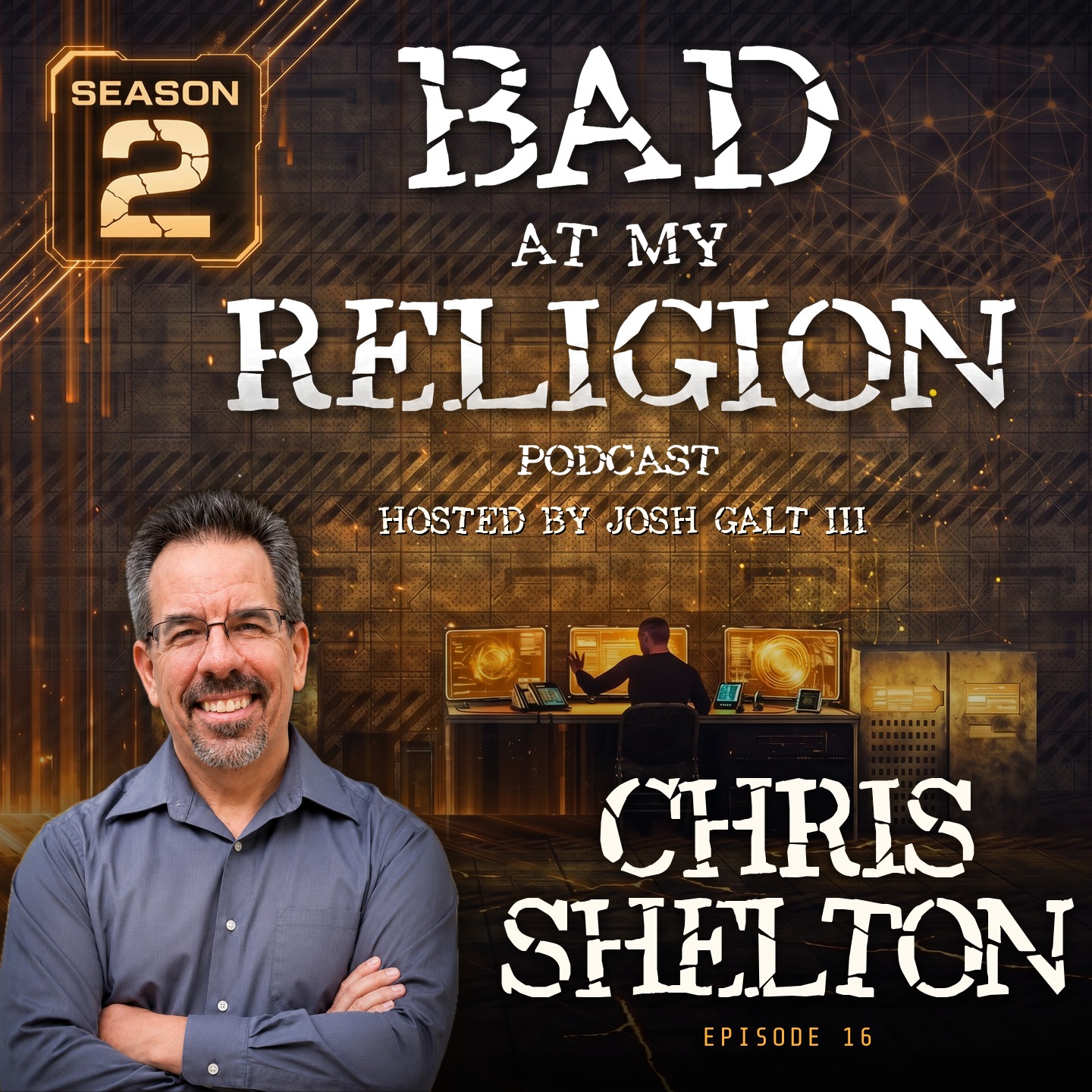
[00:00:02] Speaker A: Today's guest is Chris Shelton.
Scientology is a money making scam that was designed to use religious cloaking to hide the nature of the scam. And the scam is not a simple scam. And it is not a scam that easily reveals itself. A lot of people kind of look at it, think it's a pyramid scheme. It's not. They think it's, you know, weird multi level marketing fused with religion. It's not.
It's its own thing.
And I'm not saying it's in a category of its own, it's a destructive cult, but it is a scam. Let's be clear about that. L. Ron Hubbard started this knowing he was fooling people.
[00:00:44] Speaker B: You're listening to the Bad at my religion podcast, hosted by Josh Gold.
[00:00:49] Speaker A: I grew up with Scientology as my religion or faith or belief set because my parents had gotten involved when I was very, very young. I'm a second generation, or was a second generation Scientologist is what we sort of call, you know, or multi generational cult members. Right? Is the. The experience of growing up in them. And my parents got involved when I was very young, about three, three, four years old.
So all my living memories are having Scientology in them.
I grew up in Pasadena, California, and my parents were involved with Scientology there. In fact, they not only were doing Scientology, as far as doing the classwork and the counseling or therapy or. It's really not counseling. It's. It's. The word they use is auditing.
So I will go ahead and use that word because I don't want to confuse it with psychological counseling. It is, it is not that. It only has a sort of facade of looking something like that.
So my parents were involved with it, doing the auditing and doing the classwork. But then very quickly they joined staff and worked for the church in Pasadena. And so I grew up with the staff and the. The staff's kids and, you know, the people of Scientology were very much part of my life. It was not just the sort of thing of books on the shelf or something that my parents talked about.
Anyway, growing up with it, I also went to public school, so I wasn't completely immersed in the bubble world, and not until I was a teenager and graduated high school and we had moved up near Santa Barbara, California at that point that I actively got what is called onlines myself, where I, as a. As an individual started doing classwork and auditing and I joined staff myself right out of high school. And I worked for the Church of Scientology for 25 years.
So I worked in Santa Barbara, California, for eight years as a staff member there.
And I then, at 25 years old, doubled down and signed the billion year contract that some people might have heard of, and I joined the Sea Organization. As in sea. As in the oceans. As in a naval paramilitary outfit. That's what the Sea Org is.
It's sort of the core faithful, fanatical group that keeps Scientology going.
That's. That's the part that I grew, that I joined at 25, and I worked for 17 more years as a Sea Org member. So I. I didn't really fulfill the billion years, but I did my time as 17 years. And in 2012, I had my, you know, sort of epiphany moment of wake up.
It had followed 10 years of incredibly abusive behavior in the Sea Org, and yet I put up with it, put up with it, put up with it. And had varying degrees of. Of awareness and wake ups. But it wasn't until 2012 that I decided, at 42 years old, I am not where I want to be, and my life is not what I thought it was going to be, and this is not the situation I thought I was going to be in. And so I didn't want to no longer do Scientology.
And. And I'm. And I'm not getting into any of the details here right now. We can get into all of that. There's 25 years of details, so there's a lot to cover. So rather than even try, I'm just giving you the very broad of broad strokes here.
So I left in 2012. I left the Sea Org because it was an abusive, hostile work environment.
I didn't leave Scientology.
That didn't happen until I left the Sea Org in the. It took me about eight or nine months to get out, out of the Sea Org and still be in their good graces. I did not slip out the back door. I wanted to keep doing Scientology. So you had to maintain good standing with the church. And people who leave the Sea Org are not admired people. They are, you know, looked down upon. It's. It's a. It's a betrayal of the group to. To leave the Sea Org. So you have to make up and do atonement and this kind of thing. So they don't call it atonement. They call it amends, but that's what you do. And I was in the process of doing that, but also going down the Internet rabbit hole that I now had full access to as a Sea Org member, I did not have access to the Internet in an unfiltered way very often. And when I did, there were mechanisms of thought policing installed over the years that were very effective. So I would not go look at critical information about the Sea Org or about Scientology, even when I did have unfiltered Internet access.
Once I left the Sea Org, some of that conditioning melted away, and I started looking at the truth about the group that I had been involved in. It took me about four months of. Three to four months of pretty daily exposing myself to the stories of ex members, the news media. I finally watched south park about the Tom Cruise episode. I watched Tom Cruise jump up and down on a couch on Oprah. I had never really seen any of that when I was in the Sea Org. Yeah, the sea org is a 247 outfit. You don't have a TV, you don't have a laptop or a phone or Internet access. There was none of that.
So I did not know what had been going on in the big wide world. I knew Tom Cruise had married, you know, Katie Holmes. I knew that. That Tom Cruise and David Miscavige, the leader of Scientology, are our, you know, best friends. But I. So I knew all this positive stuff, but I didn't know any of the. Of the negative stuff.
And. And when. When Tom Cruise sat and, you know, lambasted psychiatric medications and got into it with Matt Lauer, we all thought Tom Cruise was the good guy in that conversation, you know, so we thought Brooke Shields didn't have any idea what she was talking about, you know, when Tom Cruise was. Was going after her. So. So I had a very, very different take on the world and everybody in it from my Scientology perspective.
And. And when I left the Sea Org and went down that rabbit hole, it was life changing in a. In a. In a way I can't even begin to describe in easily in words.
To say I was angry would be an understatement. I was furious at how much had been hidden from me and how actively and blatantly I had been deceived over all those years. And I had. I'd grown up in this group, so every single bias and every single idea about how good it was had been, you know, had been there for me growing up. This wasn't a group I had. I. I had a skeptical mind about.
And so.
So leaving was a. Was a real shock to the system in a lot of ways, not to mention just acclimating to the big wide world again, because I had not really been in the big wide world. I had had some experiences over the last few years in Scientology. That had put me out into the world in a pretty big way, and that had facilitated me leaving. But. But.
But it. But. But I wasn't really ready for what. What. What I was facing. And so 2013 was a pretty. Pretty wild year for me. It was. I. I call it the best and the worst year of my life because I got out of Scientology and I learned the truth, but I lost everybody who mattered to me and who. Who was important to me. Thankfully, my parents had gotten out of Scientology before I did, so they were my support network when I made the phone call of, I don't know if I'm gonna be able to keep doing this. I want to leave. And I was thinking about leaving, and my mom made it clear. My dad made it clear. They had divorced and remarried separate people, non Scientologists. They were totally out individually, but they both indicated they would be there for me. And so I was. With that, I was ready to, you know, took. Took the plunge, got out, then got out of the headspace of it. And, And. And by the end of 2013, I was actively speaking out against the church anonymously, online, on message boards and social media platforms. And the church figured out that it was me, and they contacted me and they let me know that they were not happy about that.
And I had.
In the. In the year 2013, I had left the Sea Org, got settled in Minnesota, had a relationship with a Scientologist there. Her whole family were Scientologists. They were heavy duty Scientologists in the Minnesota area.
And I was.
I had asked this. I left the Sea organ. I was with this woman, and I was. It was kind of secret a little bit, and there's a whole story. Story to it. But the bottom line is she was why I had gone to Minnesota. I would. To be with her. And because of the Scientology, it entered this incredible problem because now I knew Scientology was not really what it said it was, but she and her whole family were totally steeped in it. So I had no idea at all what a cult was, what psychology of influence or manipulation or control or coercive control. I didn't know about any of that.
Nothing.
So I was winging it. And I, you know, didn't know what I was doing. And the church contacted me and said, look, you've been a very bad boy, and we've seen what you've been saying online, and this is not okay. And you need to do the steps to. To get back in our good graces, because we now know what a bad person you are.
And I said, okay, I'll do those steps. Because I wanted to be with her.
And so she disconnected from me. She wrote me a letter. We're done. I'm finished. They told me what a bad person you are, and I believe them. And so we're kaputs. And no more relationship, no more marriage, no more anything. And we were going to get married. And so I lost all of that.
And this was. This was December 2013, that she wrote that letter to me. In fact, I received it on my birthday.
And so after that, I didn't have any reason to stay connected with Scientology or do their stupid steps or do any of it, because I no longer believed in it, and I had lost all the relationships that mattered to me.
So overnight, I told them, okay, I'm done. I'm not doing this. We're. We're. We're finished. And I'm. I'm finished.
And so they said, okay, good. You're declared a suppressive person now. That's the label we're giving you. And that label has incredible significance in Scientology. That means nobody will talk to you, nobody will relate to you, nobody will have anything to do with you. You are completely cut off and shunned from all Scientologists all over the world. That's what it means to get declared suppressive.
So overnight, all my Facebook friends, all the people I knew who were in the Scientology world, were no longer in my life, and that sucked, because I really hadn't established very many other relationships yet.
So after that, I was pretty much free of Scientology's influence in my life. They were no longer contacting me or trying to get me back in or deal with me, but I had lost everything.
And so I didn't know I was going to be hitting the reset button on my life twice. I knew leaving the Sea Org was going to be a big deal. I didn't know that a year later, I was going to be out of Scientology entirely. That was not part of the plan.
So here I am a year later, and I know a lot about how bad Scientology is, and I had been part of it for 25 years, and I had worked at the highest levels of it for all these years, and I had all this information about it, and. And I had a mind and a mouth, and I wanted to do it. I wanted to use it. So I started appearing on other people's YouTube channels, and then I made my own YouTube channel.
I had written up an extensive article breaking down the. Not the abusive nature of Scientology and sort of an initial analysis of it that I put together as to why it was not only a destructive, abusive group, but. But it was actually self destructing and it was. And its nature was self destructive. And I wrote out all these reasons as to why. And originally this was sort of a get it out of my system kind of write up that became an article that became something I wanted to get published.
And I realized if I try to get this published in a newspaper or local magazine or something, it's really not going to reach anywhere near the number of people I want it to reach.
And I just wanted people to know what I now knew and what I understood about this group. And I wanted to help expose it. And I saw online that I had connected up with other people who had been doing this work for years. The ex Scientology space, you could say, both on and offline.
It had been active online since the 1990s. Ever since the Internet started, there had been message boards and I had not known about or been part of any of that because I'd been in the Sea Org.
So now I was finding out about all this stuff, about years of information, years of people telling their stories, years of drama and all kinds of stuff going on in this community of ex Scientologists. So I plop into this community. I'm the newest guy and people are, oh, what's all the news and what's happening and who are you and what were you involved in and all this? And so I'm telling my story and writing on blogs and I start a blog and I start a YouTube channel. And I. I don't know what I'm doing. It's 2013. I'm. I'm fresh out of this thing. So I'm just sort of making this. I turn this whole essay into a series of videos and I publish them on a blog that is known, well known in the ex Scientology space. So there's a blogger, his name is Tony Ortega. He's an actual legitimate journalist. And he was never a Scientologist, but he covers the space quite well. He was actually part of. His stories were part of my waking up. So I contacted him and I said, I got a story to tell. And he was like, well, I'd contacted him earlier when I was still anonymous, and I'd been feeding him some information.
In fact, it was there that I kind of gave up too much information about who I was. Right? So that's how they figured it out. Anyway, I maintained my relationship with him and was feeding him my links to my videos and he was publishing them and people were contacting Me and even people I had known who had left Scientology.
Oh, Chris. Yeah, you're out now. Great. You know, and we were meeting up and, you know, it was great. Literally, the woman who recruited me to be on staff, you know, a whole bunch of people. So it was. It was pretty awesome. And.
And I found a very welcoming space, and I was blown away. And I also, at the same time, had been putting my foot into. I discovered the Internet and I discovered meetup.com, which was not something.
I didn't know how to meet people. And I found critical thinking and skepticism and sort of the humanist, atheist world, because that's who focuses on sort of, you know, how religion can mess with you.
And I dived into the skeptics world because I wanted to make sure. I didn't want to rant and rave. That wasn't. My goal was to go be part of some hate fest about Scientology or about religion.
I.
Where I was at in 2013 was trying to figure out, how do I proceed? 2014 is me beginning to do this. But. But at the end of 2013, I was still very like, whoa.
And the thing that I. And. And what I didn't know what to do about or how do I. What. What the question on my mind was, how do I make sure I don't fall into another group like that again? How do I make sure I'm. I'm. I'm leaving this. How do I make sure nothing like that happens to me again?
That was first and foremost. That was my top priority, was don't get fooled again.
Because it was so awful. And I. And I can tell you all about.
Was so awful, I didn't want to have any kind of an experience like that again. And so googling, you know, how do I. How do I spot the bullshit? Right? How do I spot the. How do I spot the bad stuff?
Immediately, what comes up? And I am so glad I did. This was Carl Sagan's book, the Demon Haunted World.
And this book is a manual of critical thinking. It is written by a man named Carl Sagan, who is perhaps next to Mr. Rogers, you know, the highest candidate in my universe for, you know, saint of humanity. I mean, these are just incredible people. And Carl Sagan is one of the best educators I've ever run across. And I. And I was. And I. And I got his book, and I read it, and I was like, oh, my God, this guy really knows what he's talking about. Not as a guru, not as somebody I'm going to follow, not as somebody who I Want to go, even talk to. Just. This book is brilliant, and it really is helping me to figure out how to detect. Well, he's literally got a chapter in the book called the Baloney Detection Kit.
And of course, online they called it the Bullshit Detection Kit. It's same thing. And that was what introduced me to the world of skepticism and critical thinking. I had no idea about any of this stuff.
So that began me on a journey that of skepticism, critical thinking. And I embraced critical thinking. So much so that I called myself the critical thinker at large. Right. I didn't. I didn't say that I am this amazing critical thinker. I was trying to position myself as somebody who was learning about it and through my channel, putting content out about it, all related to Scientology and the cult stuff. As I produced more and more and more content and learned more and more and more, as. As time went forward, Scientology.
My discussions about Scientology became more broad, became more, you know, oh, there's groups out there that do this. Oh, this is. This is. Oh, this is how L. Ron Hubbard kind of did what he did.
And then it was kind of like, oh, wait a minute. L. Ron Hubbard was just one of many.
There are so many of these groups out there. I learned about Jim Jones. I learned about Keith Rainier, learned about, you know, Marshall Applewhite. I mean, you know, the whole.
The sort of mass suicide thing. I mean, just tragic, tragic stories out there about what extreme levels of belief will do to people. And that was very, very, very interesting to me. It was very fascinating material because I found myself producing content on YouTube while I was doing work, you know, video work, and kind of getting my life together and kind of figuring out how to live in the world.
And I wanted to know what happened to me. I wanted to figure it out. Like, what. What was all that?
And I. And I'm a real. I guess you could say I'm a kind of a cerebral guy. I. You know, I don't. I don't say that like some status thing. I just.
I think a lot.
Yeah. Yeah. I'm a thinking guy. And so I wanted to understand what happened to me and what happens to people in these groups. What is this all about?
And that question took me about eight years to answer fully to myself, where I really felt like, I get it. I really get it now. I'm. Now I'm still learning, and I still learn new stuff. It's not like I don't have anything else to learn about these things. But I'm. I'm saying I got To a place where I was fully satisfied for myself that I really can explain to anybody what these groups are. Not just Scientology, but destructive cults. Groups that take extreme belief sets, whether religious or non religious, because Nexium is not religious. Multilevel marketing groups aren't religious, but they use the same techniques. Exactly right. So that, so I'm a psych guy now. I'm a, I'm like kind of a psychology social guy. I'm into the, the individual and the social psychology of all of this. And once I kind of figured out what had happened to me now the next question became. And the thing that I've been pursuing since is why do people act the way they do? What, what, what drives us? What is this all about?
And, and so you can see my interests have, have gone pretty broad from a very hyper niche cult of Scientology to the broader spectrum of cults to the even broader world of coercive control.
And it was in 2020 that I was, when Covid hit 2021, I think it was 22, that I got an opportunity to actually go and do a master's program in the psychology of coercive control and really kind of put some real academic chops behind all this self learning I've been doing all these years.
[00:23:44] Speaker B: Right.
[00:23:45] Speaker A: Basically through my channel I'd been interviewing psychologists and ex cult members of all stripes. I had. I mean my most popular stuff is not Scientology related, it's Bill Gothard related.
Right. That's that whole world.
Yeah. You know, duggers and all that nonsense. So I, I've covered a lot of territory over all of these years and I've interviewed psychologists, psychiatrists, neuroscientists, you know, people from all across the spectrum of professions, academics, researchers, anybody I can get who can explain some aspect of influence, coercion and manipulation and also cult recovery. How do we get over and past this? That's been, if anything, the primary driver of my channel has not just been how awful it all is. And let's talk about the salacious bits. It's what do we do about this? What can you do about this as a person?
And what should we be doing about this as a society? And so that's the, that's the whole.
There it is. There's the whole schlemiel.
[00:24:59] Speaker B: That's amazing. There's so much to end back there.
But it's, it's really cool also how your, your personal story has turned in, blossomed into something that can impact a lot more people leaving a religion or leaving a cult, which I I. In my mind, a cult is much stronger in terms of coercion than perhaps a religion. I think a lot of people are bad at their religion, and so they don't necessarily leave, but they're also not really in. They're sort of lukewarm, which, you know, depending on your. Your religion, scripture will say, like, don't be lukewarm because God's gonna cast you out of his mouth. Whatever.
[00:25:39] Speaker A: That's right.
[00:25:40] Speaker B: Be hot or cold.
And so the, the premise of. Of what really made me want to start talking to people about this was people who are just really, really terrible at their religion, but yet force that on their kids and force that on everyone else around them that I am this. You know, it's part of their personality, their Persona, their everything, and yet they're not doing any of the things that their religion were. The. They're not doing the majority of those things with your background. Like, I think people, myself included, unless people have really studied something like Scientology. I mean, all those names you mentioned, I have heard of.
You know, I've actually joked, made perhaps not the best joke, but joked about how the Hale Bop people were actually good at their religion. You know, they went all in. Like, they, they went all in, but
[00:26:32] Speaker A: they were definitely true believers.
[00:26:34] Speaker B: Right. Which is a little bit crass. But I mean, that's. It's an example that I think for when I'm talking to Christians or Catholics or Muslims even. It's like, I mean, if you really believe your religion, like, these people actually were willing to die for it. Are you willing to die for it? Like, like you're not even willing to talk about it at work because you might, you might like, make your boss upset. And this is something that's existential, right? So, but that's. That aside from.
From my perspective, I don't know a lot about Scientology other than what I have seen the memes, right. Like, we've all. Tom Cruise, I think, John Travolta. They do the thing. They. They believe in something that's in a volcano. It's like, you know, very basic surface, shallow level stuff that, that everybody knows about Scientology, but we don't really know anything. So. Right, let's start with what were the core tenets of this? Like, is it a religion or is it a. Like a social club sort of like secret society? I mean, I guess because of the Hollywood connection, like, people sometimes think of it that way, but, like, what is the belief system? What were you supposed to be doing? How do you worship? Like, you called it a Church at one point.
What. What is the framework there and how does that look in like the day to day as a Scientologist? We'll just, we'll just cover this so that I can better understand and then, you know.
[00:28:00] Speaker A: Absolutely.
Great. Yeah. Absolutely. No problem. What? At all.
So, first off, because I always fail to say this at the beginning, so I'm going to remember this time.
Scientology is a money making scam that was designed to use religious cloaking to hide the nature of the scam. And the scam is not a simple scam, and it is not a scam that easily reveals itself. A lot of people kind of look at it, think it's a pyramid scheme. It's not. They think it's, you know, weird multi level marketing fused with religion. It's not.
It's its own thing.
And I'm not saying it's in a category of its own. It's a destructive culture, but it is a scam. Let's be clear about that.
L. Ron Hubbard started this knowing he was fooling people.
And he read that.
[00:28:49] Speaker B: Yeah, yeah.
[00:28:50] Speaker A: And he ended his days full in the belief system. So L. Ron Hubbard was not a, you know, the same guy he was in 1986 when he died, was not the same L. Ron Hubbard that started this whole thing in 1950.
He obviously changed over that time, and his mental state declined significantly over that time.
[00:29:14] Speaker B: He really believes everything that he was putting out. Even though he knew starting out he was scamming people.
[00:29:18] Speaker A: Correct. Yeah. And. And this is the product of years of derangement and physiological, you know, neurological decline.
Accidents, things happen to him and his, you know, disordered mind, let's say, because he had arguably a number of disorders. There was not just one thing wrong with L. Ron Hubbard. He's a complex guy, but I got a right. I'm sorry.
[00:29:49] Speaker B: He was obviously convincing to.
[00:29:52] Speaker A: Yes, he was. Charismatic is a word.
Yeah, charismatic is absolutely a word that applies to him.
There are. He was not necessarily a, you know, a good looking, attractive man to everybody, but that didn't matter. He had women and all the rest. He was a serial flounder and he was just a very immoral or amoral kind of person.
So. So that's kind of L. Ron Hubbard and what it really is. I just want to get that out of the way because I don't want to say all of this next stuff and give this idea that this is all legit and real and true, because none of this is. I don't. I don't believe any of this anymore. And I. And it. And it doesn't. The Scientology's faith system breaks down logically in ways that make it impossible for these beliefs to be true. But that's, you know, neither here nor there. And I don't just mean the volcanoes. I mean the spiritual stuff too. Well, we'll get to that.
[00:30:49] Speaker B: Which I think is common, honestly, a common thread throughout many religions. When you really look at them through a critical thinking lens, it's like, yeah, doesn't make a lot of sense. Well, you got to take it on faith.
[00:30:59] Speaker A: Yeah, yeah, you do. And, and unfortunately, Scientologists don't think about their belief set as faith.
They look at it and think about it the same way you look and think about gravity. They think about it in scientific terms. They think about it as though it's literal truth and that it is proven truth. And that because these things are recallable or memorable, or because their electronic device that they use, which is called an E meter because that has a needle on it that moves around that they believe. Oh, this, this must mean that all the things that L. Ron Hubbard are saying are true.
And that's, that's not how reality works at all. But you know, you can't tell people in an extreme belief set about reality because to them the beliefs are there. Reality.
Yeah, so that's. And that was where my head was at.
[00:31:55] Speaker B: Right?
[00:31:55] Speaker A: That was my parents head was at all of it. I don't, I don't, I don't say all of this as though I'm above it and senior to it. This is all the stuff I've, I've been learning about over the last decade.
[00:32:05] Speaker B: So did you like, sing songs as a kid? Like, like, is there Sunday school? Or like, how does it work to indoctrinate the kids? Like, like other.
[00:32:12] Speaker A: I'll tell you. I'll tell you. It's. It's awesome stuff. So the basic idea of Scientology, okay, so first off, there was Dianetics and then there was Scientology. DY is the book that starts all of this. And Dianetics is not a religion. Dianetics is the modern science of mental health.
That's the, that's the subtitle to the book.
Hubbard puts it out in May 1950. And this book purports to tell people how they can twin up, work with another person in their home and do ready made psychotherapy, psychotherapy on each other, following this dynetics technique.
And the reason that you would want to do this is because you want to get to a place L. Ron Hubbard promises you'll get to called the state of clear. You will become clear. And when you are clear, you will have full eidetic recall of everything that's ever happened to you. You will have no sicknesses. You won't get sick anymore. You will have a generally happy, productive disposition.
You will.
Oh God. You will not get sick. You're not going to get sick anymore because you're clear, right? It's all the reasons why you get sick, all the reasons why you can't remember things, all the things mentally that get in your way will be cleared.
That's where the term comes from. And specifically that there's a particular part of your mind called the reactive mind, which stores all of your trauma and the. And the word that is used in Scientology for when you have an episode happen to you that is painful and contains some part of the memory is unconsciousness. There's unconsciousness there. This special kind of memory is called an engram, and it is stored in the reactive mind, not in your regular mind. So you don't get access to it the same way you get access to your regular day to day memories. And this traumatic memory of pain and unconsciousness will come back on you later when similar circumstances in your environment trigger or restimulate that engram. And the words and content of that engram will impose themselves on you now and influence your behavior and your thinking and your emotional state.
Subconsciously, you're not aware that this is all happening to you. All of this is described in the book Dianetics in 1950. And people took to it like fish to water. They loved it. It was a big boom, huge fad, Dianetics craze. It hit America. It was sweeping the nation coast to coast. And L. Ron Hubbard was riding a propaganda promotional wave and wanted to keep it going.
So he toured United States, Los Angeles, New Jersey, Wichita, New York, Chicago. Went all over the place, giving lectures about Dianetics and public demonstrations of it and continuing to make outlandish promises about memory and sickness and recall and what a great life you'd have if you would use these Dianetic techniques and pay him to get the latest techniques. Because of course, this is a living, working science. And. And every week we have new announcements and new developments. And here we go. And so Hubbard took this thing and ran with it. And organizations started in Los Angeles, in New Jersey.
They were the initial science, the initial Dianetics foundations. And Hubbard was making money hand over fist. And what he would do is he would go to an area, give some lectures, take all the money, and these guys are trying sincerely and following his book and following his work, and this is all in 1950.
They're trying to get something going and actually make a social movement out of this. This is grassroots. It's actually happening. And Hubbard keeps going around and raiding the till and taking all the money, and so nothing can ever get off the ground. And he has the organizational sense of a woodchuck. The guy has no ability to put organizations together. So all he's doing is trying to ride the high of this and take all the money.
Well, fine. That's what he's doing.
He comes up with Another book in 1951 called Science of Survival.
And this second book of Dianetics is where he introduces a concept of theta.
He uses the Greek letter theta, and he says this word represents life energy, and it is not.
He contrasts it with matter, energy, space, and time. He says this universe is made up of matter, energy, space, and time. We call it in Scientology the messed universe.
Take this.
Four. Four letters, right? So we have physical universe around you composed of matter, energy, space, and time. But then there's this other thing, theta.
And theta does not have any existence in the physical universe. It is. It transcends the physical universe because it precedes it, and it will survive it.
Theta is the. Is the collection, the total collection, you could say, of all life energy.
But individual life units, you, me, and the are thetans, and we are individual life units made up of theta.
That we're not all one big being. Hubbard is crystal clear about that.
We're not joined like a coral reef or something. We are all individual entities.
But we transcend this universe, and we proceed it. We are, in fact, the creators of this universe, is where this goes eventually. But for now, with Science of Survival, he's just introducing this concept of theta.
And because of the way that Dianetics is running, when you are doing Dianetics, what you're trying to do is recall and release the trauma from these charged engrams, these incidents. Right. And I use the word charged because that's the way they describe it. Hubbard. Hubbard Talked in the 1950s about actual electrical energy that is contained in these memories.
They're not just memories in your brain. Hubbard comes up with this concept as a spiritual entity in 1951-52.
And from that entity comes everything else. This is. This is the basis of Scientology.
So, Diana.
[00:39:22] Speaker B: Overlap. Sorry, there's a lot of overlap with like. Like, Eastern religions and with other belief systems and with. With just science. Right.
I mean, it just. He put some other terms in it. It seems like, to make it seem like it's something new and innovative, but I mean, essentially you're just describing what I think most religions would describe as God and spirits and, you know, being connected in some spiritual way as opposed to material like outside.
[00:39:55] Speaker A: Yes, if you're. And in fact, everything you just said is absolutely true. And Hubbard, in fact, promoted and marketed Scientology as the merging of east and West.
And again, let's.
[00:40:09] Speaker B: Merging of religion.
[00:40:10] Speaker A: That's right. And let's hearken back to the fact that this is the 1950s, post World War II, machine age, computer age just getting started.
And everybody's all aflutter about how the mind can now be compared to a computer.
And Dianetics has a lot of appeal to engineers, but with the Theta theory, with this whole Theta thing now, Hubbard is kind of turning the engineers off and he's. And. And the very small following that he's now still has following him because he's managed to kind of screw up the whole thing organizationally. He ends up bankrupting dianetics. And in 1951, it was over and he was in receivership and. And a guy named Don Purcell in Wichita, Kansas, bails him out because he, Don Purcell believes in Dianetics and thinks this is a workable thing.
He hadn't really critically thought about it too much. And so he bails Hubbard out.
Within less than a year, Hubbard has blown town, you know, taken the mailing lists with him and went from Wichita, Kansas to Phoenix, Arizona and set up Scientology because he didn't have the rights to Dianetics anymore, so he had to come up with something else.
And he used that theta mess theory thing about, you know, the, Our Satans, and he starts developing the. The subject matter that he's talking about in terms of Scientology. And by the end of 1953, he has incorporated the Church of Scientology.
[00:41:57] Speaker B: So that's like as a non profit, as a.
[00:42:00] Speaker A: As a church, as an actual church entity. Nonprofit. Yes. Tax exempt. Right. All of it.
So that's where it all.
[00:42:08] Speaker B: Was he conscious because you, you've looked at his writings and all of the background on it. Was he conscious about what he was doing? That like, I'm going to create a religion with this and, and, and grow it even though I know I'm scamming people?
Or was it like, oh, well, this is working pretty cool? And then. Well, maybe it's.
Maybe it's real.
Like, yeah, you said that his mind was changing as he went along.
[00:42:37] Speaker A: Like, yeah.
[00:42:39] Speaker B: Or was it just straight scam?
[00:42:42] Speaker A: It's a little hard to get into L. Ron Hubbard's mind because a lot of drugs were there.
So I don't know if. I don't know if I can crowd in there.
Hubbard, God, there's so many details to this. I don't. I don't know. I don't want to get awash in all the minutiae of it. But Hubbard.
Hubbard was trying desperately to just kind of keep his life going and keep money coming in.
And after the bailout from Purcell, Hubbard meets a woman named Mary Sue Whip, who becomes his third and final wife.
He denies that he ever had his second wife. She's been completely erased from church history.
She literally doesn't exist as far as Scientology is concerned.
Hubbard was married to two different women at the same time for a year.
And after that fiasco, he meets mary sue. She's 19, he's like 40 something, and they get together, and she becomes his partner in crime, basically.
And she. She eventually ends up in jail in the 1980s, but that's way down the line. So she is someone who comes into his orbit, who I personally believe had a sense of organization and had an ability to sort of whip people together and get things going. That Hubbard, Hubbard had charisma and knowledge, or at least, you know, purported to have knowledge that he could give people, but he couldn't organize his way out of a wet paper bag. The guy was just awful at dealing with groups. So when Mary sue comes along is when things start getting a little bit more organized, which is why I kind of assigned that to her. But Hubbard had a lot of adherents, people who were always kind of. He always had an inner circle of people coming in and out. All cult leaders do, and they use people, and then they use them up, and then they cast them aside. And then if. If those people try to make noise or. Or complain, then they get what in Scientology is called fair gaming. In any other group, it's just called harassment and stalking and, you know, that kind of thing. So to shut them down, they get bullied into silence. All cult leaders do that. And now Ron Hubbard actually put a name to it. He calls it fair gaming. It's a whole practice.
And.
And they like Scientology.
[00:45:15] Speaker B: I talked to some ex Mormons recently as well that I haven't published yet. But it's. You know, you get excommunicated if you say things or whatever. And it's very. It's like,
[00:45:26] Speaker A: yeah, it's a standard control mechanism in almost every cult.
There are only. How it. How it works is there are only so many ways to control people.
And we know what all those ways are. So once you kind of know it and you figure it all out, it's like you see the pattern behavior and there pattern behavior to this Anyway, as far as Hubbard goes. So he's basically racing a mile a minute to keep his followers satisfied, to keep giving them new information and keep moving the goalposts. On this concept of clear, he hasn't given up on it. He keeps promising. See, people are doing this Dianetics in 1950 and they're not getting clear. And they're like, dude, you said we, if we did this, we would get all this, all these goodies.
And that's not happening. What's the deal? And he goes, oh, no, no, no. He always has an explanation. No, no, no, no. You see, we just didn't know about this or we just didn't know about this. All of the 1950s. Hubbard is giving hundreds, thousands of lectures as he's touring around all through the 1950s. And it's all about moving the goalposts, right? We thought we had clear figured out, but now, oh boy, do we have it figured out now. Just wait till you see the newest releases, the newest book, the newest lecture set, right? You're going to be blown away. It's going to be crazy. And we, you know, we thought we had it all figured out, but now we found this new thing and that's how he kind of kept it going.
There was always new stuff coming out, new techniques, new procedures, new auditing practices, new auditing theory. You know, we're addressing the reactive mind and engrams. Oh, hey, turns out that's too high level for people we have to undercut. They're not ready to run Ingrams yet. So we have to do this memory to work with them first. And that's called straight wire. And oh, turns out that's actually too high level. People need to learn how to be controlled because you tell them remember something and they actually don't remember that they remember something else entirely because they're not under your control. So we have to control people.
So now we're going to introduce a whole bunch of drills and practices on the subject of control.
And we're going to literally do auditing that is not about remembering your engrams or relieving you of trauma. Instead, this auditing is called objective auditing. And it's going to move. We're going to move your body around in the environment and I'm going to make you go touch walls and look at the floor and look at the ceiling and things like that. To orient you in your environment because you're so screwed up you can't even control your own body.
Right. Like, that's where the theory of Scientology is going. And L. Ron Hubbard is putting this stuff out and people are lapping it up now. Not a lot of people, but his followers.
[00:48:26] Speaker B: Enough.
[00:48:27] Speaker A: Yeah, enough to keep him going. And it's.
[00:48:29] Speaker B: Why do you think. Why do you think people need that, that.
That sense of someone else taking responsibility for them?
[00:48:39] Speaker A: Yeah, because people want simple answers to complex problems.
And I don't say that in a derogatory way.
We're busy people. People have. We are a very complex industrial society. We are not a society of nomad herders or cavemen or ancient Greeks. Right. We are in the modern world.
We are overwhelmed 24 7.
Our psychology is overwhelmed. Our social worlds and our social. Our ability to socially cohese is constantly being pressured and pushed, and that results in people. And it's been that way for a long, long, long time. Right?
Generations.
So we have people kind of stirred up all the time, and it's hard for them in the modern world, especially since the Internet hit. But it's been this way for, like I said, for a very long time. That.
That society just stirs people up so they cannot.
We don't. We haven't lived in the world since when, the 13 or 1400s, when that guy said, yeah, it's no longer possible for one guy to know everything.
Remember that, that old quote about that?
Like. Like there's. There's just way too much for any one person to know. So you realize being born into this world, you're gonna have to listen to some people and you're gonna have to get some information from other places. And you can't know everything there is to know about everything. So we have to be selective in the process of living. What do we need to know? What is. What's nice to know? What do we need to do? What's nice to do? Right. We have to grade it all.
And we have been doing that since hunter gatherer days. But it's harder and harder and harder in our modern world. So when gurus come along and say they've got it all figured out and your salvation is easy, we got it. We got the road. We got the path. We have the 12 step program. We've got the road for you, whether it's religious or not successful.
Right.
[00:50:47] Speaker B: Well, that's where the influencers on social media come from. Right?
[00:50:51] Speaker A: Exactly.
[00:50:51] Speaker B: What are they influencing? This kid is 19 years old, like very, you know, they barely lived, but suddenly they're an influencer. What are they influencing? What is the message? Like, what. Why are we following them? Oh, because they. They rent a Lambo and they flash money, like. Or whatever it is. Like, that's just.
[00:51:08] Speaker A: That's right. And it's also.
It's also a reflection of certainty.
You know, one of my mom. My mom tells a story about when she was talking to my uncle years ago about Scientology. She came from a big family. She's close with her brothers and sisters, and he looked at her. You know, they had this whole night. It was very pleasant. They were. My mom and dad were telling them all about Scientology and stuff. And. And he's. He's Christian and not Scientology. You know, not at all interested in. In changing that. But he.
He looks at her and he says, how can you be so sure?
How can you be so sure? Like, whatever else came across, it's the certainty that appeals to people.
[00:51:53] Speaker B: And yet, as a Christian, couldn't she just turn that question right around back to him and be like, how can you be so sure?
[00:51:59] Speaker A: Oh, she wasn't trying to play gotcha with her brother. It was just a point that stood out to him because he wasn't so sure about his religion. They weren't debating religion. Religions. It was just. They were. My mom and dad were. Were proselytizing to them. Right. We're torn that we're trying to.
In Scientology, they call it disseminating, scattering seeds. Right.
So they were disseminating to my. My uncle, and he, you know, he wasn't particularly buying it, but he. But the. But the thing that impressed him was the certainty. And. And in 1954, L. Ron Hubbard called Scientology the science of certainty.
Well, and when you feel sure that you have the right answers, there is an emotional need for stability and security in this world. And answers like what religion gives us fills that bucket for us. It scratches that itch, that need.
And it's. And it's not a want. It's an emotional need. We have got to feel like we have some degree of stability and security in our life, go deeper on that predictive power. Right.
[00:53:15] Speaker B: I'm curious about the. As you've studied and over the last decade or more, and then looking at your experience, like.
Because I think that that's really at the. The heart of.
Of religion, of political beliefs and persuasion of. So much of the division in our world is that need to have some stability and certainty in whatever it is that we believe. And it's like, I've read things that it's physically painful to change your belief system because of the psychological aspect. But, like, it can be physiologically disturbing to say, I used to believe this and I no longer believe this. And yet I guess that's why I like to ask these questions of people who are certain in their beliefs.
And in your case, you've come at it from the totally opposite side. So it's very. It's fascinating because I like to question, and I grew up in a family where my mom allowed me to question, but my dad did not.
And so anything that was scripture or anything about God or the world or whatever, anything that was a question. Because I'm just curious, like, I ask why about everything.
I want to know why that was not acceptable.
And so for me, it's very puzzling sometimes when people don't question.
Still, even as an adult, I can intellectually understand why people don't question and why they need someone else to tell them what to do.
But on a deeper level, I'm like, I don't get you. I don't understand why you wouldn't question at all.
It has to do with what you've learned.
[00:55:01] Speaker A: Absolutely. No. It has to do with moral. With their moral foundations and how they were brought up and how they see the world and how they believe the world ought to look.
I don't look at morality as just right and wrong, good and bad.
Our moral foundations are our entire sort of map of how the world ought to be, how it's supposed to look. Right?
And so the good and bad are obviously outcomes of that. I mean, you can tell right away if the world is supposed to be this and it's not, that's bad. And if it's, you know, and if it's aligned with my moral foundations of how the world is supposed to look, that's good.
So that's how we think about those things. And.
And I call them emotional needs. When I talk about stability and security. It's an emotional needs. So when it's not met, we have emotional reactions, right? It's an emotional point. It's not a point of logic. It's not a point of reason. It's a point of emotional need. We feel unstable and insecure and like, you know, sort of destabilized if we don't have something solid that we can, you know, base our worldview on. And at least a lot of us feel this way if we think about it at all. Some people don't have this need, not for stability and security. Everybody's got that, but everybody has it in varying needs, a varying quantity, we could say.
And so, you know, my needs are different than your needs. We have the same kinds of needs, but different amounts.
So some people, once they find stability, they want to keep it.
This is a stable place from which I can view and navigate the world.
Why are you trying to upend this? What's wrong with you? Are you. Do you hate me? You know, like, that's kind of how they would approach that conversation. Whereas other people have other needs, such as, you know, for some people, curiosity is. Is very, very present, and for other people it's not.
And I don't sit here and pretend to have, like, a solid answer as to why that is. But I can make the observation and know that it's true that some people are more curious than others.
And I know that what compels curiosity is generally a lack of satisfaction in the answers. So far, it doesn't quite do it for me. I want more.
So that's why we are driven with curiosity to find out more. But for some people, they don't need to know anymore what they've got. That's it. I'm done. And I'm happy with this. And in fact, if you start questioning me about it, I'm going to get pissed because you're destabilizing what I have. And I don't want to be destabilized because I don't know what else I'm going to put there.
I have no idea. Right. And they wouldn't even be able to explain this to you that way. But that's kind of what's going on, is you start destabilizing somebody, you better have something else.
And the one thing that it seems to me this is just an observation, just an opinion, but it seems to me that there are two things that people really struggle with, we have very deep problems with.
And one of them is not knowing something.
Having to admit I don't know is its own problem. But just the fact of not knowing, having that vacuum of information and being okay with that is real hard for some people. They've got to have some answer, even if it's not the right one.
It's got to be something. Living with, as they say, you know, uncertainty or ambiguity, I think is how the personality test guys kind of talk about this is really, really hard for some people.
I. I think it's a complex psychological map underneath that. I don't think it just surrenders to simple answers as to why people are that way, but I know that they are so I. So that's a way of categorizing people.
[00:59:28] Speaker B: And so when, when you were inside of this, it provides certainty a ton. And what it sounds like also is that it closes you off to the outside world so that there isn't questioning, because there's no questioning. Correct. But how does the abuse come in terms. And we don't need to get into necessarily the details of what the abuse is unless you want to share about that. But the being within that system and being controlled gives someone a sense of certainty. But does it give purpose? And what is the purpose that people have within that system?
And is it more earthly or is it eternal? Because it's like most, most religions that we would look at that, you know, maybe we would consider cults.
Yeah, you could blanket that with religion in general. But you know, there are some, some sects or denominations or whatever that are more cultish than others.
[01:00:26] Speaker A: Yep.
[01:00:27] Speaker B: They have a. An eternal sort of purpose, a goal, something that's going to happen after this life. And so a lot of it has to be taken by faith. You don't really have a choice with Scientology, it seems like, because it is science based and because it's supposed to do these things to you physiologically, you know, the clear idea on this earth, there's not something like bigger that has to be taken so much by faith. So how does.
[01:00:59] Speaker A: I haven't even told you half of it yet, so let's continue.
I'm not going to give you the full chronology of the entire thing. I was just trying to give you the early days, days to give you this sort of the setup for how. What Dianetics is and how it rolled over into Scientology.
Scientology is very forward thinking. And I'll. And I'll lay it out for you here.
The. The spirit is eternal. The spirit does not die, cannot die, cannot be killed.
You can hurt a thetan, you cannot kill it.
Now, it is an incorporeal being. It does not exist in physical universe terms.
It only has a thetan, doesn't experience time. It doesn't get old.
A thetan doesn't have male, female. A thetan isn't about any of that, if anything.
And let's get right down to brass tacks here. If anything, a thetan is pretty much everybody's conception of God.
Timeless, transcendent, and creative.
Because the thetan wants a thing to exist.
Boom. It exists, right. If a thetan at full power, right in native state and you know, back to battery, because that will get there. But the whole concept is we are not operating Very well as thetans these days. Right. Because we're all convinced we're just bodies.
And these bodies are basically like a suit of clothes or a toy you're playing with. You're not your body in Scientology, so there's an immediate dissociation.
You are not your body. Like, not any part of it. Your body is literally like a splinter in the thumb of your thetan.
It's that. That's how Hubbard describes it. That's how it's thought about. Bodies are a dime a dozen. We don't care.
[01:02:50] Speaker B: Not a vehicle. It's. It's actually something that's baggage.
[01:02:54] Speaker A: Yes. It is an unnecessary encumbrance that you are involved with because you are trapped in this universe. You are not here by choice anymore. You're stuck here, and you're stuck on this planet.
So there have been a series of incidents that have occurred over an incredibly, unthinkably long period of time. Hubbard.
The universe, apparently, according to science, is something like 16 billion years old or something.
Hubbard says that's nonsense. Hubbard says, no, no, no, no, no. This universe is 4 quadrillion years old.
Big numbers.
[01:03:34] Speaker B: Just something that's just so big that it doesn't even. You don't even need a number. Why don't you just say eternal at that point?
[01:03:40] Speaker A: Yeah, it just goes beyond any human reckoning.
[01:03:43] Speaker B: Right.
[01:03:44] Speaker A: Quadrillion is just. Oh, just add some more zeros on top of all the zeros I already can't think with. Right.
So Hubbard says that we've been kicking around in this universe for a very, very, very long time, and that we have experienced everything there is to experience a thousand times over.
That this universe itself has changed in its formation and how it is put together.
That there were times, pre. Bodies when we were spiritual, free flying around, free Satans, free beings.
And in those days, way back, we were playing marbles with planets. I mean, it was just like. It's just not. You know, we. We are just these infinite beings. Right? We are not what we've been reduced down to.
And there is so much power in convincing people of stuff like this.
They will just, you know, just shut up and take my money. Right? They just can't throw it at you fast enough if you can restore them to that state. And that's what Hubbard ultimately started promising. That's what Scientology became. It went way past clear.
Clear became a stepping stone. And by the 1960s, Hubbard was formulating what he called the OT levels, the operating thetan levels.
So he keeps moving the goalpost all through the 1950s, all the way to an entirely different playing field.
That's how far he moved the goalpost. Right. Clear was just. Oh, yeah. Clear is just something you pass along the way. We've got a much bigger thing for you now. We're going to restore you to full cause. Over matter, energy, space, time, life and form.
[01:05:39] Speaker B: You are connect with. With the hippies and. And drugs.
[01:05:44] Speaker A: Well, drunks, no. Hippies, yes. Hippies were a very big part of the 60s Scientology movement.
Marketing of Scientology changed over the years from a Dianetics engineering thing to a spiritual religious thing to a hippie dippy kind of a thing, back to a kind of a sciencey kind of a thing to a sort of a 1980s slick glossy. You know, take control of the battlefield of. Of your mind, you know, these kind of marketing things. In the battleground of life, your mind is your best weapon. I think was one of their marketing lines for dianetics in the 80s, and they had a resuscitation.
Yeah, well, it got. They promoted. It's not mlm, but it's. It's because nobody.
[01:06:31] Speaker B: Right. But in the way that they promote. Like, I. Yeah, they got very thought about MLM until you mentioned it. Like, I should try and get a hold of some MLM leaders because I think it would be fun to have that conversation and not. Not to. To debate them, but just to let them talk about how they bring people in, because it is.
I have misgivings because I've had friends that have gotten sucked into MLM when I'm more. When we were younger, like in her 20s, you know, and people just.
[01:06:59] Speaker A: That's the public. That's the. That's the target demographic for the most part.
Okay, yeah, yeah. MLMs are.
[01:07:04] Speaker B: Sounds like sort of the same thing. It's like, there's always these promises, and they build people up, and you got to go to the meetings. And so there's that energy that happens when you get a group of people together and all excited about something, even though it's like, just step outside for a second, have a coffee and think about this for five minutes. Like, think everything about it.
[01:07:22] Speaker A: But that's the thing. Everything in the room is designed to not let you do that. That's the whole point.
And that's. That's landmark S Drive. That's. That's, you know, MLMs, et cetera.
[01:07:35] Speaker B: I want to. I want to hear more about how that works. Like, what. When you were in it, like, what were you doing that. That kept you in it? Like, what did you do in the sea Org or what do Scientologists.
[01:07:47] Speaker A: Oh, so many things. Yeah.
Okay. So. So first there's this concept of ot. I just got to explain that first because. Because you got to know what the goal is. This is the carrot. This is what everybody in Scientology is chasing, is getting ot. And it's not as. It's not a one state thing. There are the. The. The. The way Scientology is organized is it's a ladder of indoctrination, and you're climbing it.
[01:08:15] Speaker B: Okay?
[01:08:16] Speaker A: They. The analogy they use is a bridge.
You're crossing a bridge over a chasm of darkness and ignorance to, you know, a place, a place of more ideal living and, you know, a whole new. Whole new world. Right? You're crossing this bridge while getting up that bridge or crossing that bridge means you're going to be paying and paying and paying for hours and hours and hours and hours of auditing. Because the way to get to OT to clear not is through auditing. This is not something you think about. This isn't something you learn. You have to go into the auditing room with an auditor and do the auditing process over and over and over again.
Thousands of hours to get all the way up to OT level 8. That's the highest of the levels. And each level you pay for individually and do individually in sequence.
But before you even get to the OT levels, you have a whole lower bridge to do, which consists of the steps that are supposed to get you to clear.
And they've reworked the definition of clear, so they still make claims about it, but it's all religion now, so it's just faith, right? We don't really have to do these things. You don't really have to have full eidetic recall in order to be clear. You just have to no longer have your own reactive mind.
And then by doing the OT levels after clear, you are addressing things that you are told that go beyond just you.
You're addressing environmental factors through. By going in session in auditing, you are addressing things external to you. So you're addressing your own stuff, but you're also addressing real world stuff.
There are people who go into session as OTs on the OT levels who believe that they are curing other people's cancer or having that kind of an effect on real world situations.
So that's where their heads go with this stuff is very, very big.
And of course, this feeds an awful lot of self aggrandizement as well, right? Or another word for that is narcissism.
And Scientology feeds that by. Through this process, and it's years in the making. Nobody's doing the OT levels in a couple weeks.
This takes years of dedication to get through, and there are loyalty tests to even get on to the OT levels. It's very analogous to the Mormons ladder where they have a temple ceremony and temple initiations, and not just anybody gets in there. You have to be cleared to get in there. Same with the OT levels. They have these things under security systems you wouldn't even believe. It's all on the Internet, but in the world of Scientology, it's all super hush hush for 20. For all those years I was in Scientology from the age 3 all the way to 42, not one time did I hear the word Zenu.
Super confidential. But that name, Xenu, is the perpetrator of the whole volcano, atomic weapons thing. That's all super confidential. Nobody in Scientology who. Who hasn't reached the level of OT3.
That's where you get all that story. OT3.
That is one of eight OT levels.
So there's that. That whole story is just one story. There is so much sci fi in Scientology, I could spend hours just breaking that down.
[01:12:10] Speaker B: So.
[01:12:11] Speaker A: Because here's.
[01:12:12] Speaker B: Okay, good.
[01:12:13] Speaker A: Yeah. Let me. And let me tell you. And let me tell you why, because it sounds whack, but let me. There's a logic to this, and I'm not. And I'm no Scientology apologist, but I just don't want people coming away with this thinking we were a bunch of simpletons. Because I wasn't a simpleton.
[01:12:27] Speaker B: Yeah.
[01:12:27] Speaker A: And no, nobody in Scientology is. Some of the brightest, smartest people I have ever met in my life. I met in the church.
Doctors, lawyers, engineers, scientists. People subscribe to this stuff and put their critical thinking aside while they're inflowing all the Scientology stuff. They just can't, you know, they. Because these things don't. They don't go together, right? Not totally. You have to do a lot of mental gymnastics to make this all work.
But in Scientology, very, very smart people subscribe to this. It has nothing to do with how smart people are. It has to do with their emotional needs.
That's what fulfills people and keeps them in these groups is emotional needs.
And. And that's kind of something important to understand about all this, right? It's not a matter of how smart or stupid you are. We all know. Let me just say this real fast. We all know really smart people who subscribe to some of the stupidest beliefs. You know, we all know these people, right? There's they, they read their horoscopes, they have their crystals, they have their magnets, they have their little thing that they do. And you're like, you're an engineer. Why are you, you know. But because we're emotional creatures. That's why we're not logical.
So anyway, we're just. That being said, the OT levels really test. Your really test. They put all this to the test as far as your, your loyalty or your faith goes.
But the idea is that if you are, and think about this for a second, if you are an immortal spiritual being who has been in this universe for four quadrillion years, what have you been doing?
Everything you've had, every life you can have on, every planet you can have life on, because you can be in. As a thetan, you can be anywhere in this universe, just like that. You are wherever you think you are.
That's how that works. So you're God. You get to be anywhere, right? But over all those years, you accumulated a ton of very fucked up experiences. Sorry, pardon my French. But it just. A lot of really nasty shit happened to you. And you did a lot of nasty shit to other people too. You weren't just an innocent little snow white. Over all these four quadrillion of years, you blown up planets, you have started wars, you've engaged in genocide, you have done brutal, brutal stuff over all these years. We all have.
That's how we ended up here. By victimizing each other, by screwing each other over, by getting screwed over, by getting hurt over and over countless, countless, infinite numbers of times.
Our spiritual power was reduced. We got stuck in harder and harder and harder to our biases and prejudices and fixed ideas.
And we were brainwashed about a billion times. Hubbard goes into very specific ways that Satans were brainwashed. The word he uses is implanted. We were implanted. We were forcefully implanted with ideas and goals and I. And things that were not even ours. We didn't even want to do those things. But we were made to do those things because we were implanted to do them. And through that time, over billions of years, your infinite power was reduced down to, you know, a piece of coal. You are nothing compared to what you really are now. All that genie power and infinite ability is still there with you. It's all there. You are always who you always have been.
But you don't think you are that anymore. And because you don't think that so hard, because you're so certain and so convinced that you're not, that you can't be that. And you can't find your way back to being that.
That's what Scientology is really offering you. Full spiritual rehabilitation. And if you buy into that idea, what price, what cost, what would you not do?
[01:16:54] Speaker B: It does sound attractive.
[01:16:55] Speaker A: Yeah. It's huge. And very, very rich people pay an awful lot of money to attain this godhood and get up to that level of OT 8.
And the horrible part about the con right now is OT 8 is not the top. OT 15 is.
But they haven't released OT 9, 10, 11, 12, 13, 14, and 15.
[01:17:19] Speaker B: They don't even.4 Johns revolt.
[01:17:21] Speaker A: They don't even exist.
They're just fantasies. They don't even exist. But there's a chart that lays out all the steps of the Bridge. It's posted on a poster board in every single Church of Scientology. Anybody can go look at it. You can look at it online, look up the bridge to total freedom, and you'll see it goes all the way up to OT15.
But I'm just telling you as an insider, after OTA, they got nothing.
And that's as far as they've been able to take people and other people at ota.
No, I never. I never did any of the OT levels my parents did.
[01:17:58] Speaker B: But are there. Are there people like. Like with someone like Tom Cruise or John Travolta or other, like, famous people that are. Are they at 6, 7, 8? Are they at level.
[01:18:07] Speaker A: Yes. Tom Cruise is dying.
[01:18:08] Speaker B: They're not.
[01:18:09] Speaker A: Yes.
[01:18:09] Speaker B: They're not just scamming for. On behalf of them.
[01:18:12] Speaker A: No. This is the longest, most extensive con, I believe, in human history. I don't think anybody's ever scammed anybody as successfully as long as L. Ron Hubbard has, with the complexity of the con that he put together, because he ended up falling for his own con.
And Hubbard had mental conditions that we can get into, including what I believe was temporal lobe epilepsy. That's not a disorder. That's an actual physical condition. And. And it creates very interesting behaviors. So. So we think Hubbard had that.
[01:18:54] Speaker B: Did he connect with other religions? Because I.
I want to ask you this. Maybe this is not. Not the right time, and we can just cut the tangent quickly, but maybe you can answer.
I saw a plaque to L. Ron Hubbard in front of a Catholic church in Guatemala.
[01:19:10] Speaker A: Yep.
Yeah. The church engages in interfaith activities and uses its front groups to try to bring Scientology techniques and principles to other religions and groups as a sort of a protective measure. Right. They're. They're very pro interfaith because together, we stand united. We, you know, you know, divided we fall kind of thing. And Scientology is a failing cult. It's. It's. It's shrinking very, very rapidly right now.
So they're all about, you know, trying to create good press and gain allies. They call it pr, they call it public relations area control.
That, that the PRs that work for the church, in the church, will literally geographically consider that the zone around the church is their area, and they need to control it. And so they reach out to other churches and groups and opinion leaders, religious and non religious, especially civic leaders, and establish themselves with those people.
And they call this, this whole process is called PR area control.
[01:20:18] Speaker B: So is there money involved? Because I think the plaque, it was so weird. I remember this was. This was years ago when I saw this, but it's like in. In dedication or in gratitude or something to L. Ron Hubbard, and it was for this church in like a big central square in the town. I was like, why on earth? I took a picture of it. I have it somewhere. But like, why on earth would they be doing that? And so. So really, someone from Scientology must have been in that area and decided, like, I want to connect with these people to control my area. And so they. That's all it was.
[01:20:47] Speaker A: You got it. Yeah, that's generally how that works.
[01:20:50] Speaker B: They look at it from us like a science sort of side, as opposed. It's like, we're not threatening your Catholicism. Like, can people still be Catholic and be Scientologists? Is that sort of the. The way that they bring people in? Yeah, so it is almost like a.
Yeah, it's. It's almost like, I don't want to say a business type of thing, but it's like a self help, like a Tony.
[01:21:15] Speaker A: It is a business.
[01:21:16] Speaker B: Not that Tony Robbins is a cult leader, but I don't want to get into that.
[01:21:21] Speaker A: He's not a cult leader.
[01:21:22] Speaker B: He's helped me like, over. Over the years with certain thinking things.
[01:21:26] Speaker A: He's not a cult leader.
[01:21:28] Speaker B: No, but it kind of seems a little bit like that too, where it's like, I can be a Muslim or a Christian or a Buddhist and like Tony Robbins and follow him or.
[01:21:39] Speaker A: That's right.
[01:21:39] Speaker B: Or, I don't know, some of these other people that are out there.
[01:21:42] Speaker A: That's right. No, Scientology promotes itself as non denominational. It says it straight up. There's even a thing Hubbard wrote in the 1960s to a Roman Catholic to, you know, sort of let them know it's okay, you can be a Catholic and be a Scientologist. We're not going to step all over your. Your God beliefs, even though he was lying through his teeth. And by the time you get onto the OT levels, good luck maintaining your Christianity. I know one woman in all the years of Scientology who maintained her Christian beliefs all the way through the OT levels. It would be very, very hard to do because of the nature of what you are indoctrinated in and learn. It would be very, very hard to. To keep thinking Jesus is your personal savior when science, When Jesus. L. Ron Hubbard says Jesus is an implant.
So that doesn't reconcile with Christianity. So at the lower level, before you get to that stuff, they're not going to tell you Jesus was an implant on day one. They're never going to tell you that.
That's high level stuff.
So you can come in and they're like all welcoming, oh, yes, yes, yes, yes. Come on in and bring that fat wallet with you. Come on in. We'll. We'll work with you. We'll. Oh, absolutely. We're completely tolerant. We're not going to step on your Christian beliefs at all. Your Islamic beliefs, your Jewish beliefs, your Hindu beliefs, your Buddhist beliefs. Oh, no, we follow in the tradition of Buddhism. We're. We're 100 down with Buddhism. Not one Scientologist has any idea what Buddha actually said. I can say that with surety because I thought I knew all about Buddha. Then I got out of Scientology and learned everything I learned was completely wrong. So. So that was fun.
L. Ron Hubbard claimed to be Buddha.
Brought back, by the way. Yeah, resurrected. He claimed that there is a Buddhist prophecy that calls for a red haired man from the west to come back and unite east and West.
One, no such prophecy exists. And two, there is no red haired guy. And three, L. Ron Hubbard certainly is not the reincarnation of Buddha.
That is, there's literally a book in Scientology that L. Ron Hubbard wrote, called him of Asia. H Y M N Him of Asia.
[01:24:06] Speaker B: Okay.
[01:24:07] Speaker A: And it's all about, am I Matea? Am I Mattea? He's asking the book. They're asking the question all throughout. Originally, when the book was originally written, it was saying I am Mattea over and over and over again. But then somebody said, no, no, no, you shouldn't quite put it that bluntly. And he was like, okay. And he made it a question instead.
And the church actually asked about that. They don't publish that book anymore.
Just, just so. Just since that came up. But yes, Scientology will tell you they're non denominational. All are welcome.
They also make that claim about LGBTQ by The way. All welcome. Come on in. We're. We're totally accepting of anybody, but you find out sooner or later Scientology is one of the most homophobic belief sets on this planet.
[01:24:59] Speaker B: So eventually they have to get that. That trauma out of the person. And as you go up levels, then you have to change and conform.
[01:25:05] Speaker A: You can't. You're. Unless you're a celebrity, like John Travolta, you're not never getting those OT levels. If you are homosexual or on the LGBT spectrum, you're just never gonna be allowed to do them. The only exceptions are the celebrities.
[01:25:22] Speaker B: And is that. Is that known in Scientology, or is that just something that is seen from the outside? It's understood.
[01:25:28] Speaker A: It's only from the outside. You would see that.
[01:25:30] Speaker B: The money and the publicity, because people
[01:25:31] Speaker A: don't talk about it. But it. But in the writings of L. Ron Hubbard, he is crystal clear that if you were on the LGBTQ spectrum, you're psychotic.
It's in that second book, Science of Survival, that he wrote in 1951. It's in Dianetics that he wrote in 1950.
It's in both of those two books are the source materials, the references from Hubbard that say being LGBTQ is, no, not okay. It's psychotic.
[01:26:00] Speaker B: Why are humans so susceptible or so willing to set aside contradictions in belief systems? Is it. Is it just the emotional? And if it is, then how can somebody overcome that? Or. Or what is the danger there? Because, like, some of the things that you're saying, I can see connection to trends that are happening now with younger generations.
And like, my mom would call it New Age because that was sort of, you know, the. The 60s terminology. Right.
But it's coming back in a different way that is more about, you know, loving everyone, accepting everyone, and more looking at. At this world. We're all interconnected. And some of these things, like, I. I have some of these belief systems too, so I can kind of. I can look at it and step outside and be like, okay, that sounds a little weird, but I kind of also believe it, so why do I believe it?
But some of the things that you're saying with Scientology kind of sounds similar to that. It's like we are eternal spirits. Right. Just to put it in real general terms, they give their own terminology, but, like, we're eternal spirits. We're here. So there's different reasons why we're here. Some. Some views, it's like this is a prison planet. Some views, this is like a spiritual enlightenment step that you have to go through to get to the next spiritual level. I mean, there's all these different things that are sort of becoming more popular. I see it, especially on social media, and it's not. I think there are people that are sort of gurus and making money off of this, for sure, like, you know, having meeting gatherings and whatever, and maybe even something like Burning man, which is obviously different. But those people get together, I think, in those types of ceremonies and meetups and whatnot. But why are we. So why is it such a challenge to think critically about our own beliefs? Maybe that's the real question.
[01:27:57] Speaker A: Well, because they're giving us that security and stability that we crave.
Why would you question that? It's not generally something we do. Once we've accepted a thing into our world, we don't keep questioning it. Once we get married, we don't keep sitting there going, should I be with this person?
You know, you settled that question, right? And once that question settled, it's settled.
So your need has been fulfilled. In other words, now maybe it's not going to stay fulfilled over time.
That's the magic of life, is conditions change, and so. And so do we. But for the time being, right, and for the position you're in right now, this thing did the trick. It scratched the itch, answered the questions it. It gave you. And. And I have not particularly gotten into this at all, but the auditing process of Scientology is.
It's not a singular thing. It's. There are. There are thousands of processes with about 10 different categories of auditing procedures that are done. They're radically different kinds.
So auditing can take very different forms. But all auditing accomplishes one specific thing. Every single auditing session has the goal of accomplishing an awe experience.
Are you creating a euphoric experience for you? When you leave the auditing session, you are supposed to be in a state of awe and euphoria. And I gotta tell you, it feels pretty good.
And when someone controls the interpretation of your experiences, they own you.
So you can have an.
Right. You have the experience, and then you have the interpretation of the experience.
And when you can induce a euphoric experience in someone and they don't know how you did it, they'll buy your explanation right away because they don't know, and you seem to know. So you tell them, right? The reason you feel so amazing right now is you as a spiritual entity have popped out of your head, your exterior, right now.
That's what this feel. Yeah. Isn't it amazing? Oh, my God, this feels so good. I'm out of my body. Wow. I'm a spiritual entity. This is amazing. No, you're dissociated, and that's not a good place to be.
But if. But auditing will induce that.
And people don't know what you know. It just feels good. It's like when you go accomplish something in the world. When you go to a concert and feel that feeling when you are, you know, running down, you know, skiing down the mountain, you're driving, you know, 100 down the road, when. When that feeling is coming or is there, it's magic. It's amazing.
And so if somebody tells you, gives you that experience and then says it's not because of a fast car, because of a, you know, something you ate, it's because I did this process on you and your spirit, you know, re.
Had a. Had an experience in blue charge. There was electrical charge that you're carrying around with you as a spirit. This is what Scientology says. And that charge is part of what holds you down and impedes your ability to be awesome.
So we're going to go in session, and we're going to induce these feelings in you, and those feelings are to be interpreted that you are making spiritual progress towards becoming a God again, towards becoming ot operating thing. They don't call. Nobody in Scientology says you're becoming a God. Nobody says that. I. I say that in a ridiculing way. In Scientology, they just talk about getting OT and how does it work?
[01:31:56] Speaker B: Because I'm envisioning, like, two people sitting in a room, and I. The only thing I've ever seen, I think was. Was Travolta with these little, like, metal bars and a little thing that has the. The reading, like the. That you're talking about.
But from what I've seen in other. Other religions, and that's. I mean, you look at, like, Pentecostal Christianity, which is where I. I grew up in that. And it's the. The worship service is.
And sorry, mom, if you see this, but it can be very manipulative in the sense of emotional with the music. And I mean, I can say this because I was a worship leader for several years while I was in college, and that's really where it finally broke for me because I realized, what am I. This is messed up.
I am, as a man, as a critically thinking person now manipulating my audience.
I say that I'm connecting with the spirit, and maybe there's. Maybe I really, truly believe that and feel that in some ways, but also I'm directing this because I know that, like any Good rock star. You bring it up and you bring it down. You bring it up and you bring it down. And that connects people emotionally with the music, and they start to feel things. Right. I mean, that's what.
That's just what great rock stars do. And so that's what happens in the church. And I started seeing that. And anyway, so I understand how that works. I can understand how mass group sort of cults can work. You know, the MLM thing. Or even like going and praying five times a day with hundreds of other people. You're all praying, saying the same chant like that makes sense to me on. On a level of understanding it.
[01:33:40] Speaker A: Yep.
[01:33:41] Speaker B: I don't see, unless the person is a hypnotist, I don't see how I could go sit in a room and get that feeling that you're talking about. If there's no drugs involved, there's no alcohol, there's nothing but just me and another person.
That person must be really, really good at being hypnotizing and convincing.
And so then the question.
[01:34:08] Speaker A: You're using exactly the right word.
[01:34:10] Speaker B: Okay.
And are those people in on the scam or do they truly believe it? Because.
[01:34:16] Speaker A: Okay, it is required that, you know, you're hypnotizing somebody in order to hypnotize them.
[01:34:23] Speaker B: That's really interesting.
[01:34:25] Speaker A: L. Ron Hubbard wrote a book called Dianetics, which is a manual on how to hypnotize somebody.
That's what the process actually is.
And that is the word to use. But it's a tricky word and it's very loaded. And most people are not actually tracking with what I'm saying when I use that word, because they think about stage hypnosis or the things that they see. Because very few people have had clinical hypnotherapy, so they don't really know what actual hypnosis looks like. They concept the swinging watch or the person on the stage talking like a turkey. Those are real things that really does happen. But the reasons why it happens have to do with social pressures and expectations, more so and role fulfillment more so than what happens in an auditing session. There are shadows of that in an auditing session too, though it has a great deal to do with the indoctrination also. Otherwise it wouldn't work. If I just took a person randomly off the street and put them in an auditing room and started doing the auditing on them, they would not understand what the hell was going on. It would be very confusing. And I would not be able to induce that euphoric experience unless I Kind of in the process of doing it, explained what was expected of them and what we were doing. Otherwise it would just be bizarre.
And it's interesting because I can give you a vaccine, and it doesn't matter whether I explain it to you or not. It's going to work. That's how that's actual science is. Regardless of whether I explain it to you or not, it's going to happen or it's going to work. Right. But if I need to do this whole indoctrination process for it to work, maybe something else is going on here. And it turns out that's the case with auditing.
The auditing process and being put in a room with an auditor is, from beginning to end, wall to wall coercion.
But it's done so gently and so calmly or with your agreement that it doesn't appear to be what it is.
[01:36:39] Speaker B: And if the people that are doing it don't even realize at the lower levels, maybe what they're doing because they have been indoctrinated into this.
[01:36:47] Speaker A: You got it.
[01:36:48] Speaker B: It's the same thing as someone that's a worship leader, a prayer leader or a chant leader or whatever. They truly believe it, and that indoctrination has come, and that because they're good at accepting the indoctrination and then bringing other people in, they move up through the ranks. That totally makes sense.
[01:37:04] Speaker A: You got it. That's exactly how it works. And the auditing processes are designed to mess with your head in very, very significant ways. And this is what Hubbard spent decades figuring out. I mean, all that research and work that he was doing through the 50s and 60s was not wasted time. He wasn't just running a con and moving on and running in the same con in another town and then doing the next thing in the next town. He was developing a series of procedures and processes that are some of the most powerful mind control techniques anywhere in this world. And I get to say that now because I've actually dived into this stuff. It's not just random opinion. Scientology is one of the most multi layered, complicated control processes that. That exists in any cult anywhere in history, because there's so many layers to it. There's so much going on in Scientology. It's not just prayer or chanting or meditation or group awareness training. It's all of those things and more.
Right?
[01:38:12] Speaker B: And who runs it now? Who has picked up the. The mantle or the torch from L. Ron Hubbard and knows the dirty secrets and yet is continuing to. To carry on the organization like a shadowy group? Of people? Or is it are people, the people that are known to the world? It's one.
[01:38:33] Speaker A: One guy. One guy. All of Scientology was structured to service one man, L. Ron Hubbard.
It's. It was all built around that concept of servicing and protecting him.
He died in January 1986, alone and very, very friendless and just not in a good place. He was actually pretty nuts when he died, and he was in hiding from the law in Creston, California, at a ranch about an hour from where I lived. In fact, I was in high school in 1986, and I was about an hour away from him. Anyway, he died, and a guy named David Miscavige took over about a year later. He had gotten rid of. Through a whole series of power moves and. And coups and various things, he had gotten rid of anybody else who was a contender for the throne, and he took over. And he's been running Scientology as a dictator ever since. There's an organizational structure built around him of hundreds of people who do his bidding to keep Scientology going, but he is the decision maker. And no important decision in Scientology happens without his okay. And I mean, not one. Every commercial, every promo thing, every. Everything that goes out of Scientology, he has to have his eyes on it. He's involved in all of that stuff. He's involved in all the legal lawsuits they're involved in. He. He is. Got his fingers in every pie, but he's not a very good manager anymore than L. Ron Hubbard was. So, know, it's been a real interesting. We. Again, it's. You know, there's tons of details, but over the course of time since he took over and he's run Scientology longer than Hubbard did at this point as the second, he has shrunk Scientology significantly, and he has repackaged and re.
Sort of done a bunch of stuff with Hubbard's materials, but he can't add anything new to it.
He can't put his name on anything.
The way Scientology is put together, it is only L. Ron Hubbard.
Everything in Scientology is L. Ron Hubbard. If it's not L. Ron Hubbard, it's not Scientology.
So David Miscavige can't have his own innovative ideas. He can only re. Work with what's there that Hubbard left him. Now, he has changed some things. In fact, he's changed some big things.
But he. He has a whole way he convinces all the Scientologists that he's. That. That it's the right thing to do, because he said that Hubbard left all these instructions for what to do.
[01:41:13] Speaker B: See, or something like that.
[01:41:15] Speaker A: Yeah. So he can. He can basically pull the wool over the Scientologist size by telling him whatever story he tells them. And he fooled me for a long time. I mean. I mean, you know, like I said, it's. It's. He's effective at what he does, but it is a shrinking group because what David Miscavige does not know how to do is get new people in. He's really bad at it. And he doesn't like people. He kind of hates them. He's a bit of a misandrist or misanthrope. Right. So Scientology doesn't really succeed very well at getting new people in these days. It used to be a lot better at it than it is now.
[01:41:53] Speaker B: Do you think there's any positives from Scientology for those people that are in it? Because there's something like, you look at religion, and even people who have come out of religions often say, like, even though I believe it's a lie, it was a lie that brought positive things to my life during that period of time. And I understand why people need religion. And you know what?
It's. There are positives. There are good things that come from it. So that's one perspective. Do you think that there's any positives from Scientology, or is it. Is it crossing the line from something like a religion that brings community and it gives, you know, possibly hope for the future, etc. Etc. Moral values, a structure. Not that you have to have religion for that, but it gives people that. That foundation.
Or is Scientology cross the line into, like, dangerous, damaging cult, and there's not really positives for.
[01:42:49] Speaker A: Well, people have positive experiences that leave lasting impressions of improvement in their life or something they thought of as, or look back on as something that, you know, made things better for them?
I would not and do not ever seek to take those experiences away from those people.
If somebody, you know, was having marriage troubles and they talked to a Scientology staff member and they were able to reconcile or resolve things with their spouse, and they, you know, kept their marriage and they're happy about that.
Good, positive thing. Right. I did that work. I help people with their marriages get off drugs. Right. Learn something. There's a whole study methodology in Scientology for how to learn things.
You know, if that helps somebody along the way, great.
I don't point to Scientology as the source of that change or improvement because L. Ron Hubbard was a very shameless thief of ideas, and he would. And Scientology, there's. There is very little in Scientology that is actually original to Scientology.
The entire auditing Procedure of dianetics is taken from Sigmund Freud.
Freud and Breuer, who Freud worked with, gave a series of lectures in America in the. At the turn of the century where they described the dianetics process. And Sigmund Freud says on stage, and we stopped doing this because it doesn't work.
So that's kind of fun.
[01:44:38] Speaker B: Get rid of that detail.
[01:44:39] Speaker A: Yeah. And the E meter, the electro psychometer, the electronic device that they use in Scientology to register that electrical charge I was telling you about.
Yeah. That whole thing was experimented with by Carl jung in the 1800s, and it was abandoned as a psychological mechanism because it doesn't work.
You can't use an electronic device like a galvanic skin response meter, which is what the E meter does. It registers resistance to an electrical signals being sent over the body.
That was already shown to not be useful in any way psychologically because the answers, quote unquote, that you get from the needle moving around on the dial is too random and indeterminate to be able to be helpful to anybody. And Jung experimented with this for months, working on word association and various other psychological things to try to get this thing to be useful. And it wasn't useful in a scientific setting where they are actually doing laboratory experiments 30 years later, 40 years later. Right? L. Ron. No, no, 50 years later, L. Ron Hubbard is like, hey, we got this electronic device that'll read your mind. No, it doesn't do that at all.
[01:45:59] Speaker B: Right.
[01:45:59] Speaker A: So there's so much put up. There's so much nonsense in Scientology as to what's actually going on, that all of Hubbard's explanations are so much.
They're so steeped in nonsense that.
That when I said earlier that if you control the interpretation, you. You really can own somebody. That's how he owns people, is he says, look, we got this electronic device. It'll read your mind when the needle moves. That means there's something significant there. And when it's not moving anymore, that means we've dealt with it and it's gone and it's not going to bother you anymore. And people believe this, and then they go home after their auditing session and the euphoria dies down and they're bothered by it again.
But they have to.
[01:46:50] Speaker B: Placebo effect. Yeah.
[01:46:52] Speaker A: Now they have to tell themselves, oh, no, no, that's not really happening. See, because I handled it and the meter showed that it's not there anymore. So I'm just. Just, you know, that's not. That can't be true. That can't be happening. And they will suppress it.
I've talked to so many ex Scientologists over and over and over again. We, we repeat this, this problem, right? We, we met this problem with, oh, no, I must suppress my emotions, suppress my reactions, because I can't be having them, because they can't really be there, because L. Ron Hubbard told me, right? So this is what people do with belief, is they will. They will twist themselves all up with it to conform with what they think is expected of them. It's another emotional need. It's the need for acceptance and community, right? And we, and we find ourselves, you know, falling prey to, you know, group social pressures because we want to fit in, we want to conform. We want to be the good person. We don't want to be the squeaky wheel. We don't want to stand out.
And so we suppress our reactions and emotions and trauma to try to fit in. And that's the pattern, that's the behavior. That's what happens. So that's not good for people. So if you have a euphoric experience, great, you had a euphoric experience. That doesn't mean you are now personally spiritually transformed and have achieved godhood. It means you had a euphoric experience. And, and separating those two things out is really hard because people really think that experience is proof of something.
It's not proof of anything other than you had an experience.
And if you really want to get down to the brass tacks of why those experiences happen, it has to do with emotions and it has to do with our physiology. It doesn't have to do with a spiritual thing at all. You don't have to bring spirits into it at all to explain all of this, which is not to say that spirits don't exist, but they're not necessary to understand any of this. And I think that's an important thing to know about all this. This is what my deconstruction has been all about over all these years, is not losing the concept of faith, but clarifying what it is and what it's not so that we don't cross those lines.
[01:49:10] Speaker B: And I.
Yeah, anyway, what is your framework now?
What, what is your faith now in Or. Or do you have faith? Or where are you at now after going through all of this and all these things that you have learned and changes that. That sound positive?
[01:49:27] Speaker A: Honestly, it's been a positive experience, but it's also been. It's also been a series of existential crises.
Because when you lose the framework that I had, I mean, my framework explained as a Scientologist explained everything, and. And I had answers for everything. I mean, you want to talk about certainty? I was the most certain person you could. You could meet, and I. I had all the answers.
So once I lost that, I was adrift. And I was adrift for a long time. It took a long time because I did not want to just jump into another cult or go off and find some other guru to tell me what to think. I wanted to think for myself.
So that's the hard road.
The easy road is, go to a church and have somebody tell you what's up. That's easy.
Figure it out for yourself.
So that's what I've been working on. And so I'm not in any place where I'm going to say I've arrived at solid answers that I fall back on.
But what I do have is a lack of spirituality in my life.
I do not think about things in a spiritual way anymore. I don't think about myself as an infinite spiritual entity who is immortal. I. When I die, I'm dead, and that's it. I'm gone. That's how I think about my. This experience of Chris Shelton. When this body dies, Chris Shelton dies.
The memory of me carries on, and I hope it carries on for a good long time, because I like to think of myself as a cool guy, and I hope people will remember me, but I'm not in control of that. Right? Once I'm gone, it's game over for me.
I used to obsess a lot about legacy and, you know, having my name remembered and stuff like that, which was really taking a page from L. Ron Hubbard, because that's what he wanted for himself. And at the end of the day, little secret between us girls is all of Scientology is L. Ron Hubbard's system for never being forgotten.
That's actually what L. Ron Hubbard wanted. And I know that because he literally wrote it down in a letter to his wife in the 1930s.
So L. Ron Hubbard, before Scientology was even a thing, L. Ron Hubbard had goals. And immortality was one of those goals. Right? And that was how he thought he would be remembered.
But as far as my own systems of belief go, so I have explored a lot. I'm not going to say everything, but I've certainly explored a lot. I don't know much of anything about Hinduism, for example. I couldn't speak about Jainism in any real intelligent way. I can speak mildly intelligently about Buddhism, but just a little tiny bit.
I can speak very intelligently about Christianity and about Judaism and the Abrahamic religions, because I've spent years in and out of, you know, looking at various aspects of that stuff.
I don't find any of these belief sets to be compelling in any way as far as my concept of what a God figure would need to be.
I think of the universe itself as God.
And for me, that's a, that's. There's a word for that. I forgot what it is. There's a, there's a, there's a way to describe that concept of, of, you know, the universe as a living thing. I don't think of it as a self aware thing. I don't think of it as something that has intention as such, but I think it is the thing that answers the question of what created us? Where are we going when it's all over? What, you know, what is all of this?
I think every day our telescopes and our scientists tell us more and more and more. And I can't think of anything, and I have not experienced anything since leaving Scientology that has induced more awe and wonder in me than learning about this universe. The size and scope and breadth and width and knowledge that we have of our place in this, our tiny, tiny, tiny, insignificant place in this gigantic, unthinkably large space we call reality is mind numbingly awe inspiring. I am just blown away by the thought of it.
It's not just the space and the time of it, because you have those various dimensions of the space and the time and the consideration of what time is and how long have we been here and how long has the universe been here? And should we even be thinking about it in those terms?
In human terms of cause, effect, beginning, end? Do those terms even apply to something like the universe? Well, do they apply to God?
[01:54:14] Speaker B: No.
[01:54:15] Speaker A: So do they apply to the universe? Not to me, they don't. I don't think about the Big Bang as the beginning of anything. I think about the universe in a cyclic way if, if I need to think about it at all. Because I don't believe that any human being who is going to conceive of a creator of all of this is going to have the slightest idea what such a being would actually be or want. And to put it in the most coarse human terms that it's put in, in the Abrahamic religions.
Come on, guys. This is the best you can think of? A God who watches you masturbate and gets mad at you for eating and doing the wrong things for eating shellfish? Are you kidding me right now?
[01:55:00] Speaker B: Or who makes bets with the devil about the people with like With Job.
[01:55:04] Speaker A: Exactly. This is what we've reduced the, the cosmic order to, is that somebody who cares if I jerk. I mean, I just can't even.
It's so beyond my ability to accept that I reject it out of hand. I just don't even have to think about it in terms of the reality of it. It's ridiculous.
It's so human. It's as human as what the ancient Greeks did or the Romans did with their concepts of gods and goddesses and supernatural forces. And I feel I've done enough research on this now and enough dives into history, evolution, culture here. Halfway through the Odyssey, I'm like, I do read, I do dive into this stuff because human beings fascinate me and the history of this stuff is fascinating. So I feel like I've come to a place after all these years of understanding why people need these beliefs and want these beliefs and what role it fulfills for people. I don't, I don't want to take any of that away from anybody at all. I get it. I'm not mad, I'm not angry at people who believe. I'm not. I don't think they're stupid any more than I think Scientologists are stupid. It has nothing to do with intelligence. That's not the itch that religion scratches.
It's not there to give you answers of an intellectual nature. It's there to fulfill emotional needs. And that's a whole different picture.
So, so I, so I feel like I understand the need for it and why we are that way as a species. But individually I know that we can transcend group ideas and needs.
And I don't feel like I need to conform to anything like that for my own personal take on things.
And as far as what happens when I die, I think that whatever energy and matter that makes me up will be redistributed in this universe and create other things, including life. We are star stuff, as Carl Sagan says. And I, I, that's, to me, that's what brings tears to my eyes, is that kind of thinking, right? That kind of awe inspiring thinking that I'm part of something so big, so huge, and that it's a cyclic thing, that the things that make me will one day make other things that are alive and therefore I will survive, but not as me if that. And that's the best I can give myself as far as how I carry on.
And that's the best I'm going to be able to do for myself right now in my current way of thinking. About things. And 10 years from now, if you check in with me, I hope it's different, because I don't want it. Because the one thing I don't want is to stop growing and learning and changing.
So every answer I have every day is just the best one I've got for that day.
[01:58:07] Speaker B: That's a good way to look at it, though. That is a really good way to look at it. Lots to think about and lots to take from from those things.
Where can people find you, Chris?
[01:58:18] Speaker A: They can find me on YouTube and they can find me through the Speaking of Cults podcast that posts every week, and they can find me on my website, Chris Shelton. Msc.org awesome.
[01:58:30] Speaker B: Well, I will link all of that, and people can go and check out your books and your podcast and. Yeah, I really appreciate the time.
[01:58:39] Speaker A: Awesome. Well, thank you very much. This was a very fun interview to do. I was looking forward to this, and it did not disappoint. Thanks for all your wonderful questions.
[01:58:46] Speaker B: All right, man. I could go for several hours more. I'm sure it was really, really interesting. There's so many more things that I'm thinking about I want to ask and, like, man, but I.
[01:58:57] Speaker A: It's a common thing.
It's a common thing. Yeah. I haven't even told you half my story, too.
So, yeah, if you ever want to talk more, I'm more than happy you can tell I like talking and.
[01:59:09] Speaker B: And that's fascinating. And it's something that has been so closed off. I think that your story, I'm sure that you really are making an impact for people. And it's curious to me, too, because I'm looking forward to just digesting all this and thinking about it more, because it's kind of funny. I started this thing because I got mad about having to go to a baptism and hear Bad Bunny, and nothing was talked about. The baptism. I'm like, I'm spending three hours of my afternoon like, you just baptized your kid in, you know, the holy faith. And everyone's getting drunk and the kids have a pinata and they're eating candy. It's like, why are we here? This is so, like, I just. I went off. I'm like, I'm gonna start a podcast.
And as I've been doing it and getting more and more out of, I guess, my circle, I'm getting more like, I am learning and being like, maybe my premise is wrong. Honestly, like, maybe we don't want to be good at our religion. Maybe we have to ask a much bigger question of, do we need this at all.
[02:00:13] Speaker A: You know, that's a. That's a good question. I would love to have that conversation with you. I've contemplated that question deeply.
I'd love to have a conversation with you about religion. I think that would be fun.
[02:00:24] Speaker B: Thank you so much, Chris. We'll talk again soon. Have a great afternoon. Bye.
[02:00:32] Speaker A: Like and subscribe.