Episode Transcript
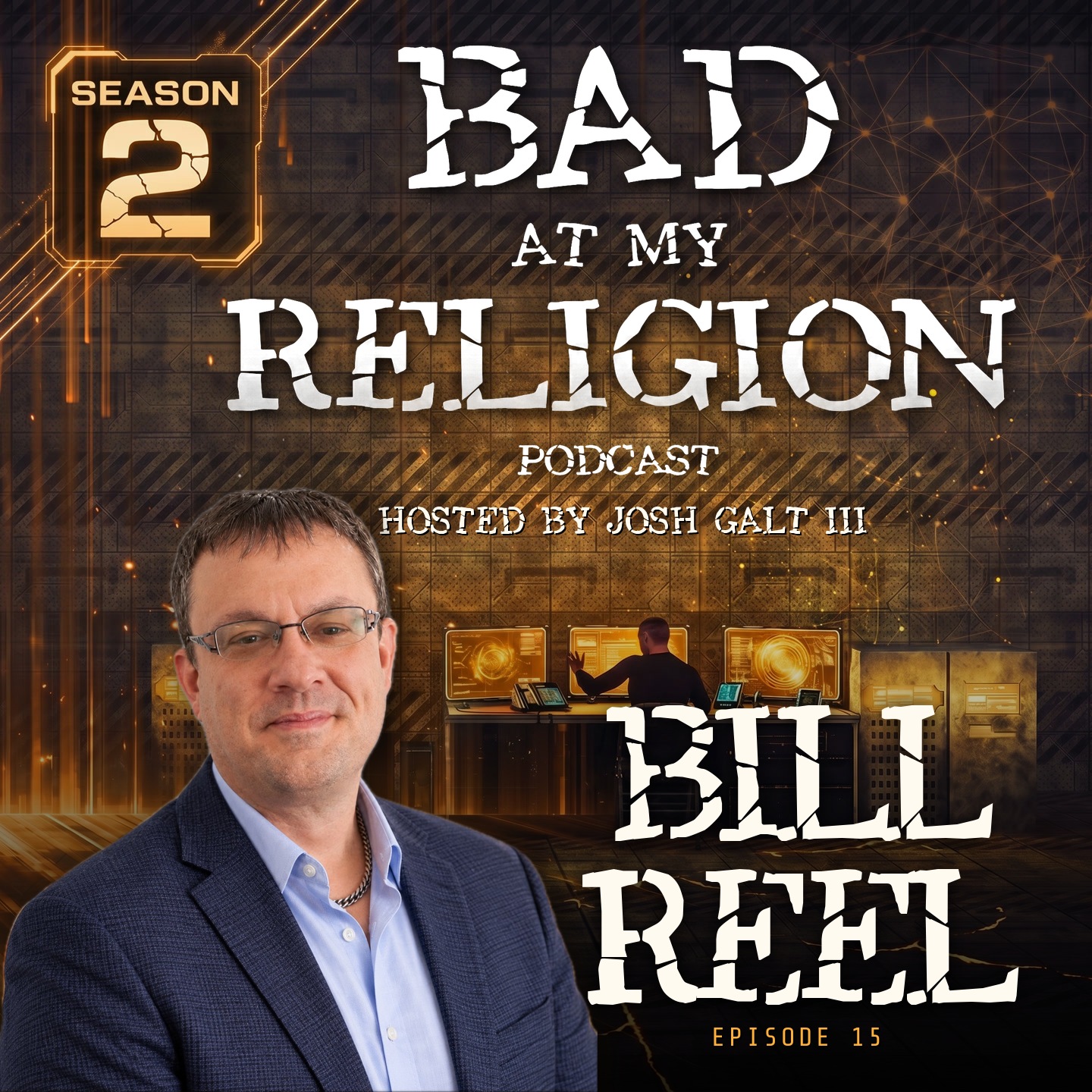
[00:00:02] Speaker A: Today's guest is Bill Real.
And so I was very stern with my children. I was very critical of people in my home.
I, I sort of showed up. I don't know if you allow bad language on your podcast or not.
[00:00:15] Speaker B: Absolutely.
[00:00:16] Speaker A: I sort of showed up as an and.
And not being the best human being. So even though I'm going to church and I'm doing Mormonism really well, I know in my own head that maybe I'm not going to make it to heaven.
You're listening to the Bad at My Religion podcast, hosted by Josh Gold.
[00:00:36] Speaker B: Well, Bill, I appreciate you taking the time to come on today and talk about your story and your framework.
It's a very interesting episode for me because I think you're going to turn sort of my premise for this whole show on its head.
So if you would like to just start with a real high level overview of your, your background, your connection to religion and where you are today.
[00:01:06] Speaker A: Yeah, so my beliefs have changed a ton over time. So let me go back. When I grew up as a kid and a teenager, I grew up in a home. I have one brother four years apart from me.
My parents stayed married their entire marriage until my mother died of cancer.
They were never religious. I didn't grow up in a religious home. We had a family Bible sitting on a shelf, but I never once saw my parents ever take it off the shelf and open it up or do anything with it. When I was 17 years old, I was in my senior year at high school and I met a girl through where I was working. I was working at a fast food restaurant and I met her and she asked me on a date and we ended up getting married. But in the process leading up to our marriage, she was a Mormon in a Mormon family.
And her dad lived the motto of every member, a missionary. And so he made a great effort to, to get me, invite me, encourage me, nudge me to go to the Mormon Church, the LDS Church, Church of Jesus Christ of Latter Day Saints.
And I had such a great experience from the very first time I walked in.
It was magical to me. I was 17 years old and I was still prone to some degree of magical thinking, obviously.
And I found myself falling for Mormonism. I fell in love and I fell hard and I ended up getting baptized.
And from the moment I was baptized, I'm immediately serving in leadership positions.
I'm the assistant ward mission leader again, for those who don't know Mormonism, this is sort of the local assistant to the ward mission leader who is in charge of making sure. The missionaries are functioning appropriately inside that local congregation.
And from there, I became a counselor in an Elders Quorum presidency. I became a counselor in a young men's presidency. I became the Elders Quorum president. These are all important positions in Mormon local leadership.
I don't know how I'd compare them to sort of other religions, but Mormonism has a lay ministry, and it's all volunteer, but people higher up ask people in the congregation to serve in these positions. And I'm rubbing elbows from the very first moment I join with sort of the upper echelon of leadership in that local congregation.
[00:03:31] Speaker B: And is it sort of like a career arc where when you are young, you do aspire to get higher in the church? Is that part of how it works?
[00:03:40] Speaker A: Yeah, I. I definitely wanted to be a leader in the church because I. I wanted to help people. I wanted to.
I wanted to help the church grow. I wanted to have influence on. On what happened in our local ward.
But eventually I end up becoming the bishop of the ward. I'm 29 years old, and that's a little young for that, but I sort of felt honored that here I am at 29 years old and I'm leading the local LDS congregation in Sandusky, Ohio.
But I should probably back up and say this, too, that from the moment the missionaries were teaching me the missionary discussions, the. You know, the Mormon elders come to your door and they knock and they ask if they can share a message about Jesus Christ. And really the goal is to get you to get baptized. And they go through a handful of discussions. During my time of investigating the church back in 1996, there were six missionary discussions. And as they're going through those with me, I took a deep interest in Mormonism before I was even a member. So I'm going to my local library and I'm getting every book out that I can. And one of the books that I'm reading is no Man Knows My History by a woman by the name of Fawn Brody. She is writing a critical biography of Mormonism's founder, Joseph Smith. And there were lots of blemishes on both Joseph Smith and the Mormon Church in that book. And I remember going back to my future in laws again, the parents of the girl I'm dating. And I'm asking them, I'm like, hey, I'm reading this book, and it says this and that and the other thing. And they seemed.
And that's like an insulting word, but they seemed inadequate at knowing what the messiness was in Mormon history. And I Took a fascination with it.
So I immediately start reading everything I can get my hands on. I go to my school library, I go to the city library. I'm getting all the books that I can. The Internet is just starting to come on at that point, and I'm going to bounce around because this is how my brain works. But after I get baptized, I'm going to college at Bowling Green State University, and they allowed all the students to use the computer lab and print as much stuff as they wanted at no charge.
And I, rather than doing my schoolwork, which I should have been doing, and that impacts me later, but I just kept spending all my off time in the computer lab at school between classes, looking up everything I could on Mormonism, printing off hundreds of pages a day, taking them home, reading them, making marks on the pages, underlining things, highlighting stuff to the point that when I get baptized, and I get baptized because I read the Book of Mormon, because I had a spiritual experience, because Mormonism was magical.
And after I joined the church, I'm sort of known in the local congregation immediately after baptism as being one of the people in the ward who really knows his Mormonism inside and out.
And so it's very natural for me as somebody who shows up, somebody who rolls up their sleeves and gets busy doing the work of what's going on in any given church and having as much of an informational foundation about Mormonism as I had, it was really natural for me to sort of move up the ranks in leadership in the ward. And when I get called as a bishop at 29, I'm aware of the messiness of Mormonism. Although I took an apologetic approach, I understood that what the problems were. I understood there were workarounds to solve those problems, whether they were reasonable or not. I enjoyed knowing questions that no one else knew and enjoyed knowing the. The answers to those questions that others didn't even know the questions to. So it was maybe for a little bit of my ego, it was really good for me to feel important, to know things, to know how to put the puzzle pieces together. And so the missionaries were always taking me out with them to go see investigators who had hard questions. I was the guy they took because I could sort of work on the fly and resolve, at least to the missionary satisfaction, that there were good answers to the hard questions that were out there.
[00:08:02] Speaker B: Like, I don't know a lot about Mormonism. So you said that. That Mormonism was a magical experience for you. How, like, how would you define what that magical aspect of Mormonism is? In the spiritual sense, as, as it differs from, say, Christianity. Oh, did, did you study Christianity while you were studying Mormonism or did you just say, okay, Mormonism is the answer?
[00:08:25] Speaker A: Yeah, so I had no background in any other religion at all. And so I come into Mormonism with sort of that being the only story I'm given. And I'll just say the Church of Jesus Christ of Latter Day Saints tells a very different version of its history than how history actually played out. So to your listeners, Catholicism, of course makes the claim that it is the Christian religion that's been there since the beginning.
Protestantism essentially says Catholicism got off somewhere, it got off track and we're here to put it back on the track.
Mormonism comes along and makes a completely different claim. It says that once things got corrupted in the original Christian church, there is no way to go back just because you want to. It requires a quote unquote restoration.
And so Mormonism makes the claim that in 1820, this young 14 year old boy named Joseph Smith goes into a grove of trees in upstate New York and he goes there wanting to know which church is true. And he's been looking into Methodism and Presbyterianism and he's just not satisfied. And so he goes into the grove of trees and he says a prayer. And next thing you know, Heavenly Father and Jesus Christ show up with Heavenly Father looking over to his son and saying, you know, this is my beloved son, hear him.
And so Mormonism has this incredible claim that the heavens are open again, that God has his own fingerprint on putting his church back together. He calls young Joseph Smith to be a prophet. Within a few years, Joseph Smith is meeting with an ancient inhabitant of the Americas who shows up in the form of an angel named Moroni, who is telling Joseph, hey, you know, here you are. And Palmyra, New York, and lucky you, there's a hill back here behind me. And in that hill is a set of gold plates, gold tablets essentially, with writing on them in reformed Egyptian. Egyptian, but Egyptian that no one could read, including Egyptians, and gives Joseph Smith the assignment to translate that.
And so Joseph Smith, again, the early history is told less accurately. The Internet is forced to the LDS Church to become more accurate with its history.
But the original story was that the biblical Urim and Thummim, sort of a breastplate with some a form of like spectacles attached to the breastplate are inside the box with the plates along with other items too.
Of course you've got to have all kinds of cool little magical charms. But Joseph Smith then uses this Urim and Thummim, which I would call the Nephite spectacles, to differentiate it from the actual item he used to translate those gold plates into what Mormons have as the Book of Mormon. It's the reason they're called Mormons. It's the reason it's called the Book of Mormon is because as various ancient American prophets are writing down their scriptures on sacred records in the Americas, the one of the final people to deal with those records is an inhabitant by the name of Mormon.
And Mormon is put in charge by God to sort of go through all the records and put the most important pieces together which makes up the Book of Mormon. And so Mormonism, in trying to make a claim that it's the restored church, it has a prophet, it has apostles, it claims that it has priesthood authority, that it's the only church on the earth with actual priesthood authority, the, the authority to act in God's name, that it has priesthood keys, which are not real keys, but sort of intended to mean the ability to perform rituals in the church with authority.
And so Mormonism, one of its big claims in the modern church, and certainly going far back, is that families can be together forever. So Mormonism teaches that families aren't together forever naturally in the heavens, but that if families will live the gospel of Jesus Christ as spelled out by the Mormon Church, then they can go to the temple. And Mormons are very well known for having temples all over the earth.
And they'll go to the temple and they'll perform special rituals. And one of those rituals is meant to bind families, husband and wife, with their children together in the eternities for time and all eternity. And so Mormons really see family as a big deal, and not just a big deal in this life, but a big deal in the life to come.
So Mormonism has lots of differences with sort of run of the mill Christianity, but those, I think, at least lay out some highlights about its narrative foundational story, as well as some of the principles behind how it sees itself different from the rest of the Christian world.
[00:13:44] Speaker B: So is the divorce rate much lower then, as compared to the rest of America, for example?
[00:13:50] Speaker A: Yeah, but yes, I want to, I want to throw a caveat in though, which is, so Mormons who go to the temple and participate in those rituals do have a lower divorce rate than non Mormons who are just getting, you know, civil marriages or married in their churches.
But that can be explained with lots of reasons, one of which is that Mormons are highly encouraged to marry as really Young.
So a lot of Mormons go off to like byu, which is the church college, and they're getting married within weeks, if not months at most of when they meet the person they think is it. And they've been taught that any two people living the gospel can make a marriage work. So the ideas of compatibility and knowing yourself and knowing what you want in a partner. Mormons aren't figuring that kind of stuff out. What they are doing is they're getting married so young, they're encouraged to have lots of children.
And to some degree, I would argue that that mechanism sort of traps them in a life without really knowing any better and without really having a way to do something different.
[00:15:03] Speaker B: But you came into it from the outside and joined up. Did you get married young or was the magical experience more of just finding something in people and connection to the divine that you were like, this must be the truth because of the way that it makes me feel.
[00:15:21] Speaker A: Yeah. I was one week after turning 19 that I got married, had four kids, back to back to back to back. Yeah. And the game that Mormonism plays. And again, it's in the Book of Mormon. If one were to turn towards the end of the Book of Mormon, it's going to be in the Book of Moroni again, named after the same prophet who as a spiritual angel of sorts, comes to Joseph Smith and tells him where the plates are. The same Moroni teaches that the way to know whether something is true is to ask God and by the power of the Holy Ghost, you may know the truth of all things. And Mormons are told like, don't exactly trust the Internet, don't exactly trust books. What you should trust is your spiritual feelings.
And only if your spiritual feelings mesh with what the leaders of the church say. If your spiritual feelings go against what the leaders of the church say, that's the clearest way to know that you're being deceived by the adversary. And so Mormonisms from a really young age are taught to follow the prophet. They have songs in their nursery for the 18 month old to 3 year olds. Follow the prophet. Follow the prophet. Follow the prophet. He knows the way. So they're taught to follow the leaders of the church and they're taught that their spiritual feelings should coincide with the feelings and thoughts and teachings of the leaders of the church. And that when that happens, that's the way that you know that something is true. And so when you're born and raised in a system that teaches you not to trust information, to not trust facts, to not trust science, and you're told that your emotional feelings are the way that you know what is true and what isn't. It's no wonder that Mormons learn a different route to truth, one that is difficult to nudge them into reconsidering or deconstructing when they are, when they are trust to not trust, when they are taught to not trust information to begin with.
[00:17:32] Speaker B: But when you came into it as, as an outsider, like had, had you been searching on a spiritual level previously, like as a teenager, were you, were you looking at the stars and wondering about God? I mean, even from, from sort of an agnostic family that wasn't religious, did you have that spiritual inkling or did it just. You were in love with this girl and what she, what she believed seemed really, really interesting and you connected with it and so you decided to go all in?
[00:18:02] Speaker A: Yeah.
Without any religious background, I was pulled in early in the church into having experiences that I saw as God produced.
And so I was in certain lessons in classes and feeling like the Holy Ghost or the Spirit is working upon me.
I read the entire Book of Mormon prior to being baptized. I took it really serious. Yes, I, I had met a girl and yes, that played a role, but I took Mormonism really serious and I read the book and I did what they told me to do. I prayed about it.
And when I prayed about it, at first I didn't get an answer, but if you don't get an answer, keep trying. And eventually I had an experience that even to this day I would say I can't exactly explain. I would call it sort of visionary.
I would caveat that by saying lots of people in lots of religions, religions that contradict each other, have spiritual experiences and lots of people think their religion is true because they had spiritual experiences within the lens of their religion. In reality, human beings might just be prone to these kinds of hallucinations or spirit, you know, experiences of a spiritual sort just naturally by the fact that how we've been programmed by our culture, programmed by evolution. And I don't see my Mormon spiritual experience as any more truth telling or real or conducive to knowing what truth is than the spiritual experiences of everybody else out in the world in their various religions.
[00:19:46] Speaker B: Basically, you said the only thing I was good at was Mormonism. Like you were, you were very good at your religion. The inspiration for this whole show is like, why are we so bad at our religion? Like, why do we have these things that we say have eternal consequence, but yet very few people actually live what they say? They believe on a day to day level. Right, but you were doing that. So walk me through a little bit about how, how you were being good at your religion and how that applied to day to day life.
Because it seems like just the pure, simple idea of integrity is important for us, whatever the belief system. Do you think people should try and be good at what they believe in or is it like now you should just be a good human and like leave the theological side? Yeah.
[00:20:32] Speaker A: Let me start by saying that I think one can be a really good Mormon without being a great human being.
And I think I was definitely doing the former and struggling a bit at the latter.
To be a good Mormon means that you say prayers every day, that you serve whenever the church or its members need you. So if a family's moving in or moving out, you're there to help pack boxes and pack the U Haul or unpack it.
You are a good home teacher, what that means. And again, they've changed their language. One thing that high demand religions do is constantly change their vocabulary. But when I was younger it used to be called home teaching. To be a home teacher means you go out every month and you visit certain members of the congregation that you've been assigned to watch over.
It means that you show up every Sunday having read the lesson that's going to be given that day, so you're prepared to contribute to a Sunday school class.
So you show up on Sundays, on time, you're there for three hours of church, you understand the lesson material, you read your scriptures every day. A lot of Mormons have never even read the Book of Mormon all the way through. I think I had read the Book of Mormon about 14 times or so all the way through.
I had read the Old Testament a handful of times. I had read the New Testament a handful of times.
I knew the scriptures inside and out. And when we were in a class in church and someone made a comment, I knew exactly where to go. I was one of those people that you could walk up to three minutes before the sacrament meeting started. You could say, hey, brother Real.
And everybody in Mormonism is called brother or sister generally. Hey, brother Real, the speaker got sick, he's not going to be here. And we start in three minutes. Any way you could give a 20 minute talk? And I'd, you know, I'd be like, oh, I'm so excited. Like, this is my dream. My dream is to stand up and in front of a group of Mormons and to be able to pull things out from the scriptures and to teach them Something I am sort of seen as the person who is able to speak on the fly, knows his scriptures well, knows the church's history well.
I serve, I'm temple worthy, which means I've answered certain questions about paying a full tithing, wearing my garments, which is special underwear that Mormons wear after they go to the temple for the first time.
I'm telling, you know, I'm answering the questions about honesty and chastity and other moral standards that the church has. And so I've had. I've got a temple recommend, which is a little card that when I go to the temple, I show them, and. And the people at the front desk go like, I know this guy's worthy to come in here. And so in all the ways that you would measure whether someone is a good Mormon or not, I was a good Mormon. Now, now we're going into, like, was I a good human being?
I was young and didn't have. No one taught me the tools of managing my own feelings. So I would, like all of us do, get triggered or activated by past traumas. I would get uncomfortable if things were happening around me that didn't feel safe or if I was out of control. I don't mean out of control like I was out of control, but out of control and that the world around me was chaotic and I didn't have a way to put it back into something different than that. And so I was very stern with my children. I was very critical of people in my home.
I sort of showed up. I don't know if you allow bad language on your podcast or not.
[00:24:17] Speaker B: Absolutely.
[00:24:17] Speaker A: I sort of showed up as an asshole and, and not being the best human being. So even though I'm going to church and I'm doing Mormonism really well, I know in my own head that maybe I'm not going to make it to heaven. I'm. I'm too short with my.
My fuse and I'm angry sometimes. I'm. I'm. I'm hypercritical sometimes of people. I'm.
I'm really struggling in the ways that a good human being should be measured at doing that. And those two things were bumping into each other probably up until maybe five or ten years ago.
[00:24:56] Speaker B: How does Mormonism address the sort of contradiction of being a good Mormon but not necessarily being a good human or a good person in society or good with your family or whatever?
[00:25:09] Speaker A: Yeah, the church doesn't address that. The church, the Church of Jesus Christ of Latter Day Saints, is very much about appearances. And I'll Give some examples.
The church puts its top leadership forward as if they're prophets, seers and revelators. That's the titles that are given to them.
Meanwhile, behind the scenes, they are cheating the US Government, creating dummy companies and violating financial regulations by the US government getting caught in. And they had essentially created 13 dummy companies in order to hide their mass amounts of wealth.
[00:25:44] Speaker B: It's hundreds of billions, isn't it?
[00:25:46] Speaker A: Oh, the church has $350 billion or so at this point.
And then when the leaders are caught doing that, they write a piece of writing to the membership and say, essentially we consider them. You know, we've taken care of it. Don't you worry about it. We consider the matter closed.
You don't get to see behind the curtain and ask about things. The Church has whitewashed its history in extreme ways to the point where I was telling you earlier that they told the members that Joseph Smith translated with these Nephite spectacles, which are essentially the biblical Urim and Thummim. Meanwhile, Joseph Smith's a treasure digger. He's using rocks to proclaim that he sees things in them. And he's using one of these seer stones to translate the Book of Mormon, allegedly.
And so the church at every turn is not telling you about Joseph Smith's polygamy. It's not telling you about Joseph Smith's grooming and intimate interactions with children as young as 14 years old. It's not telling you about the violence that Brigham Young taught and carried out.
It's not standing up and talking about its race ban in the prior to 1978, where people of color couldn't go to the temple or receive the priesthood. It wants to avoid at all cost, vulnerability and transparency at every level of its church. So as a member, explicitly and implicitly, you see that every day or at least every week.
And you kind of know that this is a religion about appearances, even if you don't have the language to put to it.
You put your suit and tie on. It's so important in Mormonism that you wear a white shirt and a tie and a suit jacket.
You walk into any Mormon congregation and you will notice immediately that 95% of the men are wearing white shirts with ties and jackets on and some sort of dress pants. You'll notice that the women's 95% of them are wearing dresses.
Mormons preach about modesty. Don't even show your shoulders.
That would be a temptation to men that women would not want to provide.
And. But we never get any deeper than that. Nobody's talking about their struggles or their problems. There are like five acceptable answers to every question in church, or, you know, the questions asked, and the answer is either follow the prophet, read your scriptures, say your prayers, pay your fast offerings.
Mormonism is really about outward behaviors, checking boxes. And there is very little in the church that actively calls members to work over the course of their life into developing into deeper, more wise, more experienced human beings who know how to manage their feelings and to progress or grow as a human being.
[00:28:51] Speaker B: Wow. Yeah, really interesting. And so as. As people spend more time in the church and in living that, like, what is the goal that is that they think that they are going for? What is it in Mormonism? Because it seems like it's a very earthbound and from what you're saying, like a. Like live the most amazing life as a human with your family and present yourself in a certain way, and then you get to. You get to spend eternity with your family. Like, what is. What's really the goal?
Yeah.
[00:29:24] Speaker A: One of the theological differences between Mormonism and other religions is that Mormonism believes that there's three heavens. Joseph Smith taught that that there was the highest heaven called the celestial kingdom. There was a middle heaven called the terrestrial Kingdom, a lower heaven called the Telestial Kingdom. And then for those who denied the Holy Ghost or murdered or were apostates, they joined the LDS Church and lose their testimony and go away.
They get to outer darkness, which is sort of Christianity's version of hell. But those three heavens are all beautiful. But for your family to be together, together, you all have to get back to the celestial kingdom. And so Mormonism's plan of salvation would essentially work like this. You would get baptized, receive the Holy Ghost, receive, if you're a male, receive the priesthood. So at 12 years old, you become a deacon, then a teacher, then a priest in the Aaronic priesthood. Then when you're an adult, you become an elder and eventually a high priest.
And that would be the Melchizedek priesthood.
You would.
You would become temple worthy. You would make sure that your life is always in line, that you can answer those temple questions and hold a temple recommendation all throughout your life, and that you would be loyal and obedient to the leaders of the church and that you would take every opportunity to share the gospel with others.
If you're doing that, you made it. That is what Mormonism would consider worthy of exaltation, which would be different than salvation. Mormonism uses both terms differently.
Salvation is sort of being cleansed by Christ and eventually entering into One of those three heavens, exaltation, is being a really good Mormon and getting to the highest degree of the celestial kingdom.
And so if I just essentially live the basic tenets of Mormonism, maintaining a temple, recommend supporting the leadership of the church, being obedient to them, and sharing the gospel with others, then Mormons would look at you and go, that's the kind of person who makes it. He gets to the celestial kingdom, he lives in the highest heaven with God. It really doesn't go much deeper than that.
[00:31:49] Speaker B: What is the gospel, though?
And when. When Mormons go out and they're sharing the gospel with people?
Because what I'm hearing, and this is sort of the most that I have researched and heard about, you know, what goes on inside the Mormon Church
[00:32:05] Speaker A: is
[00:32:05] Speaker B: that it's kind of cult like, in a way, in that it's more about supporting the growth of the church, the existence of the church. But is there, like, what is the gospel? Do you have, like, Jesus giving the beatitude, or like, what happens when you go to the church Sundays or Saturdays or.
[00:32:29] Speaker A: Yeah, so Mormons believe in the Old Testament and New Testament. They accept that as scripture. If you were to ask a Mormon what are the scriptures, they would. They would present to you multiple books. So whereas Christians walk around with their Bible, the Old New Testament, Mormons would say, yeah, we use the Bible, the Old New Testament, but we only believe in them as far as they're translated correctly. And Mormons acknowledge that there are lots of corrupted pieces and parts of the Bible, hence the need for additional Scripture to help clarify that. Hence the need for living prophets to help clarify that. So Mormons have, in addition to that, they have the Book of Mormon, and then they have another thing called the Pearl of Great Price. And inside the Pearl of Great Price are multiple things. One of them is the Book of Abraham. Joseph Smith in 1835 or 36, gets his hands on some Egyptian mummies and some Egyptian papyri. And he sees that as an incredible moment to tell his followers that he has found the Book of Abraham. And so he translates the standard Egyptian funerary text into what he says is the Book of Abraham. He says it's the writings of Abraham written by his own hand.
Turns out that once we understand what Egyptian says, it doesn't say anything like that. And Mormonism has had to create some mental gymnastics around it. But it has the Book of Abraham. It has a thing called the Book of Moses where Joseph Smith claims that via revelation, he was able to fill in some voids around the Narrative of Moses by what God told him to write down.
There are other things as well, but Mormons have a whole handful of books that they consider scripture. And Mormons are challenged to be reading their scriptures every day.
Mormons are encouraged to be reading the talks of their leaders on a regular basis. Every month they get a magazine in the mail. Used to be called the Ensign, I think now it's called the Liahona. It used to be called the Liahona before again, we just constantly change our vocabulary, but they would get in the Ensign the words of their leaders, and they're supposed to follow that. They get general conference every six months, it just happened this past weekend, where the leaders of the Mormon Church, every six months stand up and one after the other, they give talks telling the members of the church to continue saying their prayers, continue reading your scriptures, continue to try and be a good Mormon, go to the temple.
And there are lots of things that teach them to frown upon and shun to some extent, those of their family and friend circles who don't believe in the church and have walked away.
For Mormons, like, what does it mean to be a good Mormon? You go to church every Sunday used to be three hours long. Now it's two hours.
You have sacrament meeting, which would be equivalent to, like, Catholic Mass.
The blood body and blood of Christ are passed around as bread and water, and everybody partakes of that. And then the leadership of the local ward, the bishop and his two counselors proceed to conduct a meeting wherein people have been asked to give talks each week. And it, it sort of fluctuates around the congregation in regards to who gives a talk.
And the members will be asked to give a talk. They're assigned a topic, and they'll preach on some principle honesty, even if the leaders of the church aren't being honest.
They'll teach chastity, they'll teach service, they'll teach going to the temple. They'll teach all kinds of things.
And then after that's over, Mormons for the next hour will split their time between adult women, adult men, and then a combined men and women class. And then the youth have all their own things that they go to as well. And the Mormons get out of church, they go home, and some of them stay in their Sunday clothes all day long.
And it really is important to Mormons to be living that gospel path that I said, which is again, full of a lot of outward behaviors that the church teaches, would then signify a spiritual motivation inside, but which never really works on being a Better human being per se.
[00:37:00] Speaker B: So what happened for you that led to the cracks, I guess, in the foundation of saying, wait a second, like, I'm not living as a good person with my family or in society. I'm a, you know, I'm a upstanding bishop, and everyone respects me, but there's got to be something else. Or what was. Like, what was your transformation? Or what happened.
[00:37:26] Speaker A: Yeah, in. So one of the quotes of Mormonism, actually, I'll play it, and I've got a sound bite here on my mixer.
This is the current president of the Mormon Church. When you say Mormonism, you. You know, you're saying, like, hey, does Mormonism teach that you're not allowed to ask questions or to raise concerns? Like, here's the current prophet of the church speaking.
It's wrong to criticize leaders of the church, even if the criticism is true.
Imagine being in a system where your leaders can create dummy companies and violate U.S. law and be in trouble with the IRS and the securities and Exchange Commission.
Imagine leaders who allow children to meet behind closed doors with a single stranger man. And we have a high amount of child sex abuse going on, but you're not allowed to tell them to do something different. In fact, gentleman by the name of Sam Young made it his life's mission to encourage the leaders to make changes around child safety, and he was excommunicated for doing so. So imagine being in a system where your leaders aren't being upstanding, ethical, moral people, and you're told that it's wrong to criticize leaders of the church, even if the criticism is true.
So, again, knowing Mormonism really well, it was really a slow burn for me.
I'm always reading the history. It's why today what I do for a living is I work from home and I do several podcasts under the umbrella of a nonprofit where me and my main co host, primarily him, and I, try to expose the truth of Mormon history. We do three live shows a week and other things where we put documents up on the screen and try to help believing Mormons go like, oh, like, they never told me this. Like, maybe they lied to me and give them the first inkling that maybe something isn't right here and give them the opportunity to ask questions and to deconstruct things in their faith that aren't true because they've never been given the full scope of history in the church, and they've never been given permission to push back against anything that felt uncomfortable inside the system.
And so, you know, again, 29 years old, I'm a bishop, but I'm still reading, I'm still thinking about things. I am. I start a podcast when I'm 32 years old as a sitting bishop. And it was my way of just talking out loud about the messiness of Mormonism.
And at first people loved it because I'm doing it from a faithful point of view.
But little by little by little, you start to recognize as you continually learn, you know, 300 more problems every year, that maybe this doesn't add up the way they want you to think it does.
And as I started to dive back into issues that I had read about years ago, I start to notice as, as I've grown up, as I'm less tolerant of nonsense, as I've become a touch more skeptical, I recognize that their workarounds don't really work, that if you just ask the next logical question, the truth claims of Mormonism essentially crumble. And so in my 30s, I'm a sitting bishop and I'm having what I will call a full blown faith crisis.
And it's at that moment that rather than looking inside the system for truth, I just, I just put my foot down one day and go. The outside world, if I am discerning of information, the outside world is doing a much better job of giving me the facts, the documentary history, the theological development timeline of Mormonism. And on top of that, it's giving me wisdom teachers that I think are much more in line with real values, real healthy values, a real healthy morality. I'll give examples. Richard Rohr, Catholic monk, Brene Brown, when she discusses things like vulnerability and shame.
Jack Kornfield, talking about secular Buddhism.
These were the kinds of voices that started to influence me.
And so in my early 30s, mid-30s, I start to find a. A voracious hunger for information outside the church that is pointing to my shadows, mechanisms I created because of my traumas in the past, because of my efforts to protect myself from having to feel shame again, my need to try to get control of the world, right? So I start reading books by people that it's just really clear that they've got more wisdom inside their thumb than Mormon leaders have in, in all of their talks combined.
And at that point, I start going down the path. You know, at this point, I'm putting it all together in ways that have me being really proud of knowing Mormonism inside and out. But on the backside of this, I am, I'm deconstructing, I'm reexamining every single belief I was given.
I'm going back into history and trying to figure out how the theology developed, how its history actually occurred. And what I come to find out is that, and I mean this, you couldn't do this on purpose. I don't think every single claim of Mormonism doesn't add up. Every single claim that Mormonism makes is based on a certain view of how history happened. And when we look at the documentary history, every single piece of Mormon history is problematic compared to the narrative that they would like to hold. And eventually I, you know, I'm doing the podcast, I'm doing it from a faithful perspective, but it gets to the point where I become more and more critical. And eventually I put out an episode called Liar, Liar, Pants on Fire, where I point out one of the top leaders of leaders of the church, Jeffrey R. Holland, an apostle. I put out document, put, you know, show the evidence, link everybody to where they can look at it for themselves. But it's five moments in time where Elder Jeffrey R. Holland, one of the church's apostles, was lying somewhat blatantly in some of those instances.
And when I. Again, you can't criticize leaders of the church, even if the criticism is true. And the moment I did that, men show up at my door, inviting me to a church disciplinary court where I was excommunicated.
[00:44:20] Speaker B: Wow. But I'm. I'm most curious about what that did to you inside, because this is something that you had lived fully like you were.
You were all in. You were a leader.
You were completely engaged in being and doing this role in this framework. And now suddenly, because you are seeking truth, because your soul, your heart, your brain is seeking truth, now you're getting excommunicated. What did that do to you? And, and where did you go from there in terms of your.
Your spirituality or your. Your beliefs?
[00:44:59] Speaker A: Yeah, I think you hit it on the head. I've always been a truth seeker.
And to come into the church because it had manipulated the data and manipulated you into a spiritual experience.
But, but still, me, I was just wanting the truth, and I thought Mormonism was true.
When I learned that Mormonism isn't true, the very next thing you have to deal with is if Mormonism isn't true, then I don't have a way to sweep under the rug the harm that it's caused to people. It's one thing if harm happens and you go, God's ways are not our ways.
[00:45:36] Speaker B: Right.
[00:45:36] Speaker A: It's another thing if harm happens and you go, these leaders, they are not moral or ethical, and hence I can't justify that harm by blaming God with it. And so suddenly you go back and you look at your founder, Joseph Smith, and again, polygamy with children as young as 14 years old, them telling people of color that they were cursed with the curse of Cain and that they had been less valiant in the pre earth life. Again, one theological notation with Mormonism is it believes in a pre existence that we all existed as spirits with God prior to coming to this earth, that we are also to some extent eternal beings.
And so Mormonism taught that when you came into this earth with black skin, it's because you didn't fight hard enough for the team of Christ in the pre existence and you were sort of swayed by Satan's argument in the, in the premortal life about what the plan of salvation should be. Mormonism even taught at one point that the reason physically and mentally disabled people are that way is because they were less valiant in the pre existence.
And so I couldn't again, homosexuality.
Once I understood, like there are genetic and epigenetic factors that demonstrate that homosexuality isn't a choice, I could no longer defend the church's theology around it because I could see the trajectory of how Mormonism got there and how it has never held a consistent position on homosexuality. So whether it's women, children, people of color, African Americans or people of African descent, Native Americans, because it has things to say about that as well, people who doubt the LGBT community, every one of those Mormonism has not been kind to and has caused harm to.
And the moment you realize that based on history and theology, that Mormonism isn't true, the next thing I right on my plate was that I couldn't stand idly by while Mormonism caused harm to essentially every group that was an old white man.
And so from that point forward, as a truth seeker, the truth matters to me. And whether I'm being ostracized from my tribe, which hurts a hell of a lot, or whether I'm fully in because it fits so good, because I'm fitting in the box.
Either path, I'm a truth seeker and I'm going to follow the truth regardless of what it means.
And I know that sometimes it comes with really hard things. Having a faith crisis wasn't easy. There were a lot of sleepless, sleepless nights. There were a lot of crying at night trying to put it back together. I wanted Mormonism to be true as much as anyone. And I spent the first, you know, maybe three or four years of questioning my faith, of trying to put the toothpaste back in the tube, hoping that if I kept reading and studying and thinking and looking, eventually I'd find a handful of things that would allow me to put the thousand problems behind me back in some order, that they made sense from a faithful lens and it just didn't. So being ostracized from the tribe, being excommunicated from the tribe, I've always valued the truth more than discomfort.
And that leaves me, yes, being excommunicated. And that was hard, but I didn't really have any other choice and I'm proud of the way I handled it.
[00:49:17] Speaker B: And what happened with your family, like was your wife supportive or, or was there a fracture there as well because of what you were questioning and then getting excommunicated?
[00:49:30] Speaker A: Yeah, they all disconnected from belief and from wanting to be at church before I did.
My ex wife, wife at the time, she was deconstructing mostly over the social issues, whereas that came kind of last for me.
That was sort of the final straw for me.
For her it was first.
She did not. She had lots of friends who were diverse ethnically who are diverse in sexual orientation, and she was never comfortable with how the church treated people who didn't fit in the box.
My kids were a mix. My two girls were also over social issues.
My two boys were more intellectual about it and so they would notice the contradictions in history away from me. It's not like I was going home every day and going, hey everyone, let me tell you the problems in the Mormon church. I really kept it to myself because I didn't want to be the one who destroyed their faith. They were independently arriving at conclusions that were not on the faithful side. And so when I told everybody like, hey, I think I'm done going to church, everyone else in my home was like, thank goodness because we've been done for a while.
So we all arrived at that decision, but largely independently from each other. Which is great because mixed faith marriages are under a ton of pressure in Mormonism, if you, if you're a non believing husband and you're a believing spouse, the believing spouse is continually getting messaging about how, how broken in multiple ways that the non believing partner is, that they're being lazy, that they're apostatizing from the church, that they are the chafe among the wheat, they're the tears among the wheat, which are references to the New Testament.
They're being taught like don't, don't listen to, don't trust, don't ask questions of your non believing or disbelieving family. And Friends.
And so there's a big strain on part, member or mixed faith relationships in the church.
It is something that I could probably have an entire conversation with you around the harm that the church does by making its believers choose it over their disbelieving.
[00:51:57] Speaker B: I mean, I'm in a mixed belief relationship. My wife is Catholic. I am very much not.
I left the church. I came from a Protestant background, but haven't really been in any religion for a very long time. But my wife, because she is a truth seeker, because of the relationship we developed, the friendship we developed, I believe God is big enough to meet anyone wherever they are, if they're truly seeking truth.
And so that's why it's very interesting to hear you talk about your truth seeking. I want to learn more about it. But in the Catholic Church, I think it's not as much of a big deal. I mean, people would definitely admonish her not to marry me because they're like, you know, you have different belief systems, it's not going to work. You're going to be going to mass by yourself, blah, blah, blah. And we decided, look, like this is what we believe, we can make it work. But it seems like in Mormonism that would be much less likely because could you even get married to a non believer in the church? Like, would that be allowed or like how, how common is it to, to even have that?
[00:53:05] Speaker A: Well, it's encouraged against. You're not going to be able to go to the temple, you're not going to have a forever family.
So every time you go to church, everyone sort of notices the, the, the small minority group of people who have not attained a temple marriage.
And there are lessons that sort of make someone feel shame and guilt for not having achieved that. There is definitely encouragement to marry another believing spouse.
And you asked how prevalent that is.
I think if we were to go back to the 1980s and 1990s, it would be a very small part of a local congregation.
I think today it's much different. We're in the Internet age.
And just to give you an example, some of the data that's come out, there's a gentleman by the name of Jeff Strong.
He's written a book called Torn T O R N. He's a believing Mormon and he's done a ton of data research, survey research into believing Mormons and where they stand with various issues.
He has pointed out that Whereas in the 1980s and 90s, Mormonism's growth was so phenomenal that it was claiming and other data researchers outside of Mormonism were claiming that Mormonism is growing at such a pace it's going to be in the hundreds of millions of people in no time.
Well, fast forward.
What Jeff Strong is saying is that 40% of stalwart Mormons have left the church over the last two decades.
That of the remaining people in the pews, that about 30% of them disbelieve to some extent the truth claims of the church, though they are still attending.
That is a dramatic shift.
And when I was in the church in the 90s, early 2000s, over the course of my first 10 years in the church, I knew of one person in my ward who left the church who was stalwart, all in believing and had discovered something and no longer believed the church was true.
Today, I think every Mormon knows, knows at least five people and probably knows 10 or 15 people in their sphere of influence who, who used to believe and no longer believe. I've had somewhere in the range of maybe a dozen to 15 people from my old ward in Ohio reach out to me and say, Bill, I know I gave you a hard time when you were raising questions out loud, but I don't believe it anymore. And I want to say thank you for being somebody who raised a voice to these things. Eventually I saw the light and it helped me figure out that Mormonism wasn't true. So I think today everyone's aware that there are problems to the point where the church is now trying to be semi transparent. It's writing historical articles, giving some credence to the history as it's happened, even though they're still very much whitewashing it, leaving certain things out, articulating things in a way that is most beneficial to a faithful paradigm, but they're at least recognizing they can't hide it from them.
[00:56:29] Speaker B: Do you, do you think that this, like the exodus from the Mormon Church is connected to globally sort of an exodus from religion, or do you think that it's more specific just to the Mormon Church because of it's built on a shaky foundation?
[00:56:49] Speaker A: Yeah, Mormonism definitely has its own specific issues.
You know, if I, if I want to challenge the truth claims of Methodism, that's a very different game than the truth claims of Mormonism.
That said, I definitely think in this age of the nuns, not the N u n s, but the N o N E s, the people who are stepping away from religion and no longer self identify as being part of any religion, I think that is having an effect in Mormonism as well. There's no doubt that again, we live in an age of information, we now live in an age of super intelligence.
[00:57:30] Speaker B: It.
[00:57:30] Speaker A: It seems so easy for all of us when we're told anything in any facet of our life.
If we want to take a few minutes, we can get information on all sides of an argument and make a somewhat informed decision about what perspective seems to be most reasonable and rational for us.
And Mormonism, like the rest of religion, is dealing with that.
The claims, though, are just really different. And here's what I mean. If I go back to ancient Christianity, it's an old world that lived in an age of unverifiable history.
And so if I believe that Moses parted the Red Sea, then I have to make a judgment call about whether I think God could perform that supernatural magic or not.
When I study Mormonism, it happens in the 1800s, and Joseph Smith highly encouraged his members to keep journals to document the history there. There is so much recording of early Mormon history that you can go back into the documents and clearly see that these things don't happen in a way that supports Mormonism's truth claims. So it's not just about making us a judgment call about how much supernatural magic you're going to allow into your modern world.
It's that what the Church is saying happened simply does not match and in fact, often in almost all instances, contradicts the documentary history when it comes to its truth claims. And I think that's just a much easier way.
You know, if I argue with a Christian about a global flood and I say, well, these are the thousand problems of the global flood.
A Christian who wants to believe in the global flood is going to have their faith to impose on me to say, like, it's still true anyway. Well, as a Mormon, I can just go, yeah, but let's look at the document. And it clearly shows it didn't happen the way you believe.
So what do you want to do with that?
I'll give one example. So, Joseph Smith.
The church's story about Joseph Smith was that he saw God the Father and Jesus Christ. They use a particular account of Joseph Smith's first vision, when in reality, Joseph Smith shared his first vision on multiple occasions.
In the earliest recording, 12 years after the first vision allegedly occurs, it's the first time he writes anything down about it.
Twelve years later, in 1832, he writes that he only saw the Lord, that the Lord opened the heavens, and I saw the Lord. It's only years later when he needs. There's some other things going on in his.
In his surrounding that he needs to shift his theology that suddenly this first vision account says something very different. And so to a believing Mormon, you go like, let's read that. What's the most reasonable way to understand what Joseph Smith, in his own handwriting is saying here?
It's just a very different, I think, game than what Christianity would play.
[01:00:36] Speaker B: So you got excommunicated, and then what happened from there in terms of your own spiritual journey?
I'm curious about coming out of something like Mormonism and, and where that led you as a man, as a person, as a father, as a spiritual being, if you still consider yourself that or what sort of framework you put around your. Your life.
[01:01:02] Speaker A: Yeah, I started the podcast in 2012. Again, I was 32 years old. I was a sitting bishop in the church.
And little by little, as I deconstructed and stepped away, the podcast stayed. I still do that today. It's now more than one podcast. It's now a nonprofit that host several online programs, primarily through our YouTube channel, but also as just audio content on our websites.
And I know you asked in sort a different question, but I want to sort of set that up by explaining that, again, this is the work that I do. I pride myself on trying to be something that the church isn't.
I try to be completely honest about who I am, how I show up in the world. I try to be completely honest about Mormon history because my expectation and what I. I say out loud is I want Mormon leaders to be that.
I try to be transparent.
I try to be kind. I try to be compassionate.
Again, these various wisdom teachers have had deep influence on me. I've spent a lot of time studying secular Buddhism, learning how to manage my own triggers, my own feelings inside.
I. I'm much better at conflict resolution. I'm much better at validating another person's feelings without sort of jumping the gun or overreacting.
I have certain spiritual practices in my life that have me doing deep contemplation on human behavior. I've worked really hard through the study of psychology, through the reading of books like Behave by Robert Sapolsky and others, to understand why we humans do what we do.
Books like Sapiens from Yuval Harari, Civilized by Christopher Ryan's another one where I've spent a lot of time trying to go like, oh, like this is the reason why humans generally and why I show up in the world with our reactions, with our overreactions, with our abrupt, you know, abrupt or disruptions in ourself when things aren't going our way, when we're trying to Hang on to something that's, that's going away or when we try to bring something in that, that really isn't ours to have.
And I think over the last maybe five to eight years, I've really gotten to know who I am really well.
And I am adamant that I'm going to be everything that the Mormon Church is not. So I'm going to be upfront, honest and kind and I'm going to respect diversity. I'm going to make room for the safety of people, especially for children, and I'm going to call out and shine a light on anybody who is doing some sort of intentional or irresponsible harm in the world.
[01:03:57] Speaker B: And do you still believe in God or a deity figure or what is your framework now in terms of your own connection to the divine or not believing at all or when, when I'm
[01:04:15] Speaker A: with my friends and my friends, we like to wrestle with the big questions. And so we, we talk about what's out there in the universe.
When, when we're having conversations around God, me and my friends are all over the place. I have friends who believe in one thing and, you know, another friend who believes in another.
For me, if we dwindle God down to the three basic premises that he is all powerful, all knowing and all present, right? That's how we've sort of defined God and Christianity at a very bare bones basic.
Whatever happened 13.8 billion years ago, they say it was a big bang.
That creative energy that moved out from that moment is now all of it. It's, it's the planets, it's the life forms on them, it's the stars.
Hence that creative energy being all of us. It is all present, it is all knowing. It is all powerful. Everything that's been done was done by it. Anything that's known is known by it.
It's everywhere.
And so at that level, I don't know if it's conscious or not.
I know there are questions out there in like quantum mechanics about how, you know, having an observer to the experiment makes a difference. And I know people like Donald Hoffman, for instance, is asking questions about whether time and space is actually fundamental to the universe. And he and some other quantum mechanic scientists are asking maybe, maybe consciousness is fundamental. I think the conversation is interesting.
I love to be in those conversations. I love to put my two cents in. But I don't come down on a conclusion. I am, I'm comfortable knowing that we humans are on a rock flying through space at millions of miles per hour and everything we think we Know is extremely limited and we couldn't possibly know enough to know what's actually going on.
So even things like simulation theory and other kinds of crazy theories out there, I love to entertain those. At the end of the day, I'll say I know what it isn't. I know it's not Mormonism. I know it's not the Jehovah's Witnesses or Scientology.
I know it's not David Koresh or Jim Jones.
I'm. I'm essentially certain it's not. Again, no offense Catholicism or Lutheranism or Methodism, but what is it? I think that's a lot of fun to talk about, but not any one of us could ever know what the answer to that is.
[01:07:00] Speaker B: How does that translate though, for you in terms of your morality? I believe that you can have morality without, have, without needing religion.
What promotes and protects life for me is where I start with, with my morale. How do you frame your morality in the day to day as far as defining what it means to be a good person?
[01:07:24] Speaker A: I think this is such a great question, and this is a question I, I wish people spent more time on, not from the point that they do. There's plenty of time spent on it, but it's from sort of, do you need an outside source to tell you right and wrong or can human beings be trusted to decide that within themselves? And I'll just say, you know, not to get political, I'll stay away from the issues. But conservatism versus liberalism, generally, conservatism is about survival of the group, the max benefit for the group. And liberalism is more about max benefit for the individual, autonomy, individuality.
And I think those two, those two extremes pushing against each other is, is where all the rules come out of. And so some of the rules we have in our society really devalue the individual and are really about the tribe as a whole collectively surviving and perpetuating.
And there are also rules that value the individual to the extent where maybe we cost ourselves the cohesiveness and collaboration of the group.
And you know, if you read a book like Sapiens by Yuval Harari, you recognize that we all need, we all. We are a social creature. We are a species that has survived through collaboration, through reciprocity, through working together and unifying over, over. Over something. And that myth has been such a huge tool at helping human beings to group up together and work together to survive at the expense sometimes of other tribes, at the expense of other species, at the expense of destroying the planet, perhaps.
How does one draw lines in That. I think that's.
Nobody's got that figured out yet. I'll say my natural tendency is to be drawn towards liberal values of autonomy and individualism, and that if we raised human beings, I don't think most human beings are at this stage, but if we raised human beings to enter later stages of development where they understood that black and white thinking is an old paradigm, and to understand nuance and complexity and to weigh moral issues based on max benefit for the individual versus the tribe, or this person versus that person or this group outside of our geographical boundary compared to the, you know, our group inside that geographical boundary.
How one makes all of those calls, I think is deeply complex.
And we're doing our best to sort of figure that out.
And while. While the.
This big part of me would lean towards autonomy and giving people free choice, I'm also well aware that if we just raise autonomy up at the expense of group survival, group collaboration, group identity, group reciprocity, we may end up causing the end of the human species.
And so religion, for instance, has served to me a very important function of slowing progress down so that we can collect more data along the way to know if changes really are effective or not.
Whereas outside of religion, it's like, hey, you're harming children. Hey, you're being cruel to the LGBT community. Hey, you're not handling race appropriately. And the left side of that argument is pushing for change as fast as possible so that we can reduce individual harm. On the other hand, slowing that change down via conservatism, religion is also effective at helping us sort of notice the kinds of results we're getting through change before we implement changes too fast and end up actually causing the very kinds of harms that we would want to avoid. So you ask what I think is one of the most complicated questions that humans could get together and discuss, which is how much room do we give people to make decisions for themselves?
And how much do we convince them through myth, through manipulation, through.
Through laws and rules, that the group's survival might be more important?
And that might mean that we have to compromise certain individual allowances in order for the human species to continue far into the future. Now, I'll. I'll say in conclusion, I don't really have a vested interest other than my kids and my grandkids and their kids, whether the human species continues or not. I don't wish ill on the human species, but I think we've acted as more of a virus on this planet than anyone. We've caused tons of harm, pollution, taking animals out of the food chain faster than anybody, and that will have consequences.
And I'm of the opinion that maybe a few less humans on the planet with no, you know, we're not killing anybody, we're not, you know, just the natural teaching human beings that maybe we don't have to have as many kids, maybe there doesn't need to be as many of us on the planet, just the slow sort of retreat of the human species. Naturally.
I'm not, I don't really have a big problem with that. And it might be best for all life, at least on this planet, for that route to be taken.
[01:13:15] Speaker B: With AI, we didn't really get into AI, but with AI and what's happening, that might come much faster than anybody is expecting. But just to follow on that point, do you think that most people are incapable of personal responsibility and that freedom and that is why the mechanisms of religion have been so effective and perhaps to the superorganism necessary on this planet to sort of maintain an equilibrium and keep humans to give a sense of morality?
Or do you think that that's exaggerated and that if we taught more of the responsibility and of the individual respect, but also and understanding that that group cohesiveness is important, that perhaps we could evolve as a species faster like the, it could go either way. Like, you could probably make the argument either way.
[01:14:10] Speaker A: I think, yeah, I've got mixed feelings. On one hand, you know, we, we say in, in our world that, say an IQ, an IQ, an average IQ, we say, is like 100, right?
And for every person who has 120 IQ, there's a person with an 80 IQ. For every person with 130 IQ, there's a person with a 70 IQ.
In order for us at the end to have 100 IQ. And I know lots of smart people on this planet who have IQs, well over a hundred.
And so I'm also very well aware that there's a large segment of the human population that has an IQ well below 100, IQ being the, the ability to more quickly and more efficiently notice patterns and, and put complex concepts together.
So part of me would say, yeah, maybe we're not as advanced beyond the other primates as we think we are, that we've developed some gifts that the other primates don't have.
But maybe we're not as far removed from them as we think.
On the other hand, I think that our school systems, the systems of learning that we have, the stories that we pass on and impose, these are true. In other words, we teach people Magical thinking.
We teach people the bare minimum of tools and resources to grow up as adults, function in a working society, contribute in some way, at least through your work and producing something, and then to go off and, you know, retire and die.
That we could do a much better job of giving the humans on this planet the tools and resources to think in more nuance, to think in more complexity, and to give people the ability to move beyond ethnocentric, which is tribal thinking, move beyond black and white dualistic thinking and move into more complexity, nuance, recognizing the balance between ethnocentricity and individuality.
And also sort of a world centric view like, hey, there are people all over the planet and their human value is no more or less than mine. And so while I want to protect the rights of me as an American, for instance, to be safe in my American society, at what point do I rebalance where I draw lines? Because there are other humans in other places of the planet that by me clinging to my privilege, I'm actually causing additional harm to them over there.
I think we could do a much better job not necessarily having the answers, but having deeper conversations around those questions, allowing the human race to slowly move into, and I think it is, by the way, slowly move into something different than, you know, binary dualistic ethnocentric thinking.
[01:17:11] Speaker B: And that's what your organization is, is really seeking to do, mainly focused on, on Mormons, ex Mormons. Correct. Is to, to help people to, to question and, and to maybe extricate themselves from that binary thinking. And the, this is the only truth that, that exists. And I'm not going to question, so go ahead.
[01:17:30] Speaker A: I'll add one thing which is most of my. The content that I and my co host create has to do with the arena of Mormonism. Helping people see that that system wasn't honest. But also people as they deconstruct religion, I want to help them into a more vibrant second half of life as well. And while I have no desire to tell them what's true or what belief systems they should join or get into, I do do a podcast called the Almost Awakened Podcast.
And my goal there is to sort of step away from Mormonism completely and say, hey, you've deconstructed that high demand system.
Now you're free to make your own meaning. You're free to find your own spirituality. You're free to make your own decisions about what you believe or what you want to think or where you want to spend your time and energy. Let's talk about the kinds of things that are in those conversations to help you move into that. And so the Almost Awakened podcast has been my effort to help people move beyond Mormonism into something else. I'll also say somewhere in the range of maybe 15 to 20% of our listeners, surprise to me, by the way, are not never Mormon. They've never been Mormon before. And some of them come from other high demand religions. There's just not enough online community, say with the Jehovah's Witnesses or the Scientologists, the ex Jehovah's Witnesses or the ex Scientologists, that they find the Mormon community at least talking about high demand religion and they find it useful. But there are a bunch of never Mormons who weren't even from high demand religion, who tune in every episode we do and make comments in our live chat. And when we've done research and when other Mormon podcasting entities, one of them Mormon stories, did research, they found the same thing that somewhere between like 16 to 25% for us, it's around 16 to 20, but 16 to 20% of our listeners have never been Mormon. I think that's quite interesting.
[01:19:25] Speaker B: That's really cool. And that leads it perfectly into to the last question I got for you here.
For those people who are in other belief systems, what would be one thing that you would recommend people do, whether they are staunch believers or whether they are starting to begin to question their own religious framework, what's something that they can do for the next 30 days, just every day, to seek truth?
[01:19:52] Speaker A: Yeah, dogma.
I remember watching a debate between Sam Harris and Jordan Peterson.
I think it took place in Canada. It's on YouTube, it's a two parter and they do a great job steel manning their position, each other's position, and having a debate really for the entertainment of the audience around really complex ideas of dogma. And dogma is when someone outside of you, some other person or source, claims to know the universal answers which could not possibly be known.
And that authority, that outside authority, tells you what you should believe and what you should think.
And I'll just say, I think dogma is one of the most dangerous things in the world, that anytime you give up your autonomy and trust the outside guru to be telling the truth, at least for me, the red flags go up anytime that happens. So I have two pieces of advice. One is that you recognize when someone's trying to convince you to believe their truth and adopt it as your own and manipulating you into feeling really safe and comfortable in doing that.
And then number two is I would suggest you read and you think and you, you go explore issues and you read both sides. And as much as you might be biased towards one conclusion or another, consider all angles and, and in the process of doing that, I would suggest that you recognize that the way you. In the rest of your life, generally, human beings in the rest of their life outside of religion, we attempt or at least we try to convince ourselves that we're thinking rationally.
And for me, rational thinking is, look, I've got lots of reasons for why there's a noise on the roof of my house.
It could be that there's a raccoon up there. It could be that a pine cone dropped and hit the roof. It could be that an alien ship landed and it's sort of like Schrodinger's cat, like, I don't know until I see it.
But I can make decisions about what's the most rational reason.
Did it sound like a pine cone? Did it sound like a raccoon? Why would I jump to aliens when that's almost assuredly the least reasonable answer?
And I think when people get lost down the paths of crazy thinking flat Earthers, for instance, I think when people get lost down the path of deeply believing in absurdity, it's because somewhere along the way they accepted answers that were less than the most rational answer. Their brain on that particular issue stopped having the ability to think rationally. And those same people in most of the rest of their life still do rational thinking.
And I would highly suggest that people recognize that every one of us believes something that isn't true.
Hence all of us should be open to hearing conversation about our beliefs not being true. And we should weigh the merit of those not based on which belief we want to be true, but which one requires the least amount of conjecture, the least amount of allowances, and then go with the most rational answer. And I'll say one more thing about that.
Religion often comes in and goes, I get it, that's the most rational answer.
But also, we don't know everything.
Maybe something comes out later and shows you to be wrong. Well, that's fine. Rational thinking requires that I go with the most rational answer until the new information comes along, not go with the less rational answer because maybe there's information out there that will come along. And so if people will make an effort to understand what rational thinking is and to only accept the answer which best explains the the data with the least amount of conjecture and allowances, I think humans will have a slight little nudge towards better critical Thinking
[01:24:08] Speaker B: beautiful. Thank you, Bill. That, that is really, really good.
Where can, where can people find.
[01:24:14] Speaker A: This is mormondiscussions.org that I'm sharing at the moment.
And so mormondiscussions.org you see the banner there? We've got lots of different things, but all of the programs we've got are down here. So we've got just our YouTube channel.
This is our main podcast, which site which hosts all of the audio for all of our content.
And then each individual show has just its own show. So there's radio Free Mormon, Mormonism live. Emancipate your mind. The almost awakened podcast, Mormonism after Dark. It's sort of a late night.
A little bit more rough language, a little more fun, a little more joking around, a little more snark.
And so you get. And then I've got like a mythical Jesus podcast where I start off with the premise that Jesus isn't the. The died on the cross, resurrected after three days, reanimated and rose to God. Jesus isn't literal. That there might have been a guy named Yahshua Bar Yosef and he might have been a zealot among the Jewish faith and that all these stories were created around him. But then I say, is there still value in the New Testament in the Christ of faith, even if we don't believe him as a literal figure, are the things we could still learn from him. So that was a lot of fun.
Cognitive dissonance has a lot to do with the psychology of high demand religion and then Rami umptim ruminations. But people can go visit our content. We put all of our financials up, which is already more than the LDS Church does.
So you can go read all of our 990 filings and know how much money we're bringing in and what we have.
There's places up there to donate contact,
[01:25:51] Speaker B: which is a whole other topic about religion and business. Right?
[01:25:55] Speaker A: Yeah, yeah. Mormonism has quietly attained $350 billion with no effort to tell anyone anything about it. It owns so many for profit businesses. It owns so much land in the United States and elsewhere.
It really has created a rack, quite a racket for itself. And if you don't believe the leaders are making money off of every one of those little angles, well, I've got some land to sell you too then.
But anyway, that's our work. We really try to just be truth tellers. And it was a lot of fun to have this conversation with you today, my friend.
[01:26:31] Speaker B: Yes, I appreciate it. Thank you, Bill. And we'll get that linked and people can check it out and if they want, want to, I guess, contact you. If people have more questions or they want to reach out, then they can do that through your site.
[01:26:46] Speaker A: Yeah.
[01:26:47] Speaker B: All right. Well, I appreciate the conversation was really, really interesting.
[01:26:51] Speaker A: All right. Awesome. Josh, I wish the best of luck to you and to your program as well. Thanks for having me.
[01:26:55] Speaker B: Thank you.
[01:26:58] Speaker A: Like and subscribe.