Episode Transcript
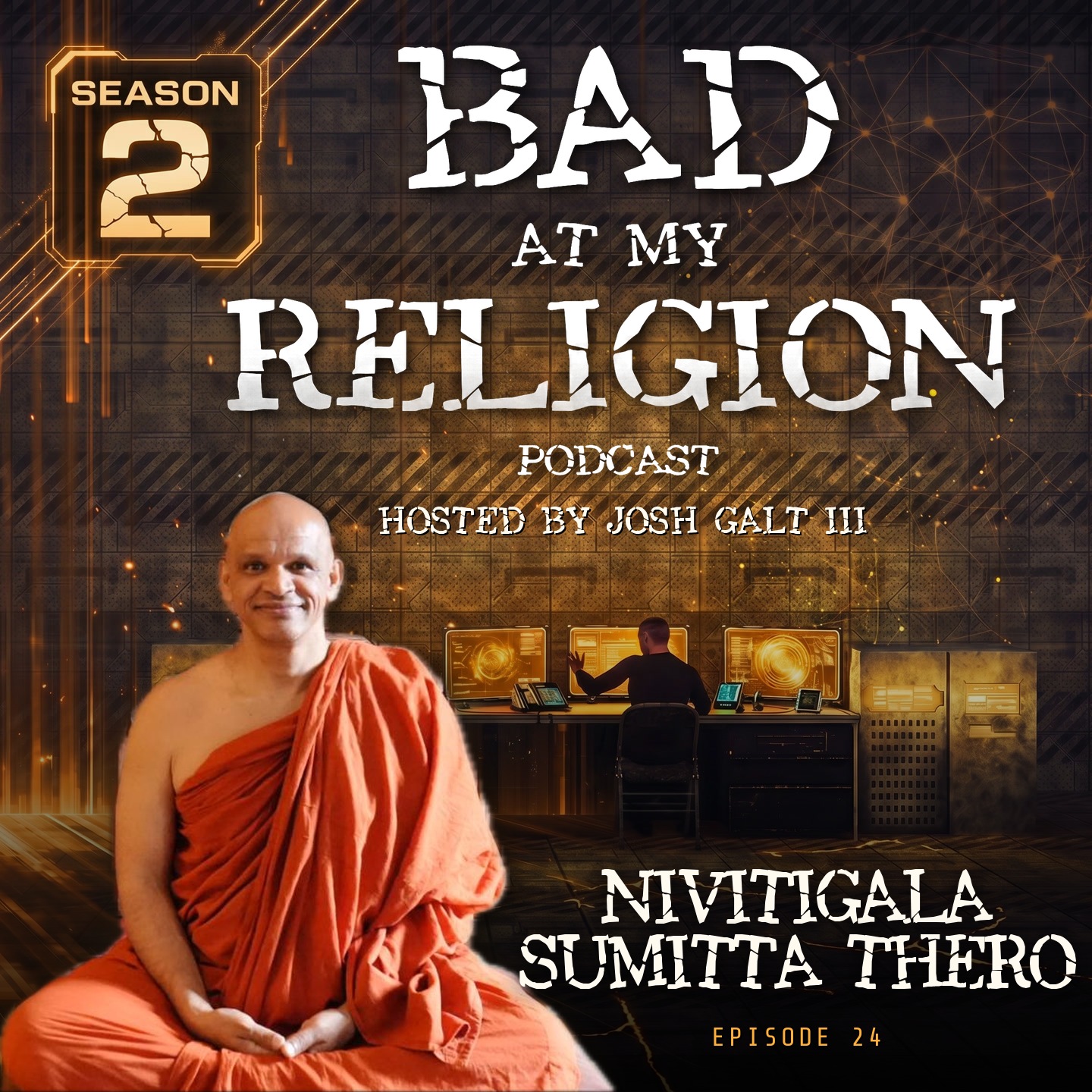
[00:00:02] Speaker A: Today's guest is Nivitigala Sumita Thero.
[00:00:06] Speaker B: Now, if you think like you have fear problem, if you think like you have health problem, if you think like I have worry problem, if you think like I have frustration problem, if you think like I am too busy problem, that means you need to meditate.
This is a good sign.
I am too busy. If somebody says that means they need self care, they need meditation.
[00:00:43] Speaker C: You're listening to the Bad at My Religion podcast hosted by Josh Gold.
[00:00:48] Speaker B: And my name is Bhante Sumita and I'm originally from Sri Lanka. I'm a Buddhist monk, Theravada Buddhist monk.
So I've been a monk for 45 years.
So right now I am in New Jersey, Empty Cloud Monastery.
And this is a hundred year old classic Catholic church turned into a Buddhist monastery.
So it's a beautiful combination.
We still have the cross and the Buddha statues.
They stand together beautifully.
So people from all walks of life, all cultural backgrounds, all religious backgrounds, they come here to meditate with us.
It's a really beautiful place. This is called Empty Cloud Monastery, New Jersey.
[00:01:57] Speaker D: Okay, and how did that come about that an old Catholic church like that would become a Buddhist monastery? That's fascinating.
[00:02:05] Speaker B: Yeah, it happened like few years ago, around eight years ago. Okay. So this monastery was run by Catholic monastery and I think they kind of were two old monks who were staying here. And so the, the original.
Founders of the inside, They were searching for a place and they found this fascinating building.
So they found it and so they had a very good deal.
So ever since it.
[00:02:57] Speaker D: That's amazing.
[00:02:58] Speaker B: And so we, I used to come here from Los Angeles from time to time. And so recently I moved to this monastery for good.
[00:03:12] Speaker D: And have you ever had any pushback or criticism or complaints from Catholics of hey, this was a sacred building for Catholics, like why are you turning it into a meditation center for something else or request to remove the crosses or you know, that type of thing? Because everyone has their beliefs about, about Buddha statues and crucifixes both.
[00:03:40] Speaker B: So actually it is the other way around. People really appreciate.
They were happy that this was occupied by another spiritual organization.
So today we met, I think the grandson of the original owner of this house.
And so this is 100 years old already.
And he and the family came here and they were so happy to see that this is beautifully maintained and I think it is really wonderful. And also seeing the, the cross on top of the building and also the Buddha statues everywhere and everyone really kind of love it.
I think the world needs so much of them living together, it's about unity in diversity.
I think it's such a beautiful example for peaceful, harmonious coexistence.
[00:04:51] Speaker D: Do you think that Jesus and Buddha would have been good friends? What would their relationship have been like if they had been in the earth at the same time?
[00:05:01] Speaker B: They were centuries apart.
Buddha lived like 6th century BC.
So Jesus came way later in my opinion.
Probably he must have heard about the Buddha.
So like we hear the history and we see all the good people around and also we learn about them.
It's fascinating to learn the history.
So Buddha wanted to bring peace to the world. He was talking about the peace, he was talking about the non violence, compassion, loving kindness, appreciative joy, equanimity, generosity, humility, all kinds of things are very much in need today, I think more than ever.
So I'm sure all those other religious founders, they also wanted to unite the world, not to divide.
And I don't think Buddha or Jesus or Muhammad or anyone else would have allowed the world to be divided.
They were having a really good intention to show, teach the Dharma, teach the good things and you know, so I'm sure they would have easily be really good friends if they ever met each other.
[00:06:41] Speaker D: Yeah. Why do you think there is so much division and especially when it comes to religion today? That's something that I have seen over my whole life. I know you probably have as well.
And even within the same religion, right? Within Catholicism there are many different types of Catholicism. Within Christianity there's many types of Christians.
Even within Islam there's different types of Muslims.
Why do you think that those divisions exist when like you said, the leaders who started these movements, they were looking to unite, not to divide. And yet our world is so divided today.
[00:07:23] Speaker B: First of all, I am not qualified to talk about the other religions, but in general I can see something like people's ego, you know, although they are founders, they had really good heart, good intention to bring peace, harmony, unity in diversity. That's what they all wanted.
Later on when, you know, over time when it spread it all across and people had different opinions due to minor adjustments probably and cultures, they were also merging with the local cultures and languages and, and then also when there are, whenever there are more people, means more opinions.
So they wanted to maybe define things differently.
So all those interpretations, maybe others didn't agree.
All these things actually happen. It doesn't happen like overnight, but it always happens when there are more and more people.
Because you see like our five fingers and they have different sizes.
Right.
So five Fingers. The pinky says I am the smallest one, so I deserve more prominence here. I need to be given priority. I am the boss.
And this one is the, what we call ring finger.
So this one says, I am the one. No matter what, I am the one wearing the ring, so I deserve to be respected more.
I should be the boss.
And this one says I am the tallest of all, so I'm the boss.
And this one, what do you call this one?
[00:09:19] Speaker D: The pointer finger.
[00:09:21] Speaker B: Pointer finger. You know, no matter what, I am the one who is so assertive and I am very strong and powerful, so I should be the boss.
And this one say, I stay separate, but I am the strongest of all of you, and so I should be the boss. So everyone wants to be boss. Everyone wants to be the big ones. And if they try to act separately, they can do much. But if they work together, that should be such a beautiful combination, such a unity in diversity. So I think all religions, all cultures, all languages, all political, social countries, you know, different boundaries should be overcome in such a way that we can make this world a beautiful place to live together.
[00:10:22] Speaker D: So the hand example is fascinating because if we look at our world today, there is a very big push for equality, which by definition, if we think about if we're each of us being treated equally, it sounds like a very good thing. But in the explanation you just gave of the hand, I think that's a very good way to look at diversity, perhaps in that the thumb and the pinky and the index finger and the ring finger and the middle finger, they're all very different.
And so instead of saying we have to make the hand equal, everyone has to be the exact same strength and length and everything else. It's just, let's work together as we are and appreciate that the thumb can know, do what the thumb does, and the other fingers can do what they do.
How does Buddhism look at that at equity, equality? This, this push to make everyone kind of the same as opposed to, hey, we're all different, but within that difference, if we work together, we can create a beautiful world.
[00:11:34] Speaker B: During the Buddha's time, actually, he was talking about how people from all corners, all parts of the country, on all different culture, backgrounds, all different castes, especially in that country. In India at that time, the caste system was really rampant and very prominent. And so people belonging to different, different castes, they were not even allowed to, you know, have inter marriages or something. And especially the downtrodden castes, the lower caste people, had very hard time to have access to many benefits in the Society.
So Buddha allowed all of them to come in, all of them, without any discrimination whatsoever. He said, just as the rivers coming from all across all different corners, all different directions, when they join the great ocean, the ocean becomes just one test like that.
All the people who come here join us. And when they attain enlightened, there is no change.
Everyone is equal no matter what.
So that is the, I mean, this is really ultra modern.
You have to think like this happened in 2600 years ago.
And the way he was thinking is so much more modern and so much more advanced for the human history. To think of all those, the women were cornered and he allowed them to become Bhikkhunis nuns, and he allowed all the people in the downcast, lower caste people to become monks. And he gave specific titles even to them so that they can be respected by even the kings.
That's how I think he did it.
So in the Buddhist perspective, there is no discrimination towards anyone.
Even as Buddhists, we don't have any right to discriminate anyone.
So we are all actually driven by ignorance, desires and ego.
And this is why so many disparities and everyone's ego really is very high today.
So they all want to be leaders.
You can see why there are so many fractions, so many divisions, so many political parties, so many religious groups. They all want to be, you know, the top leaders.
And so that's one, because of the ignorance, two, because of the, the ego.
Power politics and all are actually playing a bigger role in that too.
That's why these things.
[00:14:46] Speaker D: Do you, do you think that there is any benefit for the ego? I'll give you an example. Because you're in America, you're close to New York City, which is kind of one of the world's hubs for innovation and finance and business, capitalism, right? The ego.
Do you think that there's any benefit for the ego in terms of building, innovating, creating, or does that come from somewhere else? And we've, especially in the west, in America, we've said no, it's the ego, it's the individuality. That's what we need to focus on in order to make something awesome, or do you think it comes from somewhere else? How would you address that?
[00:15:31] Speaker B: Look, ego, ego and leadership can also be two different things.
Everyone has ego, right? Everyone has ego. So they don't want to be hurt.
Someone says something to even any regular folk, they would be feeling very hurt. And so in, so some of the qualities, I think the leaders, for example, they, they should have some qualities like Whatever they do is not selfish.
It is for the well being and happiness and benefit of the many.
That should be the case, right? So building, building countries, building huge economies or businesses or whatever is good if it helps, if it benefits the many.
You know, so this is very important.
So if you like, this country can play such a huge role in helping, benefiting many if they have the, the right to view, right to vision, good leadership. All these things can happen, if not just driven by ego, only with, you know, blindfolded ego, with lot of wrong views. And that might actually damage the very existence of the humanity very existence of the earth can be in great danger.
For example, I strongly believe this country is the top most powerful country in the world.
So that this should be a powerful country in so many ways because of the size of it, because of the resources of it, manpower and economic power.
All those things can be, should be beneficial to this country as well as to the rest of the world. Then it can be a really beautiful country. Everyone will respect.
This is what it should be like. Otherwise, just because of your ego or whatever, if you act like that and then everything will be in trouble.
[00:18:11] Speaker D: And so why do you think that it's not painting that picture of a beautiful world? Because many people, I think most people actually would agree with that, that these countries of extreme wealth and power, like we just saw the leaders of America, China and Russia all together at a summit this week, right.
And yet they signed this monumental peace treaty, but there's no mention of stopping all the wars that each of those countries is actually engaging in or taking care of peace and the people within their own countries. And so when we look at that as normal people, it can be very frustrating and sad to say.
Yeah, if they would use this enormous wealth and resources and power and ability to make the, I mean the whole world could be a wonderful place.
Is it a problem of the leadership or is it each of us individually is still not causing that ripple of positivity and love and know all of these good things that can ripple out to others in society? Are we blaming too much the leaders instead of saying, no, you know what, I can't do anything about them, I cannot control them, but I can control me.
[00:19:39] Speaker B: I think that is where we should start all the time we have the tendency to blame others.
So we look, when we point fingers at someone, actually how many fingers are directing towards yourself, right? You point finger, one finger and all the other fingers are towards you. So looking to yourself is really important. And where I stand, what contribution do I make?
For the well being and happiness of the mini.
Am I a good, sincere, honest person?
Am I doing something beneficial to myself and to the others?
So I think this is very important. So in Buddhism we talk about that, we talk about how important it is to look into yourself.
Most of the time we open our eyes and see the world.
We don't see ourselves, we can see the entire world but ourselves.
You have to go in front of a mirror to see yourself.
But in Buddhism we say, close your eyes and you look into yourself.
And when we open our mouth, we talk about many others, we don't talk about ourselves.
So the Buddha said, close your mouth, talk to yourself.
And that insight, looking into oneself is the most important thing.
So when we look into ourselves in our own capacity, we can actually create that ripple effect.
Like the epicenter is you and you can create the magic.
Just like the Buddha did 2600 years ago, he taught this Dhamma. And even today, millions and millions of people, the world have been benefited. So his beautiful teaching has never been, you know, something to do with divisions or something to do with hurting others or stealing or whatever. It's always to benefit others.
Practicing immeasurable, unconditional loving kindness, generosity, simplicity, humility, minimalistic lifestyles, all these things are really beautiful. So I think we have to work on our own. And maybe if individually more and more people work together, they can make a big difference.
So I always think we don't worry about too many people following us.
You know, even just a few people, if they work together, they can make a big difference. Even very big companies, only few brains, right? Top brains are always very few and they know how to deal with the others.
So similarly, if we individually work towards and also we have inner peace within ourselves, we can make such a big difference wherever we go.
It doesn't matter.
Wherever you go, you practice.
My personal practice is always loving kindness. So wherever I go, I think of it. I think of people wherever I go and I don't have to even talk to them.
In my heart, I wish them good.
When I board an airplane, I wish good luck to the pilot, the cabin crew, all the passengers.
And before entering a shopping mall, I wish good luck to all the people. Just a few seconds of, you know, that good wish really makes me feel so confident. So wherever I go, I walk with this and I talk to people with that.
I think this is how we have been trained.
So we are peace messengers wherever we go.
[00:24:03] Speaker D: Do you think it is difficult for us to share that loving kindness with other people? Because we don't love ourselves first. And does that come because it is so difficult to close our mouth and close our eyes and, and go within and be introspective. You mentioned that The Buddha lived 2600 years ago. And many people would say, well it's so difficult today because you know, we have our cell phones, we have social media, we have all these distractions.
And yet these principles were from 2,000 years ago, like they didn't have cell phones or any of the technology or the distractions that we have today. So really that can be an excuse. I think it's just a human condition. Yeah, that it's difficult to be introspective and think about what's going on inside as opposed to the outside world. And then to love ourselves in order to love other people. How can we do that in a better way?
[00:25:03] Speaker B: You know, easier path is to do wrong things.
Easier path. For example, if you want to do all the bad businesses, that is easier.
Do good is always difficult.
Maybe like you throw a stone towards the sky, you need to make some effort and to drop something from top. You just drop it and it will fall down so that anti gravity is there. So we have to, you know, people mostly like to follow trends.
Most of them are trend followers.
Trendsetters are just a few.
And so people like the Buddha, they were trendsetters and so they can make a big difference even today.
Today I think we need to think of it most. We think it is very modern, very advanced scientific development and all these things. But look what's happening here today.
What is happening?
Have we been able to, you know, been able to vacate the hospitals?
Hospitals are mushrooming and hospitals are being overcrowded and almost everyone is taking medicine. And can we live without medicine?
Can we live without anxiety, depression? How many people are depressed? And so what is the development that we have?
So we have been victimized by the so called development.
So we need to know our humanity, we have lost that.
So some of the ways of these distractions, how it works with the algorithm and all. So we need to know that we have to come to our basic history repeats itself.
So over time we see the world wars happening, pandemics happening. Every hundred years something, something like a pandemic happened. And now it is like every 10 years, every 20 years something really major disaster happening in the world.
And mostly man made disasters. That is the most unfortunate thing, man made disasters. So if we want to think of a sustainable future, if we think of our children today and the future of them and we have to be Little bit not so selfish. We have to think of the others.
We have to come out of the shell that we are trapped in.
So whatever development, whatever advantage we have should be used for the benefit of the many.
That I think is very important.
For example, the Buddha said there are few livelihoods we should avoid.
One is weapon business.
Weapon business is not a good idea because it really harms many people.
And so it is disastrous.
Easy money though.
And then he said sattavanijja, the animal business and sattvanijja, that is the weapon business, Vishavanija, the poison, poisonous things for example, maybe some chemical related, maybe something, you know, it gives harvest very fast, but it creates also a lot of lot of problems, health issues.
And then magyavanijja is drinks and drugs.
And then Mansa vanija is the human trafficking. Both these are easy money, but they can be deadly dangerous for the sustenance of our humanity.
That is why we have to think of. When we think of a livelihood also we have to think whether it is benefiting ourselves and benefiting others.
We have to think of it all. The people who do big businesses, they also have the good ethical foundation, you know, that is the key. Not only earning money for anything, you can earn money by doing anything. Is not what we are supposed to do as humans.
So we also have to think of the future of the world.
We have to think of the other fellow beings and also we have to share with the others. There are a lot of people you can do. If you have the skill set, you can really do a good job, good business, that is perfectly alright. But then so much money for the rest of your life you won't be able to finish some of the money you have.
So maybe it is time for us to also think of those people who are in need your help.
So a friend in need is a friend indeed, right?
So we have to think of those people in the world who are in need of our help.
This country has the most powerful buying power.
So $1 even can maybe in some country one day's whole salary.
That, that is the truth. So if we contribute towards the betterment of other so many people, you can bring smile to so many people.
You can bring shelter to many people.
So I think that way we have to kind of think for the greater goal of humanity.
Humans are not animals.
Humans are much more advanced. They can think, they can talk, they can share the history. Animals can't. Animals can't speak like the way we do.
So we should do something better. Otherwise the kind of apocalypse that we are bringing to the world is really, really dark, really bad.
[00:31:41] Speaker D: Do you think that we are at risk of that with everything that's happening? Like, all the businesses you described are basically.
It's basically run from the top. Like, I can't get into the weapons business, right, because that's run by nation states and huge global corporations and investment funds, essentially.
So all of these things, and then you bring AI into the mix. And what is happening and the potential for AI to really displace millions and millions of people from the work that they do and the livelihood that they earn.
Do you think that the world is headed toward a very difficult time? Or is this something that individually, if we really focus on developing ourselves and being the ripple in the pond, that we can together collectively keep the catastrophe and the apocalypse away?
[00:32:43] Speaker B: You know, like, if you. Like, as you said, like big corporates, they only few people, they have so much money, okay? So they can do anything. But imagine, like, if they have a good heart, if we can instill something good in them, if we can train our young children today when they grow old, when they become, you know, entrepreneurs. And if we can train them to think of the benefit of the many, not be too selfish.
You know, like the kind of weapons that we have today are good enough not only to destroy this earth, but also to the other planets.
So much weapons.
So much weapons.
What is the point after all?
I mean, who is going to win?
[00:33:40] Speaker D: Power.
[00:33:41] Speaker B: Yeah. Who is going to win? Everyone is at a loss only if a war happens somewhere in any corner of the world. Today, everyone in the world is suffering. We see that. We experience that.
So it was not like those days.
Now it is happening in massive scales. It's drone wars now. AI wars now.
Really, really terrible.
Whatever happens is terrible. So we have to think of applying the ethics.
We are not, as I said, we are not like animals.
In Sanskrit, there is a beautiful saying.
It is said, So ahara is food, okay? And nidra is sleep.
And maithuna is sexual relationship, sexual conduct.
So food, sleep, and sex, they are common to both humans and animals.
What makes the difference? Difference is the dharma.
Dharma is the ethics. The.
The thing, the fine line between the animals and the humans. So dharmenahina pashubhi samana. When you don't have dharma, you are not second to animals.
This is a powerful statement.
So all these teachings can help us remind ourselves of what we should do as humans.
In Pali, the word for man is manusa.
Manusa means manam usati timuso. That means the mind, the Mind is noble in the humans. So if you don't have a noble mind, you can do anything wrong.
Two things that I would like to also mention here, they are called world governing dharmas.
They are the dharmas of the celestial beings.
They are so powerful, so important. Two things that is called moral dread and moral fear.
Fear to do wrong things and shame to do wrong things.
And if you don't have these, hiri and uttapa, moral dead and moral fear.
People can do anything.
People can do anything. Just like zombies. Look at the people who are addicted to drugs, for example. Do they look like humans?
So unfortunate.
Maybe some people in the world, somewhere in the world, they must be having a very luxurious, beautiful lifestyle by selling those. And look somewhere else in the world, our beautiful young generation, men and women, they are like walking like zombies.
What are we going to earn?
What success, what achievement you are going to make through these things?
[00:37:38] Speaker D: Do you think that there will be a karmic consequence for the people who are living in luxury today on earth? But they're doing those things that you're saying. For example, they're selling the drugs to the young people who become zombies and drugs. We could say you could make the case that some social media platforms, or certain technology, pornography, etc. Is also a type of drug that is leading to the same thing where the people are damaged by it, but the people selling it are very rich. What happens to them on a cosmic level, on a soul level?
[00:38:16] Speaker B: That's why the lack of ethics.
Lack of ethics can be disastrous.
So when somebody, it is said, when you do something good, you will be rewarded.
If you do something bad, you will be punished. So in Buddhism, it's not only this birth, it's a circle of births, one after the other.
And so many births to suffer, probably.
So otherwise the world should run like a clock, right? Anti clockwise, it won't run.
So we have to think of the smooth running of the world.
And for that we need to have those order.
Good will be reordered, bad will be punished. Otherwise the world will be in a disarray, complete chaos.
So that's what happens. According to Buddhism.
If you kill someone, as a result, your life will be short.
And if you hurt someone, as a result, you will become sick.
And if you steal someone something from someone, as a result you will become poor.
And if you have sexual misconduct as a result, you will have bad image, bad name, bad reputation.
If you tell lies, nobody will trust you, nobody will believe you.
And if you become addicted to drinks and drugs, and because of that you will become foolish. Your thinking power, your mind power will be gone.
So some of these karmic effect are definitely are there too.
[00:40:16] Speaker D: And where does good and bad come from? How do we decide what is ethical and what is unethical? Does that come from man's thinking mind? Because you mentioned that it's connected to the mind and that's what separates us from animals, is the ability to think and have ethics. But where do good and bad come from? Is that a universal law that applies also on earth? Is that something that God or the divine has set in place? Or are the rules on earth different from perhaps the spiritual realm or other planets? Like. I think that's something people struggle with. And why they turn to religion is, where do I get my ethics from? What determines what's good and bad?
[00:41:00] Speaker B: Look, it should be applied to all, every time.
Like good should be good, right? Wherever it is, good should be good. For example, killing.
Who likes to be hurt?
Do you like to be killed by someone you don't?
Do you like to be hurt by someone you don't?
Do you like to be robbed by someone you don't? Right.
So it should be applied to others as well.
So this is everlasting.
This is the eternal law.
It's not only today in this world, it's every time in the history, even in the future.
It should be the same.
So don't kill, because killing is bad.
And the world does not belong only to us, it belongs to other sentient beings too, other animals, everyone.
Sky bound, earth bound, water bound. Every sentient being deserves to live freely. You know, we have no right to.
We have no right to claim others just like that. So in Buddhism we say Sabha SATA bhavanta sukhitatta, may all beings be well, happy and healthy.
So that is the application, the practice that we continue to do.
[00:42:33] Speaker D: So is that essentially the golden.
[00:42:36] Speaker B: Even without following any.
You don't have to become a Buddhist to follow the five precepts. For example, Five precepts in Buddhism, for example, if you want to become a Buddhist, you have to follow these five precepts. What are the five precepts? Not to kill, not to steal, not to engage in sexual misconduct, not to tell lies, not to take drinks and drugs that cause intoxication or heedlessness.
What beautiful practices. You don't want to become a Buddhist for that.
So those can be universally applied for a world to become a better place to live.
So those are the ethical, very basic ethical foundations.
I think if we can apply these things, we try we don't want to, you know, we never force people to become a Buddhist or something.
Wherever we go, we never do that. So people, if they find it helpful, they can follow.
[00:43:41] Speaker D: Is that essentially what in some places they call the golden rule, like do unto others the same that you would like them to do unto you. Is that the basis of the ethics or is it bigger in the sense of every living thing should be respected and treated as a living thing and protect that life?
[00:44:05] Speaker B: I think if we, if there should be something universal, it should be applied to all.
All right, so for example, if you talk about the killing, everyone loves life, everyone loves life, so we have to respect everyone.
So if you love your life, if you respect your life, you have to respect others life. When you respect others life, you will be respected.
So you have a free life insurance.
Imagine I practice non violence all throughout my life.
So I am not a threat to anyone.
I am not a threat to anyone. Wherever I go, I am not a threat to anyone.
So how many of us can walk like that and make a non violent promise so that everyone around us feels safe, Even the animals?
As I practice metta or loving kindness, I notice even the animals can feel our vibe.
They are so sensitive, they feel our vibe. Even the snakes, elephants, they feel our vibe.
So you can kind of purify your surroundings.
So that's how.
[00:45:33] Speaker D: So should we, should we be vegetarian then? And then the question is, I got a hard question for you that I'm sure you've been asked before in your time as a professor.
If someone is, let's say, making the case for being a vegetarian, another person will make the argument that chickens, as just one specific example, they would go extinct if they were not domesticated in order to be chickens, in order to, you know, make chicken meat for people. So it's over thousands of years, they have lost the ability to live in the wild. They have no defense mechanisms as an animal. And so therefore their purpose for existing is to live, to make good soil, to eat bugs, to lay eggs and to be eaten by us.
So how would you answer that question?
[00:46:26] Speaker B: So that is a very lame excuse by humans, right?
If you think like these animals are domesticated so they don't have any freedom. And have you ever tried them free?
Have you ever let them set free and how you try to cage them, that it says, do you like to be caged?
You don't like to be caged?
[00:47:00] Speaker D: No, of course not.
[00:47:01] Speaker B: So even the domesticated animals, they wouldn't like to be caged like that.
They won't like to be chained.
You know, if they are, you know, freely hanging around and then it's a different thing, but you make it.
[00:47:21] Speaker D: But a chicken would get eaten by a coyote or something, right?
If they were just let loose into the forest.
[00:47:26] Speaker B: So what is the difference?
Eaten by the coyotes or eaten by the humans?
[00:47:34] Speaker D: Okay, fair point.
[00:47:35] Speaker B: So who will decide that?
The animal decide or I decide?
My freedom is decided by me.
So did we ever ask the animal, chicken, do you like to be around us, eaten by us, or do you like to be eaten by coyote? They might say, I would love to go to the jungle, go wherever I want and set free. And if I am eaten by a coyote, I don't care.
They might probably, most probably most likely their answer would be that.
So we try to make some, you know, excuse like that.
So every sentient being has a right to live.
That is the truth. This is universal. This is something you cannot say. No, you know, so some of those.
[00:48:29] Speaker D: It's something that I often.
[00:48:30] Speaker B: Yeah, okay, go ahead.
[00:48:33] Speaker D: I often have to defend spiders or cockroaches or bugs that get into the house, right? Because someone that does not like those wants to kill it. And I spent a lot of time over the last 10 or 15 years in Southeast Asia in Buddhist countries around people who are Buddhist. And I picked up some of those things. Of that's true. Why should I kill the spider? The spider doesn't know that it's invading my house. It's just trying to live as a spider. And honestly, it does good things.
If you don't want the spider in the house, let's just put it outside. We don't have to take a big shoe and kill it. Like, it didn't do anything to me. We can put it outside. And then like just exactly the example that you said, maybe it gets eaten by a bird.
But that's not. That's not me making the decision on the spider's life. That's me just saying, okay, go back to nature. Because, you know, this is my space.
But I'm not going to kill you. I'm going to let nature do its thing. And I think that even just that small mindset change has helped me.
Because if I'm going to treat a spider with respect or a cockroach, and everybody hates cockroaches, if I'm going to respect that insect, then how much more should I respect the people that are around me?
And often when I don't respect people around me, then I think, well, hey, I'm treating this person worse than A spider. Like I'm, you know, and I need to change that because I should be treating people also with love and respect. But it's often so difficult, especially in the world today. Like, how do you teach people to, to be more able to love others and respect others when this world is just so chaotic? And now especially, it seems like most people are just trying to survive.
[00:50:29] Speaker B: You know, first of all, you have to love yourself.
That is the key.
Lot of people have lost confidence in themselves, lost care for themselves.
So we train people to love themselves first.
And that is the epicenter.
And the ripple effect, the ripple effect can be done. Cause only by doing it, when you do that, you can actually create such a wonderful vibe around everyone.
Actually, when I was in Sri Lanka, it's a tropical country and a lot of moisture, and whenever there is moisture, that means more sentient beings.
For example, in California or, you know, some other dry areas, you have less sentient beings because lack of water, lack of moisture.
So in Sri Lanka, we have a lot of bugs, lot of snakes, lot of sentient beings around, mosquitoes a lot.
And we have seen, like, I was actually observing the mosquito landing on my skin and then, you know, sucking the blood and then going away.
I was not panicking, but carefully observing them. And so you know what happens here?
The psychology, you hear the, the buzzing sound of the, the mosquito. The, the moment you hear that, your mind says, oh, the mosquito. I might. My past experience and hatred, anger already pollute me. Already I have become toxic, right?
And the mere sound itself is making you so infuriated. And then you see the mosquito coming and landing, and so you already decide to kill it.
And over here, when you don't panic, when you don't any. Most of the mosquitoes are actually harmless, even though that is the.
The only thing they can, you know, they survive on, on blood.
And so most of the vast majority, the mosquitoes are actually harmless.
So if you see them coming to you and taking a drop of blood, just a little blood away and nothing happens to you, I guarantee I lived there and I never had any malaria or whatever. And the Buddha lived most of his lifetime in the forest. He was never bitten by a snake or he never had malaria or dengue or something.
He was beautifully coexisting with the wild animals because they also respected him. And if we know how to coexist with them peacefully live with them, that's such a beautiful thing.
I really love every day here, some deer come so they freely go around and it's such a beautiful sight. To see those animals, and we say them chipmunks. And we saw the other animals going here and there. Birds, you know, so free.
And so they feel very comfortable and freedom in their life.
So I think this is what we need to think.
And we continue to practice ourselves.
And you become an example of yourself, of that beautiful, beautiful dharma, universal Dharma, I would say. I wouldn't want to call myself or whatever.
We should practice the universal dharma that helps the whole universe, not just one individual. That should be applied all throughout the time.
Timeless teaching.
This is what we should do.
[00:54:52] Speaker D: I think for a Western mindset, it is difficult to find the nuance between I need to love myself first so that I can then love others and love every sentient being, and I need to love myself first. So now I'm going to become a selfish narcissist and live by the ego.
I think maybe in other cultures, but because the culture itself is more interconnected and more collectivist than it is in America.
I think from birth we grow up with this individualist sort of cowboy mentality, which on some areas it can be helpful. Right. But in other things, like what we're talking about, just interpersonal relationship relationships, how do you help people to find that nuance of. No, loving yourself does not mean that you're going to become a selfish narcissist who's just trying to feed the ego. Loving yourself means something different. What, what would you explain that? That. That self love and self respect and self esteem actually is.
[00:56:08] Speaker B: Yeah. First of all, let's like, let's think like someone is thrown into the mud or someone is sinking in the mud.
So if you are there, you can't help others. You have to first get out of it. And when you are out of it, you can help others.
So most of us are actually sinking and we are not in a comfortable zone to help others.
So you have to make sure within you, you are fine.
Within you, you are very strong.
Your self confidence, your inner peace is in good, good touch. And then you can actually share.
You can share with others if you have something with you. If you can give money to others, if you have money with you, right. If you have some skill set, you can share it with others.
Similarly, if you have inner peace, you can share with the others.
So that is really important. That is why we close our mouth, close our eyes, and look into ourselves and body scan yourself and send loving kindness to focus on your breath. And then send the healing touch to the entire body.
And internal and external, bodily, the organs send loving kindness and feel Free and relaxed and peaceful. And then slowly you think of your loved ones next.
Your loved ones and your near and dear ones and your family members, your friends, your relatives, your teachers, your elders, those who have been helpful to you all throughout your life. So you can be grateful and thankful to them, send loving kindness to them, think of them and be grateful. May they be, well, happy, healthy. Just think of it that gives you so much peace, so much happiness when you do that. And then we go, after a while we go think of some other people, like most of the world people, like 8 billion people.
And we know only handful of people and vast majority of the people are unknown to us. They don't know us, we don't know them. But anytime any of these people can turn hostile, right?
If you go to the airplane, somebody might hijack the plane.
If you go to a shopping mall, somebody might, you know, take a gun and start shooting other people. So anything can happen to you. You never know.
But the magic of this is you think of those strangers, those neutral people.
Neutral people. Think of neutral people and also send loving kindness to them. May all the neutral people in the world be, well, happy, healthy. You continue to practice it, you can really, really create a very powerful energy.
It's a really beautiful
[00:59:25] Speaker D: thing.
[00:59:26] Speaker B: And then you think of your unfriendly ones. I don't know even want to call like enemies.
I call unfriendly one.
So those people who have bullied us, hate us, disliked us, hurt us, revenge upon us, you know, we think of them also. Maybe someone in the past, in your school, or maybe in your place of work, somewhere sometime somebody was hurting you, hating you, disliking you think of them.
And now you are in a good position, you are peaceful within and you send loving kindness to your loved ones and then to the next level, neutral ones. And now we just have only few people we have been holding grudge against.
Now it is time to release.
See, when you do like this, so painful, after a while you feel so painful here, just release, so peaceful.
And the moment you sincerely, wholeheartedly send loving kindness to those people who have hurt you, hate you, disliked you, you will feel so much relief.
And this is how we practice loving kindness.
[01:00:47] Speaker D: So it's not about doing what I want, getting what I want, me, me, me. It's about stillness and that energy of positivity and love. Even just in meditation and in thinking about these other people.
Why is it difficult? Is it because I think that even 2,500 years ago, 2,600 years ago, 300 years ago, like it was, there were always distractions.
But it seems like today it's. There's so much going on all the time. We have so many things running through our mind and maybe we were not made to know everything that's happening in the entire world all at the same time. You know, on our phones we have global news 24 7. We know everything that's happening in the world.
And with all these strangers that we've never met all the time. So it seems that maybe we could make the case that there is more distraction, there is more chaos today than there was a couple thousand years ago.
But just before our call, I sat out in the sun because we haven't had sun here for like a week and I love the sun. So I sat out in the sun for 10 or 15 minutes and I was.
I was struggling to be still.
And I was thinking about this because it's very difficult to just calm the mind and to do exactly as you were just describing.
How can someone who's just constantly has their mind all over the place all the time, how can we find that stillness in order to be able to go within and be introspective?
Because the mind just, I think for a lot of people today does not want to be still.
[01:02:35] Speaker B: So what happens? Actually, we are out of control. We have no control over us.
So we have given our monitoring or controlling power, remote control to the smartphone, for example.
Okay.
And so the smartphone has so many apps and then they make so many sounds, right? Social media, different, different sounds. Whenever you hear the sounds, you get distracted, so you go click.
And so there are notifications.
Maybe you can turn off all the notifications, keep your phone all the time, silent forever.
And then you check only when you need it.
For example, social media.
If you make a determination.
I am not going to check my social media this particular day, whole day, no more, no nothing. I don't even. If you want, you can even say, I don't want to touch my phone.
At your home, one room should be there.
No digital, no WI fi, nothing, no technology zone.
That will really help you find peace.
So that is very important.
And also you see how we are distracted because of our own fault.
I really like Carl Newport's digital minimalism.
And he also talks about another book is their Deep Work.
Those two books are really fascinating.
Deep Work is a book that he talks about how, for example, Carl Jung, he built a tower, a Bollinger tower, and then he went inside, he locked himself in. He didn't even allow his family members to Disturb for two whole hours, complete two hours without any distraction. He kept on writing.
He kept on writing and reading.
That's how wonderful you see what happens to our brain when you keep doing it.
That register a kind of habit pattern in our brain. For these two hours, no more distraction, complete work. And that way you know how to do deep work.
Today in the world, deep work people are very, very rare.
Everyone is shallow works, they can focus.
That is why in YouTube you have shorts, in Facebook you have reels.
Because people don't have time to, you know, watch the one hour program. Something they want to change all the time. That mentality because of that psychology that you have created yourself, you have to get out of that actually that habit, that pattern.
If you motivate yourself. I want to be a deep work person.
I want to actually succeed in my life, in my career, in my profession, whatever I do. Then focus on, give priority to your own glory, your own success, your own career.
Then you should be able to focus more, right? Work more. Two hours complete in the morning and in the evening. Just imagine somebody can do it. When the other people sleep, you work and lot of people, there are some, I heard the story like somebody wanted to be better, better off the other student better than the other student. So the other students wake up at 6 and he wakes up one hour ago. And when the other students go to bed nine, he works one more hour. So two hours extra hour, that makes the difference every single day. That's a lot of time.
So you should be smart and skillful. Even in this very highly destructive world, you should know, you should determine yourself.
It's all in our power. Actually I would say we should be able to use the technology is there. Technology should be there.
It is there to be used, but not to be abused, not to be misused.
Do it for the, use it for the better, but don't become a slave.
You should be the lord of it. You should be the master. You can use it whenever you want it.
You don't want it to be disturbed. For example, you want, let's say like you determine every day. I want to check my emails at this time only. I don't care, I don't have to check every time, right?
You want to go to, let's say like social media, okay, don't try with your phone, maybe you can try with your computer. So that actually limit, that limits, right? So similarly, so because they have been designed for you to keep going, keep going, keep going. And then the more you are in, in that and they are Happy with you. So that's why you become a slave.
You have to think, I am not a slave, I am the master, I am the Lord. So I want to control, I want to give priority to my work first.
Self care is so important.
[01:08:45] Speaker D: Where is the line there though between priority to my work, my ambition and still living in service to others? Because this is something that I personally can speak to because my wife could back me up on this. One of my biggest frustrations is not being able to do deep work. Now I have two kids under two years old. There's just constant chaos all the time. And one of my favorite things in life has always been getting into a flow state to where if I'm working on something I can go 6 hours, 10 hours, 14 hour days just completely focused on it. And it's like that is very fulfilling and you get some incredible work done really in that flow. Now it's very, very difficult to do.
It's difficult to convince other people that hey, like I need this time with no distractions.
So I think that there's, yeah, sometimes I'm distracted by the phone or whatever. So I'll just turn off the Internet and say, okay, I'm going to work with no connection at all.
But I think it's more the challenge of I feel selfish in the negative definition of the word selfish. Like I'm being self centered and egotistical and saying, well, what I'm going to work on to do this deep work is more important than spending time with you or helping you with whatever it is that you need me to do.
That's where I think a lot of people struggle. Not only me, because I've talked to many people that have similar issues where it's like I want to do deep work, I am ambitious. But also is that ambition coming from my ego or is it coming from my sense of purpose? Like I believe I have a reason for being here and I need to fulfill that. How do we find the balance? Or is it not about balance, it's about something else.
[01:10:42] Speaker B: Now if you think like you have fear problem, if you think like you have health problem, if you think like I have worry problem, if you think like I have frustration problem, if you think like I am too busy problem, that means you need to meditate.
This is a good sign.
I am too busy. If somebody says that means they need self care, they need meditation, these are the signs. And if you don't do it, you internally damage your body and the mind.
So the frustration leads to aggression. Everything becomes so chaotic.
This Is why many people today, they don't really know these things. They don't care. They don't close their eyes and look into themselves.
They don't listen to their own breath.
If you live close to your breath, monitoring your breath, observing your breath, if you become friendly with breath, breath patterns will tell you so many wonderful lessons to you every single minute. An average healthy person would take 16 breaths.
That would be 960 something breaths in an hour, 23,040 breaths in a day.
And if you live an 80 years something that will be 6 to 700 million breaths.
Every breath is unique.
Every breath is different when you are angry. Your breath pattern is different when you are sad. Your breath pattern is different when you are happy. Your breath pattern is different when you are anxious, depressed. Your breath pattern is different if you listen to your own breath.
If you observe your breath, you will know, oh, this is what is happening in me.
Then the breath will teach you so many good things. And you will never be upset or distracted.
Wherever you go with the kids, you are fine.
With whatever chaotic world, you are fine because you are internally so strong and peaceful.
Nobody can shake your unshaken mind.
So you need to train yourself. It doesn't happen overnight. You have to learn the techniques. We kind of train them.
If you come here, we could probably help you how to do that. These are the things that can actually be helpful. Listen to your own breath, what we call anapanasati and also, you know, practicing loving kindness. Mitra Bhavana if you have a.
There are six temperaments. So accordingly, the different out of the 40 meditation techniques, one is given to you so you can practice. If you are an angry type, we prescribe you practice loving kindness.
If you are like an intellectual type, then you have certain analytical things practice. So element meditation, for example, or depth contemplation, something like that. There are different types of meditation. Lustful temperament. If you have, then you have to think of the fullness of the body.
Six temperaments are there. Accordingly, meditation subject will be given.
You have to find a way. If you have these issues in your life, people think I don't have time.
Have you ever thought that you have time when you take shower?
Have you ever thought you have time when you go to the bathroom?
When you sit on the bathroom, sit on your laptop, toilet and still working with the phone.
That's a problem.
That's a problem.
So be yourself and focus on what you do. One thing at a time. No multitasking.
One thing at a time. When you take shower, observe the Beautiful thing happening within your body.
You know the magic happening within your body. Observe the water falls on your head and goes throughout your body and you feel the skin become like so different at the beginning of the shower and at the end of the shower. See the transformation, how it happens.
And have you ever done the eating meditation?
Everyone eats.
People say they don't have time, but they have time to eat.
Eat mindfully.
Eating can be a meditation.
Take something into your mouth and chew it 30 times.
Bite it 30 times. 30 bites, okay?
Don't just swallow it, bite it 30 times and let the signals go to the stomach and let all those enzymes to be released and ready for the food to come when it is properly grinded.
This is eating meditation. When you eat with the jaws, with the teeth, with the tongue, saliva mixed together and just eat, bite, bite, bite, bite 30 times.
And then slowly it goes down through the food pipe and you observe. Oh, wow. It goes down and then slowly disappears. And if you drink something, if it is cool, you feel the cooling sensation. If it is warm, you feel the warm sensation. Have you ever noticed that most people don't even care about this thing?
These are the beautiful small little time frames, slots that we can use for the benefit of ourselves that will help build a good, stronger inner peace within us.
[01:17:14] Speaker D: It's so fascinating too, because what you were talking about, there's a lot of science for each one of those areas.
I've read science about breathing and breath work and animals.
So humans are sort of in the middle of the range and our lifespan is also in the middle of the range. A mouse breathes like 10 times faster than a human, right? It's like, it's like basically we would be hyperventilating and its lifespan is very short. But a tortoise, it breathes much, much slower than we do. And its lifespan can be 200 or 300 years. Right? And the same thing about the chewing.
Most people laugh at the science of, yeah, you should chew 30 times or more because it allows the enzymes to start the digestive process before the food even goes down and gets to your stomach.
And yet it's exactly the science, the biology is connected exactly with what you're talking about for the meditative practice, which is food meditation, like you're saying, but there's science behind it as well. So either way someone looks at it, you're going to find the truth of this. And yet we just dismiss it so easily because we're in such a hurry to get where to do what. Like, this is life, this moment Is life right?
And yet it's so very difficult. Have you. You've been. You've been a monk for.
You said 45 years?
[01:18:47] Speaker B: Yes.
[01:18:48] Speaker D: So almost half a century. That's incredible. Was there ever a time when you.
You were just.
You had to confess to another monk, like, hey, I'm not sure if I can keep doing this. Like, this is really frustrating. I'm like, I want to go do something else, or it's like I'm struggling in my practice. Have you ever had those times? Or has it been something where you feel like you're just in this life of flow state, where every month, every year, every decade, it just. It grows and it's something beautiful? Or have you struggled?
[01:19:24] Speaker B: Look, when we think of our life, it changes all the time.
So impermanence, Anita, is an integral part of our life.
We change all the time. If you notice, like, every 10 years, we change.
Every 10 years, we change.
So the first 10 year is more closer to the parents, and then maybe the second 10 year more close to the friends, and then maybe the other tenure, probably to the opposite sex, opposite gender or something, and then to the children, and then to yourself, probably.
See how we change overnight over time. And what happened to me, like, I.
I had a lot of energy when I was young. I had a lot of energy, and I tried to channel all my energy to studies. When I was in my prime youth, I. I channeled them to studies. So I did two BAs, three master degrees and a PhD.
So I continued to do that, and that helped me, you see, like, you can use the energy you have for a meaningful course.
Otherwise, yes, you might be. Now, I am very happy that I learned so many things, so much. I read a lot, I traveled a lot. And everything I say reflects the enormous hard work that I had that I did before.
All the travelings I did, all the readings, all the experience that I had.
So those things benefit so many other people. So wherever I go, I give Dhamma talks, I give. I conduct meditations.
So people are benefited because of that.
So I don't have.
[01:21:29] Speaker D: And do you feel
[01:21:30] Speaker B: I don't have any. Any kind of, oh, I. I miss something, you know, I already achieved a lot.
You know, we can do everything.
We can make everyone happy, too, anyway.
But we should be confident about ourselves. So I chose this path.
I'm very happy about that. I have no regrets. I really feel I did the right thing, and I'm very, very confident of my journey so far. Very grateful to the Dhamma that I was exposed to. And I'm very grateful. My teachers who have taught me, also the supporters, my devotees and supporters who have helped me all throughout.
So I'm very, very happy, so very grateful and thankful and very happy wherever I am now.
[01:22:33] Speaker D: So it sounds like you feel like you've lived your purpose and are living your purpose.
Do you think that?
Or how can other people find that who are not perhaps in the same path or they feel like they're not on the path of what they want to be doing, who they think that they should be? How can people find purpose? Is it the same thing? Is it about introspection and loving yourself and through meditation and stillness and trying to be present, not trying, but being present, that one can find their purpose? Or is there a way to understand as a spiritual being here on this earth, my purpose is abc,
[01:23:23] Speaker B: I think today because thanks to the technology also we can see a lot of people feel like alone. People feel like secluded, solitary, they don't have any company, they feel like that. A lot of elderly people, I noticed that they are kind of alone.
So luckily we have online communities, online like minded groups, spiritual groups. You can probably, you know, somehow search a group in your area. Even there is no boundary you can be connected to anywhere in the world.
So very easy depending on your time zone.
So you can, you can find, search Google and there are lots and lots of spiritual groups where you can easily, you know, you can be welcome and see if that works for you. And probably you can also go to a monastery if you are able to come to New Jersey, New York.
Empty Cloud Monastery welcomes everyone with all religious backgrounds, all levels, all meditation levels.
People come here from all cultural backgrounds. It's a, it's a really beautiful place here.
I notice people from all religious backgrounds, they come here and they feel we don't want to give, you know, teach them like okay, you have to become a Buddhist or something. We never say that.
And they feel it's very organic way of learning and practicing.
And when somebody feels like I'm confident, I am comfortable, I want to take maybe one step ahead, then you can just try like maybe I would say maybe attend a one day retreat first and few one day retreats and then maybe like two days or three days retreat later and maybe after a few attempts of three to three, two days or three days retreat, go for a 10 days retreat, go for a 10 Days Retreat and that will give you a solid foundation even for the whole vibe, can be there even for a whole year. I would say it's so, so wonderful that foundation.
And then you have to be in connection with the community.
And if you feel like you have to practice now at home also, and then you feel like, you know, everything is impermanent again, the energy level goes down eventually and then you see, okay, time to go back.
So from time to time go for a 10 days retreat and then you will feel much better. So continue to be in touch with the spiritual group that you find more beneficial to you and see how it benefits you. So the idea here, most importantly, is not to seclude yourself from your own family or your own friends or relatives, but when you are there, you should be more productive, you should be more patient, you should be more active and more compassionate, more patient, more understanding somebody. You know, when you see, oh, this guy is now different, my mom is now different, my dad is now different, you see them, you see their behavioral changes for the benefit of the others, then you see, oh, this is worth attempting.
This is. What
[01:27:41] Speaker D: is it? Because, sorry, I was going to say it's interesting and kind of ironic that in order to connect with our individual purpose, we need the connection with everyone else.
Because everything is energy and we are all connected. And so that community is something that can be very powerful.
There are risks and rewards with that, but it's something that definitely is much more accessible, I think today than it used to be. And that's one of the beauties of technology, is we can connect. Like you and I are having this conversation today that, you know, 10, 20 years ago we probably never would have met in our, you know, in the course of our life. But because of technology, we can connect and we can have this beautiful conversation and we can talk about these ideas and I take things away and hopefully you've enjoyed the conversation as well. And the people that listen or watch, maybe someone will get a bit of inspiration or a seed of an idea or a piece of advice that they can then apply to their lives. And that's because of the willingness to connect with other people.
And I know for me personally, I didn't used to be that way at all. I didn't like people, I didn't want to talk to people. I just want to do my own thing, like leave me alone. Right? But over the course of maturing, I think that that that's part of the process of coming to understand that we are all connected in some way and that there are things that we can learn from, from other people so that then we can go and be introspective and continue to grow as individuals. So.
[01:29:34] Speaker B: Right.
[01:29:34] Speaker D: Thank you so much for, for everything that you have shared. Is there one thing that, that you would recommend to people for say the next 30 days, that if they could put one action into their routine, into their daily habits, what would that be?
[01:29:57] Speaker B: Yes.
So whatever we do, like on the cushion, you learn your theory.
Off the cushion, you apply your theory.
Okay.
And listen to your own breath.
Breath is your friend.
Ever since you were born into this world, you started with breath.
And the day you go, the moment you go leave this world, this is the end of your breath.
So be friendly with your breath.
Listen to your breath.
Maybe five minutes a day, every single day. If you have never meditated, first seven days, try five minutes sitting, doing nothing but listening to your own breath.
Five minutes, second week, increase one more minute.
Second week, six minutes.
And then the third week, seven minutes keep on increasing until you feel like, I can sit for 20 minutes, I can sit for 30 minutes, I can sit for 45 minutes. I can sit for one whole hour rock solid, without any change, without any postural change. I'm very confident. Focus.
And you see how you become such a changed person, such a peaceful person within you and how you can become a source of inspiration to many other beacon of light to so many others around you. I hope this will be really helpful.
So also love yourself.
And when you love yourself, you can love everyone else.
So I hope and wish you and your family, your loved ones, your friends, relatives, teachers, elders, everyone around, be benefited by beautiful heart if you can actually develop into that level.
And I hope most, most of the world leaders, most of the religious leaders, most of the community leaders also have this powerful sense of love, sense of gratitude, sense of respect towards ourselves and towards everyone else, regardless of their religious, cultural, language or whatever barriers they have. We have to break this shackle and to make this world a very beautiful place to live so that we'll be saved for the benefit and happiness of our children.
[01:33:03] Speaker D: Ante Sumita, thank you so much for taking the time and sharing these timeless principles, Challenging principles for many of us, but very much well worth the effort to put into practice in our lives. So hopefully there will be many things that people can take away. I know I'm taking away a lot of things today, so I appreciate you having this conversation with me. Where can people find you? Where can they find Empty Cloud online if they want to learn more about the retreats, about coming to meditate?
[01:33:36] Speaker B: Yeah, empty cloud has YouTube channel, also Buddhist insight.
You can also go to my personal Dhamma USA YouTube channel. And we have over. I think around 2000 videos already.
And also Dharma USA website. You can see most of our activities.
[01:34:03] Speaker D: Okay, wonderful. We will link everything up
[01:34:09] Speaker E: like and subscribe.