Episode Transcript
[00:00:00] Speaker A: Foreign.
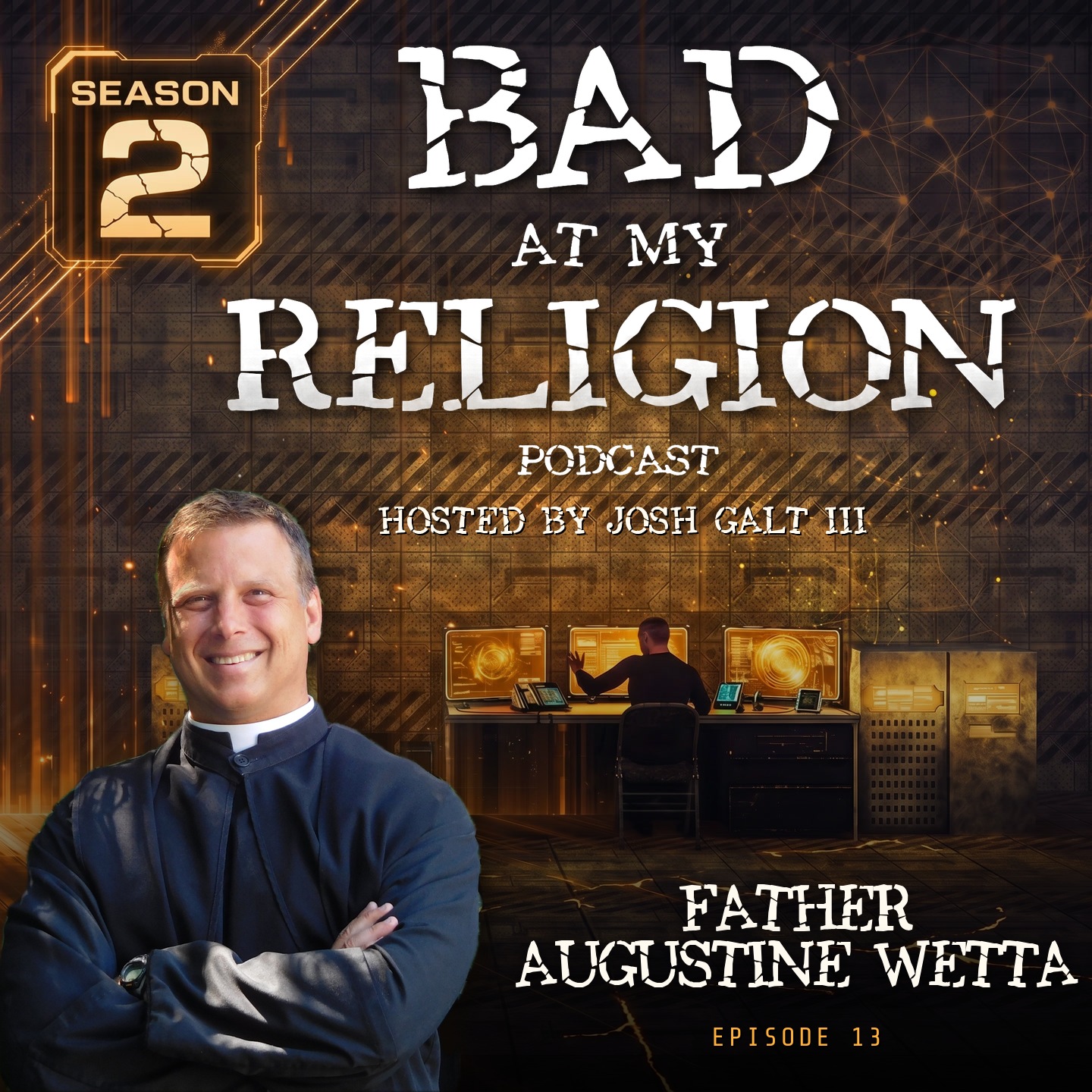
[00:00:05] Speaker B: By religion is with Father Augustine Weta, who's a benedictine monk in St. Louis, Missouri. We had an absolutely incredible conversation. Super fun on a wide range of topics. In particular, I was curious about being a monk and going all in on your faith and how that possibly translates to just normal people and what the secrets are of being a monk, because we often think of that in romantic terms and yet the reality for someone living inside of that can sometimes be a little different in a human way. We also touch on AI, how that is impacting, finding purpose, especially for young people today. Distraction from technology, good and evil, demons and angels. Talk about a whole range of topics. It's a really interesting conversation. I think you're going to enjoy it. So check it out.
[00:01:00] Speaker A: During COVID I called to see how he was doing. It was you Americans in your Covid, he goes. In Nigeria, we just say another plague. We get on with our lives, right? And I think, I think the problem isn't that our times are uncertain. Our time is. Our problem is that our times are too certain.
Right. That like my, my parents lived through Vietnam, their parents lived through World War II.
It doesn't get any more uncertain than that. I think the thing is though, that we've lulled ourselves into comfort thinking that we're really in charge when we never really have been.
[00:01:39] Speaker B: You're listening to the Bad at My Religion podcast, hosted by Josh Gold.
Well, I appreciate you taking the time to come on to start with, I guess just give a real high level overview of your framework, a little bit of your background and, and what your, your spiritual or religious framework entails.
We'll go from there.
[00:02:04] Speaker A: Well, let's see. I am a Roman Catholic. Obvious. Well, maybe that's not obvious. Yeah, I'm a Benedictine monk. I've been a monk since 1996.
Monks take a vow of stability. So you never leave the place where we join.
Well, I grew up in Galveston, Texas, an island known for its natural disasters, 19th century architecture and serial killers.
Went to Rice University where I studied classics and that's how I met my first monk. Oh, before I begin, I should probably apologize that I played 18 years of rugby and I got hit in the head so often that I've got a bit of a lisp and some days it's better than others. Today I'm particularly lispy for some reason. It also gave me a tremor. So if there's not an earthquake, if it starts doing that, it's just Parkinson's.
But anyway, I'm not drunk yet.
It's just Parkinson's.
So I met my first monk in Italy on a bus to the Vatican while I was digging at the temple of the Vessel Virgins in Rome.
Actually, it's kind of a funny story. The.
The. The. This particular bus was famous for its pickpockets, and because tourists always want to go straight from the Forum to the Vatican. And I would take the afternoon bus to go, and I noticed there was a monk on the bus. And I didn't. At that point, I didn't even know if the monks existed. I was kind of taken with him. And then I realized that this guy was trying to pick his pocket.
The thing is, in Rome, if you see a pickpocket doing his business, you don't want to alarm him, because then he might hurt somebody trying to get off the bus. So what you do is you sidle up to him and you give him a shovel.
And so I did that. I walked up, and I got on the other side, and just as he was reaching toward the monk, I shoved him. And the monk totally didn't notice.
So the pickpocket went out of him again, and I shoved him again, harder. And the second time, the monk didn't. Just totally oblivious.
So the third time I went to shove the pickpocket, the pickpocket looked at me, went like, I'm just trying to do my job here, buddy. So I tapped him on the shoulder. I said, this guy's trying to pick your pocket. And he said, oh, you American. I was like, yeah. He's like, me, too. I was like, well, this guy's trying to pick your pocket. He goes, yeah, I know. I don't have any pockets. I thought it was funny.
So I kind of fell in love with the Benedictines. At that moment, there was something just
[00:04:57] Speaker B: totally, totally at peace with the situation.
[00:05:00] Speaker A: Exactly. There was a power there.
And actually, he and I became pretty good friends.
And when my term was up, digging, because they're very short seasons in Rome. You're only allowed to dig up as much as you can preserve yourself.
So he got me a job working as a janitor in his monastery.
And.
And about once a week, all the lights go out in Rome because, you know, the electric company is run by Italians.
And they went off for about an hour and a half. When the. When the lights came back on, there was an old monk stuck in elevator. So they asked me to get him out because I was the janitor.
And we pried open the doors, we pulled him out, and when we pulled him out, he was just beaming.
And I was all sweaty and greasy. And I said to him, what's your problem?
And he said, problem? He says, I just got to spend an hour and a half in an elevator, as though that explained it. And later, I found him. I found him, and I was. And I asked him to explain what he meant by that. And he said, well, you know, I'm a professor now at this monastic school, and I spent all my time lecturing and talking and grading papers and places to go, things like. But there I was, stuck in that elevator. I couldn't see anything, couldn't talk to anybody. It was perfect. I just sat there and I prayed. For the first time in a while, I had real, pure contemplative prayer.
And I went back to my room that night, and I wrote in my journal like, I could never be a monk, but there's a power there that. That I want.
And for the next couple of months, whenever I get stuck buying somebody at a grocery line or, you know, stuck in an elevator or whatever, I just say, I'm gonna be a monk now. And I think that's how the whole thing kind of got rolling.
[00:07:00] Speaker B: That's incredible.
So you were very attracted to just the power in being able to be at peace in the moment. Did that come, like, did you grow up in the church, or what was your background as you grew up before?
[00:07:12] Speaker A: Yeah, my mother's kind of a famous artist, and my father is a historian. And so.
And they're both very argumentative people, and they both are very much practicing Catholics, possibly just because it causes so much controversy wherever they go.
And so the discussions over the dinner table, we weren't sort of a nightly rosary kind of fan family. We were more of a debate the existence of God family.
As loud as you. But, yeah, I. Part of what I. I would say what drew me first of all, was the beauty of it, like the habit. I just think the habit is beautiful.
Their architecture, monastic architecture, art is beautiful. And then the historical integrity of it, unlike these, that's actually.
Who could. You know, who knows whether Dominicans are going to be here in another 600 years? But the Benedictines have been around since the start, so.
[00:08:15] Speaker B: And so from. From a historical perspective, that's actually a question that my wife, who is Catholic, asked. She was very curious about that. How.
How in your understanding or your knowledge of the Benedictines, how have they maintained the same structure, framework, belief foundations for so long? Because that is, you know, like your. Your. Your order is the oldest in the US of the oldest order.
[00:08:47] Speaker A: Yeah, it's Actually sold. It's not actually an order.
The, the.
Every monastery is its own independent unit.
Every couple hundred years the Pope tries to consolidate us and we throw a hissy fit and he gives up.
But every before, there were religious orders that just these guys collected in groups to pray, and they decided to make them sort of little bishops, gave him a miter and a crozier and said, well, this is your little diocese. Take care of it. And that's kind of how we operate. Why has it lasted so long?
I think part of it is the purity of the vocation.
Our job, as it were, is to pray.
The Dominican. I keep picking on the poor Dominicans. I should pick on the Jesuits instead.
But the Dominicans were founded to defeat Albigensianism.
Luckily they found other things to do along the way. But every order has its own sort of work. The Franciscans work with the poor. The mission, the Dominican. Nobody really knows what the Jesuits do, but the Benedictines pray.
And so there's that. There's also just the, the really the real wisdom of The Rule of St. Benedict, which is there. There are rules in The Rule of St. Benedict, which is a really short document.
There are rules that we don't keep anymore, like turning in your underwear after you go on a journey, that kind of thing.
Or sleeping. He says, don't sleep with your sword because you might roll over and stab yourself. And that's a rule we perhaps don't use as often as the others. But then, you know, there are also rules like who should apologize in an argument and how you apologize. And I teach this to the kids all the time. That St. Benedict says that the second you discern that your brother is angry, you throw yourself flat on the floor and you beg for a blessing, which is just. It's so wise on so many levels. First of all, because it's not an apology, it's. You don't have to figure out who.
Yeah, I know. And, but it instantly. I mean, I use this every other day. I think I used it on Saturday, actually.
But it usually the reaction is laughter, actually, even among us monks that you, you. You get embarrassed that you are angry at all. And, and I recently read somewhere that like, psychologists say that when you're physically that far above someone, like when you see somebody on the flat on the ground, your instinct is to help them.
And so it's kind of a weird sort of reverse bullying in a way.
[00:11:40] Speaker B: I'm going to try that. Next time my wife is mad at me, I'm going to prostrate Myself and say, bless me.
[00:11:45] Speaker A: Yeah, I do. Yeah, it's. I teach this to high schoolers all around the country. And I got, about two years ago, I got this email, I had just done a presentation up in Seattle and I wish I hadn't deleted the email, but he said he borrowed his parents car and totaled it and had to be driven home by the police.
He said, when I got home, the door was open and my parents were sitting on the couch waiting for me. He said, So I, I didn't know what to do, so I did what you said. I threw myself on the floor, he says, and my dad got really embarrassed and left the room and my mom started crying and I totally got out of it.
Which of course isn't the point.
[00:12:28] Speaker B: Right. But it's to change the situation into one of, of love. Maybe that.
[00:12:34] Speaker A: Right.
And also, like, I think people are angriest when they feel that their dignity has been assaulted in some way. And there's no better way to restore that than to be flat on your face in front of them and it instantly gives back what you took. I, I actually, I told a joke in the faculty room the other day.
This is a while back, but I, to this day I still don't think it's offensive.
Maybe I'll tell it later, you can weed it out of the. You get.
But afterwards one of the faculty members came up to me and she said, like, I found that really offensive. And my first instinct was to say, well, well, it's a joke about brain damage, right? And I've got brain damage. So like, I feel like I have.
[00:13:22] Speaker B: So you can make the joke.
[00:13:23] Speaker A: Yeah, I can make that joke. But, so that was my first instinct was to say, well, wait a second, which one of us is brain damage here? You know, make an argument out of it. Instead, I hit my knees and I said, my, my sister in Christ, may I have your blessing. And St. Benedict says, you don't get up until you get the blessing. So you have to stay on your face for as long as it takes. And so I waited and I waited. I finally looked at it. She's looking down at me going, she goes, I was wrong.
Fastest I've ever won an argument.
[00:14:00] Speaker B: So do you find that that's when you've been there for a very long time, obviously. Is that something that has really helped you in your, your walk and in, in your life there to stay consistent?
[00:14:17] Speaker A: Absolutely. It will be partly because I'm so inconsistent, because I'm so bad at my religion that in fact, when the abbot made Me postulate, master. I said to him, but I'm a terrible monk. And he said, yeah, you are, but.
But your heart's in the right place, so give it a shot, you know, And. And that's the thing about these apologies or Apollo or non apologies, as you would have it done in this way, is that it really is humiliating to do, but it instantly restores you to grace in that situation. Like, and if they don't forgive you, and that's happened to me before and I've spent a long time on my face, then you know it's them
[00:15:07] Speaker B: and
[00:15:07] Speaker A: you can go to sleep at peace that way too.
[00:15:13] Speaker B: And do you. So the idea of being bad at your religion, there's a lot of different approaches that I can take with that from my own background and whatnot. But I like the idea. This is something that's really interesting with your.
With where you are and the vow that you have taken, the commitment that you have made, there's not really an exit.
So for everyone else, for most other people, you know, if we say, I'm a Muslim or I'm a Christian or I'm a whatever, I'm a Hindu, there's sort of an out because there's so many different denominations, there's so many different sort of ways to rationalize things in our daily life.
But you've gone all in, in a way that is like, this is my life, I'm committed to this. I am staying here, and this is what I'm going to do. Like, how important do you think that is for.
For the. To give the structure and the framework in a way that still allows you to feel like you have freedom as a human.
[00:16:21] Speaker A: Oh, yeah.
[00:16:21] Speaker B: But yet you're making the choice. You didn't, like, put yourself in jail, a religious jail, sort of, because some people might see it that way.
[00:16:28] Speaker A: Well, and sometimes it feels like that too. We do call our monastic cells cells for a reason.
It.
Gosh, where was I going to go with this? Yeah, I think the vow, stability is key.
It can become stagnation pretty easily. And so we also take a vow of conversion, constant conversion.
But I think everyone on some level is a monk in the sense that you make that kind of commitment when you get married or frankly, when you find what you believe is the truth.
If you don't stick by it, then for the rest of your life, then either you found that you're wrong or you've sold out. Right.
[00:17:17] Speaker B: But I mean, marriage is a great example because more than 50% of marriages in America end in Divorce.
So that's. It's a commitment. But is it really a commitment? Because it seems like if one out of two or, and then, you know, people get married multiple times and whatnot is there. What is it the foundation, I guess in our society that you see of commitment not actually being commitment.
[00:17:45] Speaker A: I'm not sure that it's not being commitment. I'm. And I'm gonna get converse.
Controversial here, I'm afraid. But I think we don't know what marriage is.
And it seems to me we don't know what male and female are. So when you don't know those sort of basic things, it's pretty hard to make a commitment to something that you don't understand.
People who do. I know I met.
Well, we run a prep school, my monastery does. And one of my students, his parents are Hindu and I teach a class on sexual ethics.
God help me, the kids call it Texan Nazis because that's all they ever talk about.
Which, well, which beats the previous name, which I won't tell you.
But we were talking about marriage and marriage as a sacrament, and this Hindu kid raised his hand. He said he felt that romantic love was overrated. And I was like, what do you mean by that? And he goes, well, my parents were an arranged marriage and, and they too. And I met them just recently and, and, and, and there's this. It was more about.
I, I kind of put them under the, the microscope, I don't know, put them under fire or whatever.
Asked them ahead of time, of course, but I was like, well, were you in love when you got married? They said, no, how could we be? We just met each other.
They're like, but love comes from the commitment and not the other way around. Which I thought was a brilliant little insight that people have been getting married for centuries and sticking it out and learning to love each other and to be sure. I mean, I don't know any.
I wrote this book on decision making and one of the most fascinating things is this new philosophy that has arisen around decision making is. And particularly around life changing decisions. Because like. Well, I guess I don't know if you have children, but anyone who's had a child would say I thought I knew what I was getting into.
And it was a completely different experience. Right. How can you. I have two under two right now, 202 children.
[00:20:04] Speaker B: Two under two.
[00:20:05] Speaker A: So two kids under two years old.
And, and from what I can tell, or.
And I don't have any children myself, thank God.
But yeah, I thank God. But my, the way it's described to me like the whole world is just different. Suddenly all of a sudden, my sister said, there's a piece of me out in the world now, and I can't undo that.
And how do you make a decision to have a child?
Because the world's going to be totally different when the decision's made. So trying to use what you've lived so far as a reference isn't sufficient to make the decision. So in the end, there's a great article that I read called why you will marry the wrong woman, and it's by this computer technician. It was in the New York Times, of all things, he's an atheist.
And he said that he did this study, statistical study. Like, what are the odds that I will find the perfect match?
Like, they're none like that. There is a perfect woman out there for me. There's someone in the world who is most fitting to. For me to marry, but the odds of me meeting her are almost infinitely small. Right.
And then once you're married, the odds of meeting someone more suitable are really high because you're married a lot longer than you're not.
So he said, you will marry the wrong person.
But. And then he said, but then I got to thinking, I know all these happily married people, so what the heck happened?
And he said, I don't remember whether he ends the article this way or whether it's the way I thought of it, but in the end, it's not whether you make good or bad decisions, it's how you live them out that makes the difference.
Yeah.
[00:22:01] Speaker B: And so do you think that that's sort of the. The allegory of, Of Christ and the church and the.
That being sort of a marriage? Or is that. Oh, wow, am I mixing. Am I mixing doctrines?
[00:22:15] Speaker A: No, no.
But. But that's so profound. I'm gonna have to think about it for a while.
I mean, the.
I guess the difference is that Jesus knew what he was getting into, that he created the church and stands outside of time and experienced the beauty. There's so much there to unpack. I don't know.
[00:22:38] Speaker B: I want to go back.
[00:22:40] Speaker A: He was fully human, so he couldn't one out on his killing my brain.
[00:22:47] Speaker B: So I want to go back, actually, to something that you mentioned when you were talking about.
[00:22:51] Speaker A: But that's worth thinking. That's worth the whole episode in itself. I think that's really great.
[00:22:56] Speaker B: Yeah, I'm sure, I'm sure you can take that a lot of different places. With the kids thing, though, I. I've noticed because you, you work with kids in, in the high school there.
I watched one of your videos, the, the rap video. It's really funny.
[00:23:12] Speaker A: Oh, gosh.
[00:23:14] Speaker B: But you're, you're using AI for. Or you're, you have someone that's helping with AI to, to do the editing, right?
I just want to make sure.
[00:23:22] Speaker A: Completely doing it myself, by myself.
[00:23:25] Speaker B: Okay, but you're. So you're using AI because if there was like you with I think Wiz Khalifa or some other famous rappers.
[00:23:31] Speaker A: Lil Wayne.
[00:23:32] Speaker B: Yeah, Lil Wayne. Okay. So because I do have two young kids and I work in AI, this
[00:23:41] Speaker A: is something that I. Oh, do you?
[00:23:43] Speaker B: Yeah. So I've been, I've been using AI since GPT came out in 2022. But the last, about the last year and a half that things have just really gone exponential to where now it's actually, it's actually usable so I can actually be professional with it. It's not just a toy. And so doing stuff for clients and my own businesses, adding AI into it, I see from just using this every day, I see something very dark, not to fear longer, but I see a real lack of purpose for humanity in very short order because of what's happening with AI. So talking about kids and the decisions that you're making from your perspective, from the relationship with God, from the discipline and self esteem that comes from the Benedictine order, how do you connect that to what's happening in the world today with AI and say for the young kids, let's just say high schoolers, because they're going to hit high school and college while this AI revolution is going on. So forget about my kids 15 years from now, who knows what the world's going to look like? But just in the next five years, how do those kids find purpose and stay connected to God in a world that is pretending to have connection to God? Like, I see this rise of popularity and religion in some, some ways on social media and whatnot.
And I judge it, and maybe I shouldn't, but I judge it because I'm like, come on, why are these celebrities suddenly getting religion?
And it's like the whole thing just seems like we're heading towards something that we don't understand. And what's going to happen with this, this Antichrist that some of these transhumanist, you know, tech elites are trying to build.
And how does one stay connected to the spiritual in the midst of this? Because we have to live. We have to. Especially for high schoolers. Right? They have to think, do I want to go to college? Do I want to go to the job market? Do I want to start a business with AI or not with it? Like, how does one find purpose in the middle of what's happening right now? Because this is a time of transition in our world that in our written history we've never encountered. Because of what AI is.
[00:26:07] Speaker A: Yeah, it's. Oh, man. I started scribbling down notes because I had about 20 different thoughts all at once.
I mean, I'm using AI while I was.
At the beginning of the summer, we have a camp called Monk Camp where the seventh and eighth graders dress up like monks and get little names and do manual labor and that kind of stuff. And I gave, I herniated a disc chasing these kids around, and I ended up flat on my back for six weeks, like not able to move.
Yeah, it was miserable. And for a monk? No, no, for anyone. I'm a sort of high energy guy. Like I am. Well, I'm diagnosed adhd. Like, there's no doubt about it. Anybody who knows me well, probably just from watching the videos, you can tell.
So it was torture even, even for a monk. I mean, you can only meditate for so many hours a day, read so many books, and you begin to go sort of berserk.
But AI was what sort of saved me. I, I learned to use the graphics AI. I used to learn chat gbt and I started making. I started turning the.
Well, I've always felt that the Psalms would make good gangster raps because they're all about smiting my enemies and things like that.
So I started turning them into rap songs and using Kendrick Lamar's rhyme schemes and things like that.
Just, just, just to give my brain something to do.
Lately I have been using it more for sort of serious things. I was reading a philosophical treatise and he kept making all these illusions I didn't understand.
And it turns out half of them were just things in his current culture that he was dealing with. And all I had to do is tap into chat gbt. What does he mean by hcr? Highest. It comes back with HCR highest common ratio or something like that. And, and that. And it.
And that was wonderful.
On the other hand, you're right, there is something very dark as. But, but then there's. As with any invention, any popular. I. There's something dark about the Internet, frankly. I, I sometimes think of it as sort of a Ouija board that you never quite know what's on the other side talking to you. The Internet.
[00:28:30] Speaker B: Yeah. So what?
The way that I see it differently is like everything Else in history has required humans to make it better.
So if you're talking about, you know, the steam engine, the printing press, the car, even computers, even the Internet, like we had to improve it. AI is the first thing that, that is self improving, self analyzing. It does its own research. It has the entirety of human knowledge at its fingertips. And it is, it is finding things that scientists have been struggling or wrestling with for a hundred years. It's really, it's the first thing, yeah, it's the first thing that is like able to. And I'm not saying it's conscious at all, but it's, it's able to think in a way that it's self improving. Like I build these agents that are self improving. I'm building the structure into everything that I'm building now.
That is, it's able to analyze what, what happened. It's able to look at the data. It's able to improve itself. Without me in the loop. That is where I see the real dark side of like in a year or two, most middle management jobs in corporate America are gone.
And once we put this technology into humanoid robots, which is what Elon Musk and all of these robot companies figure out are, are planning to do and are doing, like, then there's not going to be, even the blue collar jobs are not going to be protected. So it's like from that, from that side of things that's pretty existential for humanity.
So where do we find our purpose then as humans? And should we like, am I, am I in a dangerous dance with the beast? Is this the beast? Like there's just a technology, just a tool that we shouldn't be, you know, too concerned about and we should just continue living our lives the way that we have for all of humanity.
That's, I mean, that's a question I think those kids are, are having to look at in a real, real way.
[00:30:33] Speaker A: Yeah, and some of them are scared too, especially the recent college graduates who suddenly look around and think, wait a second, like what I just do with my last four years of law school. And I'm not.
I guess on the one hand I'm sort of a bad person to ask because my job will always be secure. You can't have a robot say mass.
It's just impossible. It has to be a flesh and blood human being that says it.
And, and why is that?
[00:31:06] Speaker B: Go go a little deeper on that because I think that there will be, there will be transhumanists who infiltrate religion, including the Catholic Church, to say no, it's Totally. It's totally okay. Like, we can have AI agents in your app that help you to pray or, you know, or whatever. Like,
[00:31:27] Speaker A: well, now we're getting into the nature of the sacrament, right? And.
But you're, you're.
During the Mass, as Catholics see it, it's not a memorial of something that happened. If it were, then, yes, you could just watch on television or replay it every now and then.
And for that reason, a clock should never be prominently displayed in a Catholic church because it takes a past moment and brings it into the present.
And the material of the sacrament is absolutely essential. Like, you can't consecrate hot dogs and Cokes as much as you'd love to, and it tastes a lot better and be a lot more fun. It has to be bread, it has to be wine.
And perhaps most controversial of all, it has to be a man, a flesh and blood man standing there being the altar. Christus. Right?
So it has more, I think, to do with the nature of the sacrament as a thing outside of time, brought into the present moment by concrete reality.
And you also have to be doing what you claim you're doing. So you can't baptize with urine.
You have to baptize with water that actually cleans you. Right?
And for confession, your material is the sin.
And an actual human flesh and blood priest, you can't confess over the phone, for example, or over the Internet.
The actual physical interaction is essential.
So I don't, I can't imagine a world in which. But then again, I couldn't imagine. Well, I can imagine lots of things where that could change with the appearance of a robot or even, even a sentient robot or whatever they're thinking now.
[00:33:46] Speaker B: And so do you think that purpose should then be found in. Look, this is the sacrament and our framework, our religion is something that connects us to God in a way that no AI can touch. And so no matter what happens in society, no matter what happens in our world, that is something that can remain
[00:34:03] Speaker A: sacred in a way. Like maybe it's gonna free us all up to become monks who like to pray or philosophers or. I, The.
Another article I read recently, talked about.
Oh, it was, it wasn't an article, it was a book by Kanaman. He's an economist, won the Nobel Prize. But he said the future is absolutely unpredictable, period. Like, and he said, and he did this study of talking heads. These people appear on television shows and predict things.
And he said, even in areas that were their expertise, he asked questions like, 10 years from now, will, will Russia invade Ukraine or something, or will there be more or less war, or will the economy be doing better or worse?
And he said, famously, I think he said a dart throwing monkey would have done better predicting, and I think just over the last 10 years, I would never predicted Trump, I never predicted Covid, and I certainly couldn't have predicted the effects of either of those things, to say nothing of. Just like I couldn't have predicted that I'd end up with Parkinson's. I, I couldn't predict it just anything, frankly, because the future is so unknowable.
So I guess I'm not worried about it on that level.
Recently, we.
Well, I think the Pope's letter on AI is pretty important, actually. I'm inclined to ignore Episcopal documents in general as just being too much above my pay grade. But he said one of the things he says is like, you can teach a, you can teach a computer to think and you can teach it to speak, but the one thing it will never be able to do is become flesh.
And that's.
And if the AI takes someone's job and makes it so that they are, they're free to do something better, well, then good for that, good for us. But if it makes people obsolete, then, then that's where it becomes really scary. And he also talks about warfare and how it takes the target out of warfare. That. But, but again, like during the, in Bronze Age Greece, they thought the, the bow and arrow was going to take the heart out of warfare because you no to stare your enemy in the face. And then with the invention of gunpowder, was it. Milton thought it was the devil's weapon because anyone could use it now. And you could kill people from so far away you didn't even have to know their identities.
But there is something unique about drone warfare. He says that who do you blame when someone gets killed? Like, it's. Who does the killing? The guy who wrote the program, the guy who designed the robot, the guy who gave it instructions.
So you're so far removed that there's actually no one in charge anymore.
That aside, we had this discussion in my ethics class because we get wildly off topic sometimes, and I decided just to roll with it. And we were talking about AI and the dangers of AI and this great kid in the class, Tyler Cnius, who said I could tell the story and use his name.
Real good looking kid, black kid, said, put my picture into AI. So I did. He said, tell it to make me look better.
And it made him white, right?
Oh, Jesus. Yeah. So that I find sinister.
And I think There.
But on the other hand, ever since the Tower of Babel, we've been trying to reach God without, by our own hands.
And I think maybe this is the way that modern man is going to start constructing its own gods like that.
[00:38:37] Speaker B: Absolutely. That's. They're, they're talking about that. A lot of the, the Silicon Valley leaders are very much thinking that they can summon this, this spirit.
[00:38:53] Speaker A: Well, and they might be able to, you know, but God didn't play games like that. I, I have a friend who he's actually. Well, he died recently, but he was the great grandson of Hilaire Belloc, who was a kind of important British thinker.
He, he was something of a mystic.
And in fact, he had watched three planes fall out of the sky in his lifetime.
And walking across his monastery in England, his name is Philip Jebb, you can look him up online. He's fantastic character.
He was walking across his monastery's campus one afternoon, he looked at this pile of dirt and he thought, you know, if I were an ancient Roman, I would have built my house right there. I would have buried my treasure right near that tree. So he got out with a shovel and he unearthed the largest collection of Roman coins ever discovered in England.
Wow.
But he told me this story that scared the wits out of me. He was the headmaster at the school.
I won't tell you the whole story beginning in. But the long and short of it is that these kids are playing with a Ouija board and started talking to something, apparently, and one of the kids ended up dead.
And at the end of it, I was so scared, I said, why did you tell me that story? And he said, because it's important to know that God doesn't play games.
You don't need a tarot card or a Ouija board to reach God.
And I've taken that with me.
And I think.
But I think that it's certainly possible to build things.
They contact a God, or maybe not a God, but something that thinks it's God.
[00:40:47] Speaker B: Would you say that those are demons or evil spirits or the devil itself or whatever?
[00:40:51] Speaker A: Yeah, absolutely.
I remember in grad school, this is long before I became a monk, and I was going through my brief and very tepid atheistic phase.
My.
We were reading the Romance of the Rose, and the professor had to stop and say, well, now, what you got? Or no, it was, oh, it doesn't matter, some medieval document. And he said, what you got to remember is that people back then, they really believed that the world was full of devils and angels fighting over their souls. And this girl who sat behind me, she goes, wait, I still believe that.
And it occurred to, so I, yeah, I think it's absolutely possible to reach these things via any, frankly, anything any man made instrument will do. A spoon will do it, if you like, I suppose.
[00:41:52] Speaker B: Do you think that, do you think that this is, that we are in the middle of a spiritual battle with, with what's happening with AI do you think that this is something that is demonic behind it, pushing it to, to deceive people, to lead people astray into transhumanism or into something else that you,
[00:42:10] Speaker A: well, no more so than, no more so than nuclear energy or the, you invent the handwriting and you've immediately got the opportunity to produce pornography. You know, it's, the Internet is such a dark, dark place, but it's also a great tool. Any, any powerful tool can be used for evil, I guess, I mean, I, I guess I don't worry about most things, frankly, but the end of the world isn't one of them. And that I worry about.
And I have a feel, I, like, I, I, I don't know if you remember. Well, yeah, you would remember Y2K in the pan, of course.
And absolutely, we, we, I, we imagine planes falling out of the sky and everybody's, yeah, utility shutting down. And then nothing happened.
So I guess I'm withholding judgment, but, but then again, I can afford to because I, I don't have a job that's going to be rendered obsolete.
I mean, I, I need to pray and I can't get someone else to do that for me. So I certainly can't get a machine to do that for me. So my job is pretty secure.
[00:43:34] Speaker B: But do you think that your, your position will become more important in terms of you as a vessel for God? Do you think that as things get darker and more chaotic and crazier and people are searching for a spiritual reality, a spiritual connection, do you think that then you have a bigger role to play or is it simply that your job is to do your prayer?
[00:43:57] Speaker A: Yeah, strangely enough, I was just thinking my job would become less important because everybody would have more time to pray on their own and to research these things for themselves.
[00:44:10] Speaker B: I mean, do you think that'll happen though?
I mean, as the world gets crazier, do people, do people generally?
[00:44:21] Speaker A: I mean, I don't know. I, I, I, I, during COVID kept talking about these uncertain times. And I, I have a friend from Nigeria. His name is Patrick Nakoye, and he and I were in seminary together. I Took him to his first American grocery store. And he, we were coming around the end of one of the aisles, he gripped my shoulder and he said, brother, he says this, you know, I won't try to do it in the Zach thing. That's insulting. But he said this whole, this whole aisle, he says everything in this aisle he says is food.
It's all food for your dogs.
He's like, the whole aisle, he just couldn't. And I think Covid was such a. He also.
I quote him all the time because during COVID I called to see how he was doing. He goes, oh, you Americans, in your Covid, he goes, in Nigeria, we just say another plague. We get on with our lives. Right? And I think, I think the problem isn't that our times are uncertain.
Our problem is that our times are too certain.
Right. That like my, my parents live through Vietnam, my, their parents lived through World War II.
It doesn't get any more uncertain than that. I think the thing is though, that we've lulled ourselves into comfort thinking, thinking that we're really in charge when we had never really have been.
So maybe I don't see it as that big of a revolution because I never saw the world as all that stable to begin with.
Or maybe, or maybe I think it's stability lies somewhere outside of, Well, this world, as it were.
[00:46:10] Speaker B: So you have found your stability in focusing, bringing that focus back to God and prayer. And that's what would sort of attract you, was the power of peace in the moment and, and prayer by, by those monks. Do you think that this world is then, instead of getting more chaotic, it's just simply more distracting and it's pulling everybody in different directions away from God.
[00:46:31] Speaker A: Well, yeah, it's easy to blame technology for that, but I, I think people have always been looking for ways to escape.
Yeah. On the other hand, I do kind of see monks.
Societal decline is always good for monasteries. So in a way, yes, I think we will become more important.
On the other.
I sometimes think of my job in the school as being. Well, the church often describes itself as a rock and Jesus is a rock as well. And I like to think of like these teenagers as being caught up in this sort of whirlwind of emotions and impulses and social pressures and that I've got one hand on this rock and with my other hand I can kind of reach out and grab one of them every now and then and pull them in. But that's, that's not just my job. I mean, that's your job as A dad, I suspect, is. Is to take these kids and train them how to keep one hand on that rock of stability.
I just finished reading C.S. lewis's abolition of man, which is worth going back to because it's. It.
It's almost prophetic the way he sees human beings as seeing themselves less and less important in the face of technology.
And if he was worried about that back in the 50s, and actually, now that I think of it, Socrates complained somewhere about.
About writing scrolls and that these kids these days, they just walk around with their nose in their scrolls and.
[00:48:34] Speaker B: Ironic that it's called scrolling on your phone. Right?
[00:48:37] Speaker A: Yeah, well, and I was complaining about that with one of the kids. Well, with my ethics class and saying, like, you guys don't have. Because they really can't read, these poor kids. Or they can't focus long enough to read a real.
I mean, a real document.
And I was complaining about that. And one of the kids said, well, imagine you could get an implant in your brain that would help you to remember any fact you ever want to know in an instant, but it would take up part of your attention span.
Is that. Is that a bargain you'd be willing to take and put like that? Like, if you had told me, frankly, 40 years ago. Well, yeah, 30 years ago that I could go anywhere in the world and have instant access to all the information in the world, I wouldn't have believed you.
So. But that's what we got. It's this sort of brain implant that distracts us at the same time.
And.
[00:49:46] Speaker B: Yeah, and yet people use that technology to. To look at pictures of cats as opposed to learning about, you know, the real deep and important and valuable things of the world when we have the entirety of human knowledge at their fingertips.
[00:49:59] Speaker A: Yeah, but then again, because of AI, because of the Internet, I know what a rap song sounds like if I add a didgerido and a harmonica, and my life is richer for that, you know, so.
[00:50:13] Speaker B: So talk a little bit about that because that's actually something that spawned this whole.
This whole series because of I went to a baptism. The real short version is I went to a baptism of a baby. And afterwards they have the celebration, which is. It becomes very cultural.
And so my rant was, I don't want to go spend four hours listening to Bad Bunny after going to a baptism. Like, yeah, there's a difference between entertainment and something sacred.
So, yeah, you're kind of touching on that a little bit because we're like, yes, entertainment is fine, but when does it become a distraction from the Sacred. And from where you are, you've gone all in on the sacred and all in on prayer as the foundation and your connection to God as the foundation of everything.
Where does entertainment become a distraction? Where is that line? And how do young people. And how do any of us determine. Okay, how much is okay? Where am I getting distracted? Pulled away from my relationship with the divine?
[00:51:21] Speaker A: Yeah.
Okay. I got, like, three different things going on in my head all at once. One is that I share your frustration with the sacraments that, like, I as now that I'm teaching the children of guys I used to teach in high school, I've been teaching now, asked numbers of times to do to preside at weddings. And I just. You know, these couples sometimes show up and they're chewing gum, and they haven't been to mass in years. And I finally put together this document that says, congratulations, I'm so happy for you. But before we begin, let's get some things straight. Like, you're not living together. You're not having sex. You're serious about the Catholic Church's teaching. And as a result, I don't do very many weddings anymore.
But on the other hand, I have not had a single divorce since I started sending out that letter.
[00:52:14] Speaker B: Exactly. There you go.
[00:52:19] Speaker A: So confusing the sacraments with entertainment is a real problem, I suppose.
But you're right in the sense that when everything becomes entertainment, then entertainment becomes part of everything else, too.
Did I say that right? Yeah.
[00:52:38] Speaker B: We lose the sacred when everything has to be entertaining. It's like, oh, that's boring. I don't want to do it. And it's like, for me, I'm not Catholic, but I've. I've been to Mass many times with my wife, and there's. There's certain Iglesias that I've been to that I'm like, what is this? Like, you're trying to, like, make it. Yeah. Like a popular Christian American church or something, you know, as opposed to going to a big cathedral and it's like. Like very solemn. It's very serious. It's like I connect with God more in that sort of situation because it's like, you're taking it seriously. It's sacred.
[00:53:11] Speaker A: Yeah. I actually met a kid who converted to Catholicism because he stumbled into a Latin Mass and he thought to himself, man, they worked hard on this. Anything that would take that much work has got to have something to it.
And I find that the younger kids. Well, the younger the monks get, the more conservative.
Conservative they get.
In the last, like, five years, my own Monastery has moved entirely to Gregorian chant for vespers. Does only Latin ordinary at mass.
They moved the kneelers back in It's.
And I think that that's the direct result of being so distracted outside of church that these kids, they want stability inside the church.
And the Latin, the silence, all that reminds them of stability and God, frankly.
But I'm also thinking of.
Do you know the philosopher Roger Scruton?
If you don't, you should definitely look up at least what he's written on beauty or, or watch the documentary he made for BBC called Does Beauty Matter?
But I think beauty, like real serious beauty is an answer as well because true. Oh, or Joseph Peeper's Our Leisure, the Basis of Civilization is another good one that like, true.
The ancient Greeks really believed they, they were so into art because they realized that the world is full of ugliness and distraction.
And they felt that one of the ways to heal yourself of all these ugly images that you see on a daily basis was to look at something truly beautiful, right? And so like when I, I hear confession, I hear a lot of kids confessions and a lot of porn comes up, right? And my, my often I, I don't give it as a penance, but I often suggest go go check an art book out of the library and just look at it like, try to let those beautiful images heal that ugliness that you've been forced to look at. You know, that nature.
That may. Maybe nature and beauty as a point to truth will be ours, will help save us.
Hope I'm not speaking heresy, but no,
[00:56:01] Speaker B: but I, I think and we see that we're seeing people want to get back into nature, want to turn off the screen, want to disconnect and get back into nature. And it's not, you know, there's probably some that's like Mother Nature and people are going that direction. But I think that there's also a serious seeking of. I want to connect to God, I want to connect to the divine. And I can do that much better in nature than in this artificial world. As cool as it is with all the technology and what we've built in modern society, there's just something beautiful about being barefoot in a forest or on a beach and like just breathing natural air, listening to the birds and the, the insects and all of that, it's like there is something pure that connects us back to the divine.
[00:56:51] Speaker A: Well, the kids pointed out interestingly that when they look at modern art, they often say that's cool. When they look at pre modern art, they say that's beautiful.
And I'm still not sure what that means, but there is a difference between what's cool and not. The coolness is a bad thing. But my rap songs are not great art.
They're probably not going to make you a lot holier.
They might help you get through your jog, your afternoon jog, which is the purpose of the.
On the other hand, I don't know. Kendrick Lamar is really, really a genius.
Well, I'm not comparing what I. I do to Kendrick Lamar, but I can't imagine a kid referring to his music as beautiful.
But it certainly is very much at the top of coolness. I don't know. I'm. So far, no, but that's.
[00:57:59] Speaker B: No, you're. You're right on topic, actually, because.
[00:58:01] Speaker A: Oh, good. Do you.
[00:58:02] Speaker B: Do you think that.
Because I can. I can draw the connection there with failing being. Being good at your religion or being bad at your religion and. And not wanting to admit that you're not perfect because it makes you uncool. And that is something that, in America especially, and I've lived and traveled all over the world, but American society has a real.
A real focus on being cool, especially as you're growing up. And so part of the shame mechanism is very different from a third world or an indigenous type of tribal setting. The shame mechanism in America, it seems like, is you're just not cool.
So if someone says you're not cool, whatever you did.
And so I think. I think religion has been sort of part of that is like. And maybe that's changing now because I'm not so connected to teenagers now as I. As I was, obviously, when I was younger, but religion wasn't cool when I. When I was growing up. Right. And maybe that's changing now with the trad movements and people going more traditional. But I think there's definitely something about cool versus beautiful, cool versus sacred, cool entertainment versus something that is real and substantial.
[00:59:23] Speaker A: Well, my mother used to say the difference between propaganda and art is that propaganda is fast and easy and it tells you what to think, whereas art is slow and difficult, but it frees your imagination.
But that wasn't what I was going to say.
Oh, gosh.
[00:59:44] Speaker B: Talking about cool versus real, cool versus beautiful, cool versus sacred. It's like everything in our society is built around pop culture. Bubblegum cool.
[00:59:57] Speaker A: Yeah, it's. But. But the shame mechanism, I think, is interesting that you brought that up. I. I have a sort of podcast, as it were. It's a miserable little thing with this Muslim I met, black lives Matter event. I was there to protest against Black Lives Matter, and he was there on behalf of them. We got to talking, and now we have this podcast together. We disagree about everything, but one of the things that he taught me that I think is really kind of essential is he said that.
He said, muhammad, peace be upon him, said, where there is no shame, there is no honor.
And he said, we're, as Americans, we spend a lot of time trying to make sure we don't feel any shame.
But maybe he's wrong in the sense that we do feel shame. We've just transferred that to coolness or something.
You're gonna have to help me with this, because I'm not entirely sure what I mean when I say this, but we've become a sort of a. On the one hand, we become a sort of a shameless culture in the sense that, like, nothing's really immoral now. It's just my truth versus your truth, or not even versus your truth. It's my truth and your truth and everybody's truth all mixed up.
I lost a train of thought talking about shame, so.
[01:01:27] Speaker B: So we've become a shameless culture, but at the same time, shame is used as a mechanism of control in a lot of different ways. Cancel culture is shaming someone for their views.
[01:01:38] Speaker A: Right?
[01:01:39] Speaker B: It happens on both sides.
[01:01:41] Speaker A: I'm also thinking, though, of, like, I teach classics as well and have for a long time. And we got to this passage in the Iliad, which I always mark as sort of the turning point in civilization, when the embassy comes to Achilles and they beg him to rejoin the fight, and he says, no. He says, I hate Agamemnon. Like, I hate death because he took my honor from my hands.
And the kids sometimes get confused by that. And I say, well, what you don't understand is that for the Bronze Age Greeks, they could measure their honor, right? I had 30 cows, and you only had 20. If you stole 20 of my cows, you had more honor. Being a thief was not dishonorable because you could measure how much honor they had and timing. And kleis, they called it time being stuff and kleis being your reputation.
And I said, and so if a Greek hero insulted another Greek in battle, the other one had to come up with an equal or greater insult or else forever they'd be left behind. And I said, you guys will find this hard to understand. One of my kids is like, no, I don't.
I was like, what do you mean? He's like, well, I can. I could have so many followers. And he Only has this many followers and I insult him on Instagram and if he didn't come back with a better insult. And it's all recorded and monetized and measured and another kid. And this is how I discovered Kendrick Lamar, interestingly, came back with a song which I think is called Money and Rep, which is really cool because money and rep is stuff and reputation, right? And he says it starts off something like about growing up in Compton and being in a gang and how everything was about how much money you had and what your rep was like. He says, but I fought my way out and I worked hard and I went to school. And now he says I hang out with politicians and, and, and actors and models. He's like. And he ends the song with. And now, you know, it's all, it's all about money and rep. Money and rep. Like his life has come full circle.
But, but is that, is that a problem that's going to be resolved by AI or one that's made worse? I can't, I can't really see AI making that worse, but I think that
[01:04:19] Speaker B: that's part of why people are looking for something with substance, something with depth, something that is real. Because you can game money and rep.
You can game cool in, in a way that is fake. What is virtue signaling? So now today we have this sort of thing in society, like to where shame cancel culture is sort of the shaming mechanism, but virtue signaling is the reputation. And that is the honor that you were talking about the ancient Greeks had.
It's virtue signaling. But so this goes, I want to ask you about, because you've written about self esteem, where self esteem comes from.
[01:04:58] Speaker A: I'm thinking about gaming. What do you mean you can game money and rep. What do you mean by game it?
[01:05:05] Speaker B: So it's, it's something that you. Exactly, exactly. So you can game that in a. To look like it, which is where virtue signaling comes from, right? So now today, so many people, so many influencers, right, are on social media posting that who they're with, supposedly, or with their cars, their flashy stuff. A lot of times they're renting the supercar, right? They didn't buy it. It's not there. But so that's showing the money side and the reputation side comes from the virtue signaling where it's like a hierarchy of who's more virtuous and it's. But this is where it connects to self esteem, right?
[01:05:42] Speaker A: But it's not just influencers. I mean, if the kids, when they picture themselves, they have an opportunity to airbrush this and take out this zit,
[01:05:53] Speaker B: you know, or use a filter. Exactly.
[01:05:55] Speaker A: Yeah. Which is something that we didn't have access to was. Are the best looks of all of our friends instantly available to us. But it's a disconnection that, like, you don't see your.
You don't see Kim card. Well, she's passe and she. Now it's the Earls, apparently. But you don't see Kim Kardashian when she wakes up in the morning with bad breath and has a fight with her husband, which obviously happened because they're divorced.
You. All you see is the two of them, beautiful, naked, riding a motorcycle. You know, in the.
[01:06:32] Speaker B: The highlights. You only see the highlights. Exactly.
[01:06:35] Speaker A: Right. So you make the impression that your own life is so.
So dull by comparison.
[01:06:41] Speaker B: Exactly. But also when it comes to morality. And, and so where. Where the virtue signal, I think is super dangerous is where it connects to self esteem. So tell me a little bit about how you see self esteem, because I think that this is foundational and it connects to.
To things that you've written about and talked about and that you have gone all in on your belief system.
Because when you virtue signal, you're showing that you are moral, that you are ethical, that you are virtuous, that you are of a higher caliber person because of helping the poor or whatever, you're virtue signaling. But the reality, if you're not actually living, that that causes a contradiction inside of you, which then fractures your own self esteem because you are the only one that knows you're living a lot.
[01:07:34] Speaker A: I just want to say for a second that this is the most fun I've had having a conversation a long time.
[01:07:40] Speaker B: Oh, awesome. Thank you.
[01:07:41] Speaker A: Yeah, no, this is really fun.
First of all, can you tell me what is virtue signaling?
[01:07:48] Speaker B: So it's a public demonstration of something that shows that you are a moral person, that you are a virtual person,
[01:07:57] Speaker A: always at someone else's expense.
[01:08:01] Speaker B: No, no, it doesn't. It's not necessarily at someone's expense at all. It can be. For example.
Yeah, I don't want to get all political, but like, there's so many, so many ways to explain it. Okay, let me. Let me just give you an example. Because you talked about Black Lives Matter.
[01:08:15] Speaker A: Yeah.
[01:08:15] Speaker B: Virtue signaling. Virtue signaling would be an upper class, white. Upper class, white liberal woman protesting on behalf of black people even though she has zero connection to their real life. She does. Like she lives in a gated community, drives a Mercedes. Like she has no connection to those people, but she is publicly going to be talking about how black lives matter even though she's a white liberal woman that spends zero time in black neighborhoods or with black people at all. That's virtue signaling. That's showing the world that I am a moral person even though she doesn't live it at all.
So that's just one simple example.
[01:08:56] Speaker A: We, we run a pretty conservative school, right? And one of our teachers complained because the kids are giving her a hard time about her Black lives matter bracelet. And my friend Umar was like, oh yeah, white women in their jewelry. Ask her if she's ever been to a meeting. You know, of course she bought the bracelet and complains that she's persecuted. She's not with us anymore and I won't name her anyway, but. But yeah, you're okay. That's virtue signaling.
[01:09:24] Speaker B: That's virtue signaling. It's just trying to show a morality that you don't actually live because.
And this connects to self esteem. Maybe, maybe someone is insecure because they realize like what is my purpose? Well, if I just, if I speak out for these oppressed people, then I will be able to show that I am more virtuous. But then that causes a fracture inside. So that's why I wanted to get your perspective on self esteem and where self esteem comes from. Because in my view like that, that makes you more insecure and have less self esteem because you're living a lie and only you know that, right?
[01:09:58] Speaker A: And it all boils down ultimately to truth and beauty and goodness, which the Catholic believes, and I suspect most world religions believe this as well, that God is truth and he is beauty and he is.
Now actually I don't think Islam believes it quite like that because they believe God determines what is true.
So. But I don't quite understand that. But I'll just speak from the Catholic perspective because that's all I know really. But if that God is truth. So real humility, real.
I don't like this term self esteem particularly much anyway because I just can't imagine say John the Baptist saying, holding himself in high esteem. You know, in fact even, even Jesus did not deem equality with God something to be grasped, right? He didn't have high self esteem.
And in fact any word that has self in it is, any expression is probably at least deserves a second look.
I prefer humility.
But if you want to describe humility as authentic self esteem, then it's truthful self knowledge, right?
And the story I tell in my book about that is that I had a friend at Oxford when I was there who Lived in a palace. And I didn't know that when I befriended him, he invited me to dinner at his house and his mom drove me. We came around the corner and There is this 3, 5 story mansion with its own golf course and Eucharistic adoration chapel.
In spite of being a monk and completely detached from these things, I went, wow.
And I looked over at his mom and she looked at the places she looked at me. She goes, yeah, isn't it great?
Like, and it really caught me off guard because you would expect her to say something like, oh, it's so hard to keep up, you know, or well, it really needs work, but diminish it. Yeah. But in fact, she had the humility to recognize it as a gift and so she could truly enjoy it, you know, and she was as amazed that she had it as I was.
[01:12:24] Speaker B: That's cool.
[01:12:25] Speaker A: Yeah, it is.
[01:12:26] Speaker B: Because so often people who are blessed and that, that's exactly, I mean, that connects to virtue signaling, right? It would be like, right, like right, Someone who's a politician and has three houses, their, their entire shtick is, well, I'm, I'm working for the poor and the working class and whatever else. It's like, dude, you have like 3 multi million dollar houses. Like, what are you talking about?
You're not connected to that.
But it's that fake humility, which is another form of virtue signaling. So his mom was just honest of what a blessing it is to have this amazing place, which is where I
[01:13:01] Speaker A: think fake humility can do real harm.
I have a friend who marched with Martin Luther King during.
I know her from way, way back, but she was a delegate to the World Health Organization. And the theme that year was overpopulation, World overpopulation.
And they had. Who's the guy who claimed Al Gore, who invented the Internet, he was speaking about world. Well, he's got four daughters, right? And so she, she was kicked out actually, because she raised her hand, she said, how many kids do you have? Again, he's like, or he's like, so you're not afraid that rich white people are going to overpopulate the world. You're afraid that us Africans, those South America, those Indians are those brown people are going to overpopulate the world. And they kicked her out.
But I think that, yeah, at its worst, it becomes exactly what it pretends not to be, which is the sort of veiled, murderous, sometimes in some ways racism or exactly the opposite or anything, frankly, the opposite of what it ought to be.
[01:14:12] Speaker B: And how do you, how do you get To a real humility then in. In the way that you have structured your life.
Is it. Does it go back to the thing of. If you make your brother angry, to prostrate yourself and say, bless me, like to. To.
Because there's also, I think. Well, you tell me.
What do you think about certain philosophical belief systems that talk about selflessness?
Yeah, because there's a lot of, like, get rid of the self, kill the ego and all of that. Like, does that apply in your belief system? Or do you think that. No, there's a balance?
[01:14:52] Speaker A: Not that. In fact, there's this great expression from, I think, Irenaeus of Alexandria or Irenaeus of Leon that he says the glory of God is man fully alive.
That.
Oh, yeah.
Again, you got me going, like, five different directions.
Inevitably, I wind up quoting Martin Luther's theology. And supposedly no one could remember whether he actually said this or not. So maybe he's a straw man here. But that he said man was basically schiza. That that man was right and that Jesus covered that with the snow of his grace so as to hide us from God's wrath. Right. And that's exactly wrong, in my opinion, if that's what he said.
Because we're not.
We're. We're made. We are good. God doesn't create shit. In fact, that's what's bad with words like shit as it is, because it takes something good like pooping, which at my age is. Is something I really.
And makes it something shameful and ugly or gives it a shameful, ugly name.
Oh, man. Yeah. I've completely. Where was I going with that?
[01:16:22] Speaker B: I think that's a really interesting. I'll see it.
[01:16:24] Speaker A: Back to selfless.
This, I think, is sort of a misnomer, that the more you discover your true self, the more humble you'll be. And the more you. The more you use your talents. Though ironically, when it comes to being a monk, the things that made me most humble were the crosses that I made for myself.
That it's.
[01:16:50] Speaker B: You mean figurative or literal carvings?
[01:16:53] Speaker A: Well, no, no, the. Figuratively, the. The. The times that.
That it's precisely the things that annoy me most about my brethren that are making me the most humble. And precisely the times when I do something stupid and cruel to them that I'm reminded of what I really am.
But it's also an opportunity to be the best me.
So there's this sort of.
Well, St. Benedict says the humility is a ladder that you climb as you go down.
As you go down, you get more and More humble.
So there's always this, this tension between.
Because the fastest route to humility is humiliation. Right. And, and that doesn't mean I'm not necessarily very humiliated.
[01:17:50] Speaker B: Is it though, like for true humility?
Because like in the exit.
[01:17:55] Speaker A: Well, true. Well, go ahead. No, no, go ahead. I'm interested.
[01:17:58] Speaker B: What I was going to say in the example of your friend's mom, like she was humble enough to just admit that the place was a blessing. So we, in a materialistic sense, she was going up on the ladder of materialism and things and economics and all that. So it's humiliation. Or maybe, maybe I'm not interpreting what you're saying specifically correctly.
[01:18:22] Speaker A: I would think that she was able to be like that because she was aware of her own weaknesses. And nothing makes you more aware of your weaknesses than screwing up like that. I, I would, that I, I would think that inheriting that mansion was not a humiliation for her.
That, that, that was not a way she became more humble.
Except in some fact that she was able to share it with other people maybe, but that she had spent enough time in prayer.
Yeah.
Another thing I'm fond of telling kids during spiritual direction is that the closer you get to God, the less holy you feel that you read these lies of the saints. They say, oh, I'm such a worm, I'm no man. You go, well, no wait, you're Saint Anthony, you're great, you know, or Mother Teresa, who calling herself just God's pencil stub, you know, and you say, well, wait a second, hold on. You're one of the most influential people of the last century. What do you mean? You're just a pencil stub, but it's like standing next to a skyscraper that the closer you get to God, the smaller you feel. But that's actually an accurate self understanding in the perspective measuring yourself by God's standards. So the closer you get to God, the less saintly you feel.
Which is I think, precisely why Jesus is so down on people comparing themselves to one another. You know?
Did I answer the question? Did I even.
I came, I think so. Special host.
I remembered I, I had the first of very me of lots of vocation crises. And I went to visit one of the old monks of the monastery and I told him, abbot Patrick, I'm leaving. And he said, really? You're leaving today?
And I said, well, not today. He goes, well, good, just be a good monk today and leave tomorrow. And that's kind of the philosophy I've been following ever since.
But I went off to my cell And I came back, I said, well, what the hell does that supposed to mean?
And he took out the gospel, I think it's of Luke. And he found the passage about the man born blind.
And the story goes that Jesus finds this guy and he cures him. And then he goes off and tells people, hey, look, this guy Jesus of Nazareth just cured me. And the religious authorities find out and they bring him to trial and they say, did this man heal me? And he said, Abbott Patrick was convinced that he was a teenager because he annoys everyone in the story, including his parents and Jesus.
But. But he also has this typical teenage answer. He goes, I don't know. I. I was blind and now I can see, you know, and they go, well, but don't you know this guy's a bad person? He goes, well, he might be bad, but I was blab. And I can see it. And they're like, well, do you. Finally goes, well, you guys want to be his followers? All I know is he doesn't even go back and thank Jesus. Jesus finds him and he says, do you believe in the Son of Man? And he says ironically, well, who's that?
And you can almost hear the annoyance. Jesus says, you're looking at him.
That's literally how it translates. And. And then he falls on his face and he worships him. And he goes, look at this kid. He's like, he's got nothing going for him. Like he's. He's annoys everyone. He has. He's no good before crowds. He's not even a very grateful person. But he had one talent, and that is that he stuck to the facts.
And that was enough to save him.
And I.
Well, and to bring us back to AI and virtue, signaling that it's sticking to the facts that'll save us. I think, well, Jesus will save us,
[01:22:43] Speaker B: but the facts of reality.
[01:22:45] Speaker A: Yeah, yeah.
We say of monks who are thinking about leaving, that they're looking over the wall if they're leaving for the wrong reason.
And every time I've thought of leaving, it's been because there's some fantasy I was indulging in.
And you're right that the Internet in general, and AI in particular, has a way of making those fantasies look really, really real.
And that is a danger. But on the other hand, it can also bring reality home in a way that things can't. So.
[01:23:24] Speaker B: So how would you. Just to wrap this up, I could talk to you for David, I want to respect your time. We've been going an hour and a half. Yeah.
How would you suggest for someone who's like, well, I want to live more monk like in my life, but I'm not going to go and join a monastery for the next 30 days.
If you had one thing that you would say to people like, whatever your faith is, do this one thing every day, and it's going to help you to have more of that powerful peace that the monks that inspired you found in the elevator and found, you know, in those situations and that you have found in your life. What is one thing that people can do?
[01:24:12] Speaker A: I would say start by spending 30 seconds in silence.
Just waste 30 seconds deliberately.
Not, not just, just silent silence, but put God at the center of that silence and then waste it with him.
And if you can't do that, then just drive to work with the radio off.
But. But I think, I think I. I was telling. I was talking to my students about this, and some of them have started actually incorporating a bit of silence into their day. And one of them said, yeah, I walked outside.
This kid actually locks himself in his closet for 30 seconds a day because he's so distractible. And he said, I opened my closet. I walk out. He's like. And there were leaves on the trees.
He kept saying, leaves on the trees.
And another kid said that girls were looking at him differently because he was looking at them differently.
[01:25:14] Speaker B: Or.
[01:25:15] Speaker A: Yeah, it's. It's.
Well, but also like you.
One of them said he. He had a friend who was always picking up girls at, at the dances, and he couldn't be. And they. And the girls all said he had beautiful eyes.
So he said, I watched him and watched him and watched him. He's like, he didn't have beautiful eyes. He just really looked at them when they were talking. He's like, he was really listening. You get really lean in. He'd listen, he'd nod. He's like, and. And that's a talent that you can learn just by shutting up.
[01:25:53] Speaker B: So just listening and being in silence allows the mind to refocus on things like the beautiful simplicity of leaves on the trees and, and what someone is truly saying.
Yeah, it's so simple, but yet so profound. And it's something that.
How often do we.
You go to the bathroom and you're scrolling on your phone, right? It's like you don't even have that time anymore to just be silent and be quiet. There's always some sort of entertainment or, or noise or something that we can distract ourselves with.
So that's. That's great. That's great advice. And, you know, you, you live it. And it's, it's an example for others who maybe, maybe if they look at that and like, man, I don't think I could ever go to a monastery, but I can find and create that type of space in my own life every day in order to find peace and connection with the divine. And that's something that, that's, that can be a very powerful practice for people, I think.
[01:26:56] Speaker A: Amen, brother.
[01:26:59] Speaker B: Well, thank you so much, Father Augustine. This was really, really interesting and I appreciate you taking the time and being so candid.
[01:27:08] Speaker A: It was fun. We'll do it again sometime, I hope,
[01:27:15] Speaker B: like, and subscribe.